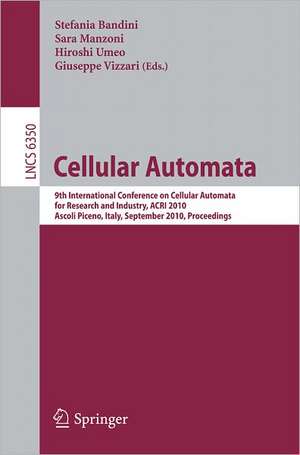
Cellular Automata: 9th International Conference on Cellular Automata for Research and Industry, ACRI 2010, Ascoli Piceno, Italy, September 21-24, 2010, Proceedings: Lecture Notes in Computer Science, cartea 6350
Editat de Stefania Bandini, Sara Manzoni, Hiroshi Umeo, Giuseppe Vizzarien Limba Engleză Paperback – 20 sep 2010
Structura progresivă a volumului, de la concepte fundamentale la implementări industriale, ne oferă o privire de ansamblu asupra maturității atinse de automatele celulare ca metodă de cercetare. Cellular Automata, editat de Stefania Bandini și colegii săi, documentează lucrările prezentate la ACRI 2010, marcând revenirea în Italia a acestei serii de conferințe de prestigiu. Ne-a atras atenția modul în care editorii au reușit să echilibreze rigoarea matematică a rezultatelor teoretice cu pragmatismul simulărilor aplicate.
Organizarea conținutului urmărește o traiectorie logică: prima parte explorează transferul de informație în rețele booleene și algoritmi pentru sisteme cu memorie partajată, în timp ce a doua parte se concentrează pe aplicabilitate imediată. Merită menționat că volumul acoperă scenarii extrem de specifice, precum modelarea avalanșelor de zăpadă, remodelarea osoasă în BioShape sau dinamica urbană. Această abordare diferă de cea din Theory and Practical Issues on Cellular Automata prin gradul ridicat de specializare a studiilor de caz — este mai puțin abstract și mult mai ancorat în soluționarea unor probleme fizice și biologice concrete.
Prin cele 672 de pagini, lucrarea demonstrează cum interacțiunile locale simple pot genera fenomene globale complexe, oferind instrumente de calcul pentru discipline variate, de la ecologie la controlul traficului. Comparativ cu edițiile timpurii, precum ACRI ’96, acest volum din seria Lecture Notes in Computer Science reflectă o evoluție clară către modele hibride și calibrarea sistemelor în medii deschise, fiind o resursă tehnică densă pentru comunitatea de cercetare.
Din seria Lecture Notes in Computer Science
- 20%
 Preț: 558.53 lei
 - 20%
 Preț: 617.17 lei
 - 20%
 Preț: 571.88 lei
 - 20%
 Preț: 1020.28 lei
 - 20%
 Preț: 851.78 lei
 - 20%
 Preț: 560.93 lei
 - 20%
 Preț: 633.70 lei
 - 20%
 Preț: 675.83 lei
 - 20%
 Preț: 1359.66 lei
 - 20%
 Preț: 620.33 lei
 - 20%
 Preț: 733.68 lei
 - 18%
 Preț: 945.44 lei
 - 15%
 Preț: 558.12 lei
 - 20%
 Preț: 793.92 lei
 - 20%
 Preț: 560.93 lei
 - 20%
 Preț: 748.63 lei
 - 20%
 Preț: 562.49 lei
 - 20%
 Preț: 1032.47 lei
 - 20%
 Preț: 731.82 lei
 - 20%
 Preț: 556.96 lei
 - 20%
 Preț: 1022.15 lei
 - 20%
 Preț: 562.49 lei
 - 20%
 Preț: 560.93 lei
 - 20%
 Preț: 313.10 lei
 - 20%
 Preț: 828.44 lei
 - 20%
 Preț: 560.93 lei
 - 20%
 Preț: 314.86 lei
 - 20%
 Preț: 1033.45 lei
 - 20%
 Preț: 563.29 lei
 - 20%
 Preț: 733.68 lei
 - 20%
 Preț: 1137.10 lei
 - 20%
 Preț: 735.28 lei
 - 20%
 Preț: 1079.23 lei
 - 20%
 Preț: 584.42 lei
 - 20%
 Preț: 854.16 lei
 - 15%
 Preț: 672.87 lei
 - 20%
 Preț: 606.22 lei
 - 20%
 Preț: 1246.46 lei
 - 20%
 Preț: 449.81 lei
 - 20%
 Preț: 984.64 lei
 - 20%
 Preț: 620.33 lei
 - 20%
 Preț: 402.28 lei
 - 20%
 Preț: 316.28 lei
 - 20%
 Preț: 663.69 lei
 - 20%
 Preț: 320.24 lei
 - 20%
 Preț: 343.12 lei
 - 20%
 Preț: 313.87 lei
Preț: 638.76 lei
Preț vechi: 798.45 lei
-20%
Carte disponibilă
Livrare economică 07-21 noiembrie
Specificații
ISBN-10: 3642159788
Pagini: 672
Ilustrații: XVI, 672 p. 332 illus.
Dimensiuni: 10 x 91 x 33 mm
Greutate: 0.94 kg
Ediția:2010
Editura: Springer Berlin, Heidelberg
Colecția Springer
Seriile Lecture Notes in Computer Science, Theoretical Computer Science and General Issues
Locul publicării:Berlin, Heidelberg, Germany
V-ar putea interesa
-
 Roadcraft: The Police Driver's Handbook 2025The Police FoundationPreț: 207.05 lei
 -
 Mathematical Biology: A Very Short IntroductionPhilip K. Maini-20%Preț: 57.07 lei71.06 lei
 -
 SpeedVaclav SmilPreț: 137.30 lei
 -
 Sabiston Textbook of Surgery: The Biological Basis of Modern Surgical PracticeDouglas Scott Tyler-29%Preț: 1168.66 lei1644.95 leiRecomandat
 -
 Life in SyncPhilippa GanderPreț: 124.04 lei
 -
 Air-BorneCarl Zimmer-34%Preț: 82.42 lei125.70 lei
 -
 Preț: 123.51 lei
 -
 Welcome to the NeighbourhoodJane FallonPreț: 73.28 lei
 -
 The Expressway WorldRichard J. WilliamsPreț: 170.64 lei
 -
 Mathematical Modeling in Social Sciences & EngineeringJuan Carlos Cortes Lopez-26%Preț: 1224.81 lei1664.32 lei
 -
 The Nature of Code: Simulating Natural Systems with JavaScriptDaniel Shiffman-34%Preț: 215.95 lei326.00 lei
 -
 Cellular Automata and Discrete Complex SystemsMaximilien Gadouleau-20%Preț: 617.33 lei771.66 lei
 -
 Statistics for ScientistsUmberto Michelucci-20%Preț: 275.88 lei344.84 lei
 -
 -20%Preț: 671.17 lei838.96 lei
 -
 Modeling Complex Processes Through Nature-Analogous MethodsChristina Klüver-15%Preț: 511.58 lei601.85 lei
 -
 Recent Advances in Natural ComputingYasuhiro Suzuki-20%Preț: 666.29 lei832.86 lei
 -
 Social Simulation of COVID-19 with AI in JapanSatoshi Kurihara-20%Preț: 950.45 lei1188.07 lei
 -
 Computational Modeling and Sustainable EnergyBrajesh Kumar Jha-20%Preț: 1435.30 lei1794.12 lei
 -
 Traffic and Granular Flow '22K. Ramachandra Rao-18%Preț: 1341.75 lei1636.27 lei
Public țintă
ResearchDe ce să citești această carte
Recomandăm acest volum cercetătorilor și inginerilor care utilizează simulări computaționale pentru sisteme complexe. Cititorul câștigă acces la metodologii verificate pentru modelarea fenomenelor spațio-temporale, de la dinamica particulelor la epidemiologie. Este o resursă esențială pentru a înțelege tranziția automatelor celulare de la simplul experiment academic la implementări industriale și științifice robuste.