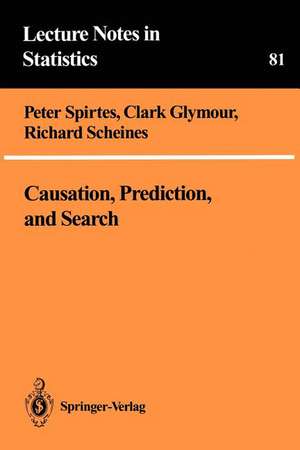
Causation, Prediction, and Search: Lecture Notes in Statistics, cartea 81
Autor Peter Spirtes, Clark Glymour, Richard Scheinesen Limba Engleză Paperback – 26 sep 2011
Din seria Lecture Notes in Statistics
-
 Preț: 477.59 lei
 - 18%
 Preț: 1236.28 lei
 - 18%
 Preț: 947.14 lei
 - 15%
 Preț: 643.38 lei
 - 18%
 Preț: 891.96 lei
 -
 Preț: 367.52 lei
 - 15%
 Preț: 608.90 lei
 - 15%
 Preț: 611.12 lei
 -
 Preț: 378.78 lei
 - 15%
 Preț: 635.22 lei
 - 15%
 Preț: 640.80 lei
 - 15%
 Preț: 673.53 lei
 - 15%
 Preț: 646.18 lei
 - 15%
 Preț: 617.80 lei
 - 15%
 Preț: 648.75 lei
 -
 Preț: 367.85 lei
 - 15%
 Preț: 611.74 lei
 - 15%
 Preț: 651.89 lei
 -
 Preț: 364.92 lei
 - 18%
 Preț: 848.72 lei
 - 15%
 Preț: 609.85 lei
 - 15%
 Preț: 623.70 lei
 -
 Preț: 364.56 lei
 - 18%
 Preț: 783.75 lei
 - 15%
 Preț: 616.45 lei
 - 18%
 Preț: 1059.82 lei
 - 15%
 Preț: 618.34 lei
 -
 Preț: 369.19 lei
 - 15%
 Preț: 613.36 lei
 - 18%
 Preț: 946.75 lei
 - 15%
 Preț: 654.41 lei
 - 15%
 Preț: 650.18 lei
 - 5%
 Preț: 721.02 lei
 - 15%
 Preț: 641.11 lei
 - 15%
 Preț: 607.49 lei
 - 5%
 Preț: 784.54 lei
 -
 Preț: 401.66 lei
 - 15%
 Preț: 617.39 lei
 - 18%
 Preț: 695.39 lei
 -
 Preț: 374.60 lei
 - 15%
 Preț: 639.64 lei
 - 18%
 Preț: 904.67 lei
 - 15%
 Preț: 613.15 lei
 - 15%
 Preț: 639.02 lei
 -
 Preț: 376.77 lei
 - 15%
 Preț: 646.40 lei
 -
 Preț: 367.04 lei
 - 15%
 Preț: 651.67 lei
 - 15%
 Preț: 612.99 lei
Preț: 798.01 lei
Preț vechi: 973.18 lei
-18%
Puncte Express: 1197
Carte tipărită la comandă
Livrare economică 05-19 decembrie
Livrare prin curier în România Termenul estimat este afișat lângă disponibilitate.
Transport gratuit pentru acest produs Plată online sau ramburs, în funcție de opțiunile comenzii.
Retur gratuit în 14 zile Comandă securizată și suport în română.
Specificații
ISBN-13: 9781461276500
ISBN-10: 1461276500
Pagini: 556
Ilustrații: XXIV, 530 p.
Dimensiuni: 155 x 235 x 30 mm
Greutate: 0.83 kg
Ediția:Softcover reprint of the original 1st ed. 1993
Editura: Springer
Colecția Lecture Notes in Statistics
Seria Lecture Notes in Statistics
Locul publicării:New York, NY, United States
ISBN-10: 1461276500
Pagini: 556
Ilustrații: XXIV, 530 p.
Dimensiuni: 155 x 235 x 30 mm
Greutate: 0.83 kg
Ediția:Softcover reprint of the original 1st ed. 1993
Editura: Springer
Colecția Lecture Notes in Statistics
Seria Lecture Notes in Statistics
Locul publicării:New York, NY, United States
Public țintă
ResearchCuprins
1. Introduction and Advertisement.- 1.1 The Issue.- 1.2 Advertisements.- 1.3 Themes.- 2. Formal Preliminaries.- 2.1 Graphs.- 2.2 Probability.- 2.3 Graphs and Probability Distributions.- 2.4 Undirected Independence Graphs.- 2.5 Deterministic and Pseudo-Indeterministic Systems.- 2.6 Background Notes.- 3. Causation and Prediction: Axioms and Explications.- 3.1 Conditionals.- 3.2 Causation.- 3.3 Causality and Probability.- 3.4 The Axioms.- 3.5 Discussion of the Conditions.- 3.6 Bayesian Interpretations.- 3.7 Consequences of The Axioms.- 3.8 Determinism.- 3.9 Background Notes.- 4. Statistical Indistinguishability.- 4.1 Strong Statistical Indistinguishability.- 4.2 Faithful Indistinguishability.- 4.3 Weak Statistical Indistinguishability.- 4.4 Rigid Indistinguishability.- 4.5 The Linear Case.- 4.6 Redefining Variables.- 4.7 Background Notes.- 5. Discovery Algorithms for Causally Sufficient Structures.- 5.1 Discovery Problems.- 5.2 Search Strategies in Statistics.- 5.3 The Wermuth-Lauritzen Algorithm.- 5.4 New Algorithms.- 5.5 Statistical Decisions.- 5.6 Reliability and Probabilities of Error.- 5.7 Estimation.- 5.8 Examples and Applications.- 5.9 Conclusion.- 5.10 Background Notes.- 6. Discovery Algorithms without Causal Sufficiency.- 6.1 Introduction.- 6.2 The PC Algorithm and Latent Variables.- 6.3 Mistakes.- 6.4 Inducing Paths.- 6.5 Inducing Path Graphs.- 6.6 Partially Oriented Inducing Path Graphs.- 6.7 Algorithms for Causal Inference with Latent Common Causes.- 6.8 Theorems on Detectable Causal Influence.- 6.9 Non-Independence Constraints.- 6.10 Generalized Statistical Indistinguishability and Linearity.- 6.11 The Tetrad Representation Theorem.- 6.12 An Example: Math Marks and Causal Interpretation.- 6.13 Background Notes.- 7. Prediction.- 7.1 Introduction.- 7.2 Prediction Problems.- 7.3 Rubin-Holland-Pratt-Schlaifer Theory.- 7.4 Prediction with Causal Sufficiency.- 7.5 Prediction without Causal Sufficiency.- 7.6 Examples.- 7.7 Conclusion.- 7.8 Background Notes.- 8. Regression, Causation and Prediction.- 8.1 When Regression Fails to Measure Influence.- 8.2 A Solution and Its Application.- 8.3 Error Probabilities for Specification Searches.- 8.4 Conclusion.- 9. The Design of Empirical Studies.- 9.1 Observational or Experimental Study?.- 9.2 Selecting Variables.- 9.3 Sampling.- 9.4 Ethical Issues in Experimental Design.- 9.5 An Example: Smoking and Lung Cancer.- 9.6 Appendix.- 10. The Structure of the Unobserved.- 10.1 Introduction.- 10.2 An Outline of the Algorithm.- 10.3 Finding Almost Pure Measurement Models.- 10.4 Facts about the Unobserved Determined by the Observed.- 10.5 Unifying the Pieces.- 10.6 Simulation Tests.- 10.7 Conclusion.- 11. Elaborating Linear Theories with Unmeasured Variables.- 11.1 Introduction.- 11.2 The Procedure.- 11.3 The LISREL and EQS Procedures.- 11.5 Results.- 11.6 Reliability and Informativeness.- 11.7 Using LISREL and EQS as Adjuncts to Search.- 11.8 Limitations of the TETRAD II Elaboration Search.- 11.9 Some Morals for Statistical Search.- 12. Open Problems.- 12.1 Feedback, Reciprocal Causation, and Cyclic Graphs.- 12.2 Indistinguishability Relations.- 12.3 Time series and Granger Causality.- 12.4 Model Specification and Parameter Estimation from the Same Data Base.- 12.5 Conditional Independence Tests.- 13. Proofs of Theorems.- 13.1 Theorem 2.1.- 13.2 Theorem 3.1.- 13.3 Theorem 3.2.- 13.4 Theorem 3.3.- 13.5 Theorem 3.4.- 13.6 Theorem 3.5.- 13.7 Theorem 3.6 (Manipulation Theorem).- 13.8 Theorem 3.7.- 13.9 Theorem 4.1.- 13.10 Theorem 4.2.- 13.11 Theorem 4.3.- 13.12 Theorem 4.4.- 13.13 Theorem 4.5.- 13.14 Theorem 4.6.- 13.15 Theorem 5.1.- 13.16 Theorem 6.1.- 13.17 Theorem 6.2..- 13.18 Theorem 6.3.- 13.19 Theorem 6.4.- 13.20 Theorem 6.5.- 13.21 Theorem 6.6.- 13.22 Theorem 6.7.- 13.23 Theorem 6.8.- 13.24 Theorem 6.9.- 13.25 Theorem 6.10 (Tetrad Representation Theorem).- 13.26 Theorem 6.11.- 13.27 Theorem 7.1.- 13.28 Theorem 7.2.- 13.29 Theorem 7.3.- 13.30 Theorem 7.4.- 13.31 Theorem 7.5.- 13.32 Theorem 9.1.- 13.33 Theorem 9.2.- 13.34 Theorem 10.1.- 13.35 Theorem 10.2.- 13.36 Theorem 11.1.