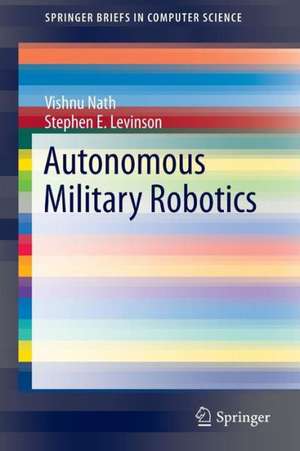
Autonomous Military Robotics: SpringerBriefs in Computer Science
Autor Vishnu Nath, Stephen E. Levinsonen Limba Engleză Paperback – 25 apr 2014
Din seria SpringerBriefs in Computer Science
- 20%
 Preț: 282.99 lei
 - 20%
 Preț: 312.38 lei
 - 20%
 Preț: 318.06 lei
 - 20%
 Preț: 175.41 lei
 - 20%
 Preț: 315.57 lei
 -
 Preț: 425.63 lei
 -
 Preț: 457.65 lei
 - 20%
 Preț: 353.26 lei
 -
 Preț: 362.88 lei
 - 20%
 Preț: 311.84 lei
 - 20%
 Preț: 311.84 lei
 -
 Preț: 331.46 lei
 - 20%
 Preț: 311.84 lei
 - 20%
 Preț: 310.56 lei
 -
 Preț: 360.27 lei
 - 20%
 Preț: 311.04 lei
 - 20%
 Preț: 309.93 lei
 - 20%
 Preț: 310.23 lei
 - 20%
 Preț: 309.93 lei
 - 20%
 Preț: 311.04 lei
 - 20%
 Preț: 309.93 lei
 - 20%
 Preț: 310.23 lei
 - 20%
 Preț: 309.78 lei
 - 20%
 Preț: 311.36 lei
 -
 Preț: 392.17 lei
 - 20%
 Preț: 309.93 lei
 - 20%
 Preț: 310.10 lei
 - 20%
 Preț: 309.61 lei
 - 20%
 Preț: 310.73 lei
 - 20%
 Preț: 223.54 lei
 -
 Preț: 361.22 lei
 - 20%
 Preț: 310.73 lei
 - 20%
 Preț: 309.93 lei
 - 20%
 Preț: 309.11 lei
 - 20%
 Preț: 309.78 lei
 - 20%
 Preț: 310.73 lei
 - 20%
 Preț: 308.04 lei
 - 20%
 Preț: 311.84 lei
 - 20%
 Preț: 311.84 lei
 - 20%
 Preț: 311.18 lei
 - 47%
 Preț: 251.63 lei
 - 20%
 Preț: 222.74 lei
 -
 Preț: 359.92 lei
 - 20%
 Preț: 311.18 lei
 - 20%
 Preț: 310.73 lei
 - 20%
 Preț: 309.30 lei
 - 20%
 Preț: 311.50 lei
 - 20%
 Preț: 311.50 lei
 - 20%
 Preț: 312.17 lei
 - 20%
 Preț: 309.11 lei
Preț: 360.64 lei
Preț vechi: 450.80 lei
-20%
Puncte Express: 541
Carte tipărită la comandă
Livrare economică 13-27 iunie
Specificații
ISBN-13: 9783319056050
ISBN-10: 3319056050
Pagini: 64
Ilustrații: VIII, 56 p. 18 illus.
Dimensiuni: 155 x 235 x 4 mm
Greutate: 0.13 kg
Ediția:2014
Editura: Springer
Colecția SpringerBriefs in Computer Science
Seria SpringerBriefs in Computer Science
Locul publicării:Cham, Switzerland
ISBN-10: 3319056050
Pagini: 64
Ilustrații: VIII, 56 p. 18 illus.
Dimensiuni: 155 x 235 x 4 mm
Greutate: 0.13 kg
Ediția:2014
Editura: Springer
Colecția SpringerBriefs in Computer Science
Seria SpringerBriefs in Computer Science
Locul publicării:Cham, Switzerland
V-ar putea interesa
-
 Intelligent Control: Power Electronic SystemsYasuhiko Dote-45%Preț: 196.40 lei354.56 lei
 -
 Brushless Servomotors: Fundamentals and ApplicationsYasuhiko Dote-27%Preț: 293.44 lei399.58 lei
 -
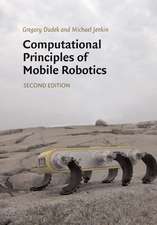 Computational Principles of Mobile RoboticsGregory Dudek-20%Preț: 350.17 lei437.35 lei
 -
 Biologically Inspired RoboticsYunhui Liu-18%Preț: 1081.50 lei1318.90 lei
 -
 Make a Mind-Controlled Arduino RobotTero Karvinen-20%Preț: 46.24 lei57.80 lei
 -
 Make: Lego and Arduino ProjectsJohn BaichtalPreț: 205.77 lei
 -
 Encyclopedia of Electronic ComponentsCharles PlattPreț: 140.61 lei
 -
 The Unofficial Lego Mindstorms Nxt 2.0 Inventor's GuideDavid J. PerduePreț: 148.84 lei
 -
 The LEGO Technic Idea Book: Simple MachinesYoshihito Isogawa-20%Preț: 127.61 lei158.67 lei
 -
 The LEGO Technic Idea Book: Wheeled WondersYoshihito Isogawa-19%Preț: 105.94 lei131.42 lei
 -
 Military Robots and Drones: A Reference HandbookPaul J. Springer-44%Preț: 261.79 lei471.43 lei
 -
 Control TheoryJames Ron Leigh-18%Preț: 761.60 lei928.78 lei
 -
 Handbook of Collective Robotics: Fundamentals and ChallengesSerge Kernbach-20%Preț: 1474.01 lei1842.52 lei
 -
 New Trends in Control TheoryVladimir G. Ivancevic-18%Preț: 1435.62 lei1750.76 lei
Public țintă
ResearchCuprins
Introduction.- Overview of Probability and Statistics.- Primer on Matrices and Determinants.- Robot Kinematics.- Computer Vision.- Machine Learning.- Bullet Kinematics.- Experimental Results.- Future Direction.