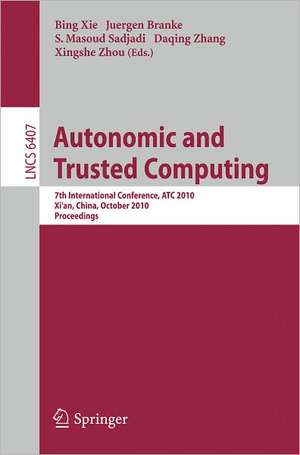
Autonomic and Trusted Computing: 7th International Conference, ATC 2010, Xi'an, China, October 26-29, 2010, Proceedings: Lecture Notes in Computer Science, cartea 6407
Editat de Bing Xie, Juergen Branke, S. Masoud Sadjadi, Daqing Zhang, Xingshe Zhouen Limba Engleză Paperback – 8 oct 2010
Sub egida editorilor Bing Xie, Juergen Branke și a echipei lor, acest volum colectiv sintetizează expertiza internațională în domeniul sistemelor complexe, auto-gestionabile. Descoperim aici o abordare tehnică riguroasă a conceptelor de „autonomic computing” și „organic computing”, esențiale într-un peisaj tehnologic unde intervenția umană devine limitativă. Spre deosebire de lucrările teoretice generale, volumul de față, parte din seria Lecture Notes in Computer Science, se ancorează în soluții practice pentru sisteme eterogene, de la dispozitive embedded la rețele la scară largă.
Structura volumului reflectă o progresie logică de la fundamentarea formală la aplicații industriale concrete. Reținem secțiunile dedicate algoritmilor de adaptare on-line și verificării compoziționale, elemente vitale pentru a asigura predictibilitatea sistemelor autonome. Un punct de interes major îl reprezintă studiile de caz privind implementarea mecanismelor de „self-healing” în sistemele auto, demonstrând aplicabilitatea directă a cercetării în ingineria modernă. Pe linia practică a volumului Trustworthy Autonomic Computing, dar cu focus pe arhitecturi organice și rețele senzoriale, prezenta lucrare analizează cum încrederea (trust) poate fi cuantificată și integrată în protocoalele de comunicare.
Comparativ cu Organic Computing - A Paradigm Shift for Complex Systems, care propune o schimbare de paradigmă la nivel conceptual, Autonomic and Trusted Computing oferă instrumente de analiză specifice, precum detecția curselor de mesaje (message race detection) pentru serviciile web prin analiză bazată pe SMT. Este o resursă tehnică ce completează viziunea autorului Bing Xie asupra sistemelor complexe, extinzând rigoarea analitică dincolo de managementul organizațional către arhitecturile software și hardware reziliente.
Din seria Lecture Notes in Computer Science
- 20%
 Preț: 558.53 lei
 - 20%
 Preț: 617.17 lei
 - 20%
 Preț: 571.88 lei
 - 20%
 Preț: 1020.28 lei
 - 20%
 Preț: 851.78 lei
 - 20%
 Preț: 560.93 lei
 - 20%
 Preț: 633.70 lei
 - 20%
 Preț: 675.83 lei
 - 20%
 Preț: 1359.66 lei
 - 20%
 Preț: 620.33 lei
 - 20%
 Preț: 733.68 lei
 - 18%
 Preț: 945.44 lei
 - 15%
 Preț: 558.12 lei
 - 20%
 Preț: 793.92 lei
 - 20%
 Preț: 560.93 lei
 - 20%
 Preț: 748.63 lei
 - 20%
 Preț: 562.49 lei
 - 20%
 Preț: 1032.47 lei
 - 20%
 Preț: 731.82 lei
 - 20%
 Preț: 556.96 lei
 - 20%
 Preț: 1022.15 lei
 - 20%
 Preț: 562.49 lei
 - 20%
 Preț: 560.93 lei
 - 20%
 Preț: 313.10 lei
 - 20%
 Preț: 828.44 lei
 - 20%
 Preț: 560.93 lei
 - 20%
 Preț: 314.86 lei
 - 20%
 Preț: 1033.45 lei
 - 20%
 Preț: 563.29 lei
 - 20%
 Preț: 733.68 lei
 - 20%
 Preț: 1137.10 lei
 - 20%
 Preț: 735.28 lei
 - 20%
 Preț: 1079.23 lei
 - 20%
 Preț: 584.42 lei
 - 20%
 Preț: 854.16 lei
 - 15%
 Preț: 672.87 lei
 - 20%
 Preț: 606.22 lei
 - 20%
 Preț: 1246.46 lei
 - 20%
 Preț: 449.81 lei
 - 20%
 Preț: 984.64 lei
 - 20%
 Preț: 620.33 lei
 - 20%
 Preț: 402.28 lei
 - 20%
 Preț: 316.28 lei
 - 20%
 Preț: 663.69 lei
 - 20%
 Preț: 320.24 lei
 - 20%
 Preț: 343.12 lei
 - 20%
 Preț: 313.87 lei
Preț: 319.75 lei
Preț vechi: 399.68 lei
-20%
Carte disponibilă
Livrare economică 06-20 noiembrie
Specificații
ISBN-10: 3642165753
Pagini: 345
Ilustrații: XVII, 328 p. 112 illus.
Greutate: 0.42 kg
Ediția:2010
Editura: Springer Berlin, Heidelberg
Colecția Springer
Seriile Lecture Notes in Computer Science, Programming and Software Engineering
Locul publicării:Berlin, Heidelberg, Germany
V-ar putea interesa
-
 Preț: 123.51 lei
 -
 Context-Aware Computing and Self-Managing SystemsWaltenegus Dargie-20%Preț: 1253.52 lei1566.91 lei
 -
 Advances in AI for Cloud, Edge, and Mobile Computing ApplicationsShrikaant Kulkarni-20%Preț: 1296.62 lei1620.78 lei
 -
 Formal Techniques for Distributed Objects, Components, and SystemsMohammad Reza Mousavi-20%Preț: 437.67 lei547.09 lei
 -
 Networked SystemsSalem Lahlou-20%Preț: 996.76 lei1245.95 lei
 -
 -20%Preț: 531.38 lei664.22 lei
 -
 -20%Preț: 558.53 lei698.17 lei
 -
 -20%Preț: 317.05 lei396.31 lei
 -
 -20%Preț: 329.74 lei412.17 lei
 -
 -20%Preț: 316.28 lei395.35 lei
 -
 -20%Preț: 321.81 lei402.26 lei
 -
 -20%Preț: 662.85 lei828.56 lei
 -
 Preț: 380.46 lei
 -
 -20%Preț: 634.45 lei793.07 lei
 -
 -20%Preț: 312.79 lei390.99 lei
 -
 -20%Preț: 315.48 lei394.35 lei
 -
 Preț: 376.75 lei
 -
 Trusted SystemsLiqun Chen-20%Preț: 326.05 lei407.56 lei
 -
 -20%Preț: 669.72 lei837.15 lei
Public țintă
ResearchDe ce să citești această carte
Recomandăm această lucrare cercetătorilor și inginerilor de sistem care dezvoltă infrastructuri critice auto-gestionabile. Cititorul câștigă acces la metodologii avansate de verificare formală și modele de încredere pentru rețele senzoriale și P2P. Este un ghid esențial pentru înțelegerea modului în care proprietățile de auto-configurare și auto-protecție pot fi implementate fără a sacrifica controlul și securitatea în medii informatice complexe.