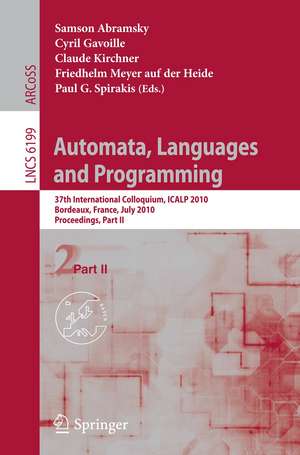
Automata, Languages and Programming: 37th International Colloquium, ICALP 2010, Bordeaux, France, July 6-10, 2010, Proceedings, Part II: Lecture Notes in Computer Science, cartea 6199
Editat de Samson Abramsky, Cyril Gavoille, Claude Kirchner, Friedhelm Meyer auf der Heide, Paul Spirakisen Limba Engleză Paperback – 30 iun 2010
Metodologia care stă la baza acestui volum se concentrează pe fundamentele teoretice ale informaticii, explorând intersecția dintre designul algoritmilor, arhitecturile de rețea și securitatea sistemelor complexe. Automata, Languages and Programming, editat de Samson Abramsky și colegii săi, reprezintă o resursă tehnică densă ce documentează progresele raportate în cadrul ICALP 2010. Considerăm că valoarea acestui volum rezidă în rigoarea procesului de selecție, unde doar o fracțiune din cele 389 de lucrări trimise au fost acceptate, fiecare trecând printr-un proces de recenzare amănunțit.
Structura editorială urmărește o progresie logică de la concepte abstracte la aplicații specifice. Partea a doua a lucrărilor se concentrează pe logica programării, semantică și modelele algoritmice pentru calculul în rețea. Secțiunile dedicate teoriei jocurilor și securității oferă perspective matematice asupra echilibrului Nash și criptografiei public-key, în timp ce segmentele despre optimizarea combinatorie analizează eficiența structurilor de date în scenarii de tip „network design”.
Ca și alți cercetători din seria Lecture Notes in Computer Science, autorii acestui volum distilează experiență reală în principii acționabile pentru domeniul cercetării fundamentale. Tonul este strict academic, axat pe demonstrații formale și specificații tehnice. Recomandăm acest volum celor care studiază limitele computaționale ale automatelor și limbajelor formale, oferind o bază solidă pentru înțelegerea mecanismelor de verificare și a modelelor de informație în sisteme distribuite.
Din seria Lecture Notes in Computer Science
- 20%
 Preț: 558.53 lei
 - 20%
 Preț: 617.17 lei
 - 20%
 Preț: 571.88 lei
 - 20%
 Preț: 1020.28 lei
 - 20%
 Preț: 851.78 lei
 - 20%
 Preț: 560.93 lei
 - 20%
 Preț: 633.70 lei
 - 20%
 Preț: 675.83 lei
 - 20%
 Preț: 1359.66 lei
 - 20%
 Preț: 620.33 lei
 - 20%
 Preț: 733.68 lei
 - 18%
 Preț: 945.44 lei
 - 15%
 Preț: 558.12 lei
 - 20%
 Preț: 793.92 lei
 - 20%
 Preț: 560.93 lei
 - 20%
 Preț: 748.63 lei
 - 20%
 Preț: 562.49 lei
 - 20%
 Preț: 1032.47 lei
 - 20%
 Preț: 678.21 lei
 - 20%
 Preț: 556.96 lei
 - 20%
 Preț: 1022.15 lei
 - 20%
 Preț: 562.49 lei
 - 20%
 Preț: 560.93 lei
 - 20%
 Preț: 313.10 lei
 - 20%
 Preț: 828.44 lei
 - 20%
 Preț: 560.93 lei
 - 20%
 Preț: 314.86 lei
 - 20%
 Preț: 1033.45 lei
 - 20%
 Preț: 563.29 lei
 - 20%
 Preț: 733.68 lei
 - 20%
 Preț: 1137.10 lei
 - 20%
 Preț: 735.28 lei
 - 20%
 Preț: 1079.23 lei
 - 20%
 Preț: 584.42 lei
 - 20%
 Preț: 791.54 lei
 - 15%
 Preț: 672.87 lei
 - 20%
 Preț: 606.22 lei
 - 20%
 Preț: 1246.46 lei
 - 20%
 Preț: 449.81 lei
 - 20%
 Preț: 984.64 lei
 - 20%
 Preț: 620.33 lei
 - 20%
 Preț: 402.28 lei
 - 20%
 Preț: 316.28 lei
 - 20%
 Preț: 663.69 lei
 - 20%
 Preț: 320.24 lei
 - 20%
 Preț: 343.12 lei
 - 20%
 Preț: 313.87 lei
Preț: 665.32 lei
Preț vechi: 831.66 lei
-20%
Carte disponibilă
Livrare economică 04-18 noiembrie
Specificații
ISBN-10: 3642141617
Pagini: 614
Ilustrații: XXIV, 614 p. 78 illus.
Dimensiuni: 9 x 93 x 30 mm
Greutate: 0.91 kg
Ediția:2010
Editura: Springer Berlin, Heidelberg
Colecția Springer
Seriile Lecture Notes in Computer Science, Theoretical Computer Science and General Issues
Locul publicării:Berlin, Heidelberg, Germany
V-ar putea interesa
-
 Combinatorial OptimizationChristos H. Papadimitriou-24%Preț: 145.27 lei190.70 lei
 -
 Combinatorial OptimizationEugene LawlerPreț: 138.69 lei
 -
 The ScoreC. Thi NguyenPreț: 196.24 lei
 -
 Tardos, E: Algorithm DesignEva Tardos-11%Preț: 722.97 lei812.32 lei
 -
 The Algorithm Design ManualSteven S. Skiena-20%Preț: 421.03 lei526.30 lei
 -
 Algorithms and ComplexityIrene Finocchi-20%Preț: 502.85 lei628.57 lei
 -
 Handbook of HeuristicsRafael Martí-24%Preț: 5596.94 lei7364.39 lei
 -
 Automata, Languages and ProgrammingLuca Aceto-20%Preț: 647.43 lei809.29 lei
 -
 -20%Preț: 828.44 lei1035.55 lei
 -
 -20%Preț: 662.02 lei827.52 lei
 -
 -20%Preț: 323.41 lei404.26 lei
 -
 -20%Preț: 643.20 lei804.00 lei
 -
 -20%Preț: 672.95 lei841.18 lei
 -
 -20%Preț: 333.68 lei417.09 lei
 -
 -20%Preț: 318.67 lei398.33 lei
 -
 -20%Preț: 330.23 lei412.79 lei
 -
 -20%Preț: 647.95 lei809.93 lei
 -
 -20%Preț: 323.23 lei404.04 lei
 -
 -20%Preț: 642.40 lei803.00 lei
 -
 -20%Preț: 1396.22 lei1745.29 lei
Public țintă
ResearchDe ce să citești această carte
Recomandăm această lucrare cercetătorilor și studenților avansați care doresc să aprofundeze bazele teoretice ale informaticii. Cititorul câștigă acces la studii de ultimă oră despre algoritmi de rețea, securitate și logică computațională, prezentate într-un format structurat și riguros. Este o resursă esențială pentru înțelegerea direcțiilor de dezvoltare în teoria automatelor și managementul informației la nivel global.