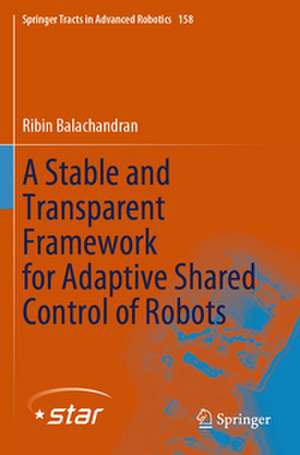
A Stable and Transparent Framework for Adaptive Shared Control of Robots: Springer Tracts in Advanced Robotics
Autor Ribin Balachandranen Limba Engleză Paperback – 4 ian 2025
| Toate formatele și edițiile | Preț | Express |
|---|---|---|
| Paperback (1) | 680.94 lei 39-44 zile | |
| Springer – 4 ian 2025 | 680.94 lei 39-44 zile | |
| Hardback (1) | 702.09 lei 3-5 săpt. | |
| Springer Nature Switzerland – 3 ian 2024 | 702.09 lei 3-5 săpt. |
Din seria Springer Tracts in Advanced Robotics
- 15%
 Preț: 410.08 lei
 - 17%
 Preț: 408.99 lei
 - 18%
 Preț: 874.94 lei
 - 18%
 Preț: 850.04 lei
 -
 Preț: 428.99 lei
 -
 Preț: 434.53 lei
 - 15%
 Preț: 612.01 lei
 - 18%
 Preț: 747.53 lei
 - 15%
 Preț: 611.32 lei
 - 18%
 Preț: 946.89 lei
 - 18%
 Preț: 1185.81 lei
 - 18%
 Preț: 914.52 lei
 - 15%
 Preț: 615.35 lei
 - 18%
 Preț: 1772.67 lei
 - 20%
 Preț: 598.05 lei
 - 18%
 Preț: 748.16 lei
 - 18%
 Preț: 856.49 lei
 - 15%
 Preț: 619.75 lei
 - 24%
 Preț: 563.68 lei
 - 18%
 Preț: 960.16 lei
 - 18%
 Preț: 911.05 lei
 - 15%
 Preț: 616.15 lei
 - 18%
 Preț: 746.82 lei
 - 15%
 Preț: 633.58 lei
 - 15%
 Preț: 629.66 lei
 - 18%
 Preț: 928.33 lei
 - 15%
 Preț: 619.87 lei
 - 18%
 Preț: 934.02 lei
 - 15%
 Preț: 611.02 lei
 - 15%
 Preț: 623.48 lei
 - 18%
 Preț: 923.51 lei
 - 18%
 Preț: 925.62 lei
 - 15%
 Preț: 607.99 lei
 - 15%
 Preț: 611.63 lei
 - 18%
 Preț: 911.89 lei
 - 18%
 Preț: 696.60 lei
Preț: 680.94 lei
Preț vechi: 895.98 lei
-24%
Puncte Express: 1021
Preț estimativ în valută:
120.39€ • 140.08$ • 104.16£
120.39€ • 140.08$ • 104.16£
Carte tipărită la comandă
Livrare economică 20-25 aprilie
Specificații
ISBN-13: 9783031479366
ISBN-10: 303147936X
Pagini: 204
Dimensiuni: 155 x 235 x 9 mm
Greutate: 0.36 kg
Editura: Springer
Seria Springer Tracts in Advanced Robotics
ISBN-10: 303147936X
Pagini: 204
Dimensiuni: 155 x 235 x 9 mm
Greutate: 0.36 kg
Editura: Springer
Seria Springer Tracts in Advanced Robotics
V-ar putea interesa
-
 Human-Centered AIBen Shneiderman-20%Preț: 109.29 lei136.61 lei
 -
 In Robots We TrustSamuele Vinanzi-17%Preț: 138.51 lei166.97 lei
 -
 Living with RobotsRuth AylettPreț: 130.47 lei
 -
 Adaptability: Seven Lessons to Thrive in a World of Competing DemandsDenise Lewis, DBE-32%Preț: 124.11 lei182.69 lei
 -
 Sabiston Textbook of Surgery: The Biological Basis of Modern Surgical PracticeDouglas Scott Tyler-31%Preț: 1080.90 lei1567.28 leiRecomandat
 -
 Robot EcologyMagnus Egerstedt-19%Preț: 499.12 lei616.19 lei
 -
 Preț: 351.45 leiRecomandat
 -
 Introduction to Robotics, Global EditionJohn Craig-15%Preț: 549.17 lei646.09 lei
 -
 An Adaptive Approach for Precise Underwater Vehicle Control in Combined Robot-Diver OperationsNaval Postgraduate SchoolPreț: 84.48 lei
 -
 Robotics Research TrendsXing P Guô-29%Preț: 503.30 lei711.94 lei
 -
 Human-Friendly Robotics 2022Pablo Borja-24%Preț: 1233.60 lei1623.15 lei
 -
 Robust and Adaptive ControlEugene LavretskyPreț: 515.97 lei
 -
 Walking Robots into Real WorldKarsten Berns-24%Preț: 1128.19 lei1484.46 lei
 -
 -15%Preț: 626.36 lei736.90 lei
 -
 Robotics Goes MOOC: InteractionBruno SicilianoPreț: 409.58 lei
 -
 -18%Preț: 1186.28 lei1446.69 lei
 -
 Human Motion Awareness and Robot TeleoperationHonghao Lyu-20%Preț: 1113.52 lei1391.90 lei
 -
 -18%Preț: 698.27 lei851.55 lei
 -
 -26%Preț: 85.75 lei116.44 leiRecomandat
Cuprins
1. Introduction.- 2. Fundamentals.- 3. Transparency Enhancement in Teleoperation.- 4. Multi-Agent Adaptive Shared Control.- 5. Stable and Transparent Shared Control Framework.
Notă biografică
Ribin Balachandran is a researcher at the German Aerospace Center (DLR) in the Institute of Robotics and Mechatronics since 2013, focusing on time-delayed teleoperation, haptics and control for robotics. He received a bachelor degree in engineering from National Institute of Technology Surathkal, India and a master degree in robotics from Technical University of Dortmund, Germany. He finished his Ph.D. at the Technical University of Munich in May 2022, for which he won the Georges Giralt award for the best robotics PhD in Europe. Other than robotics, he enjoys painting, and is working towards a life as a part-time artist.
Textul de pe ultima copertă
Robotic research and developments in computing technologies including artificial intelligence have led to significant improvements in autonomous capabilities of robots. Yet, human supervision is advisable and, in many cases, necessary when robots interact with real-world, outside-lab environments. This is due to the fact that complete autonomy in robots has not yet been achieved. When robots encounter challenges beyond their capabilities, a viable solution is to include human operators in the loop, who can support robots through teleoperation, taking complete control or shared control. This monograph focuses on a special form of shared control, namely mixed-initiative, where the final command to the robot is a weighted sum of the commands from the operator and the autonomous controller. The weights (fixed or adaptive), called authority allocation (AA) factors, decide who has more control authority over the robot. Several research groups use different methods to adapt the AAfactors online and the benefits of adaptive mixed-initiative shared control have been well established in terms of task completion success and operator usability. However, stability of the overall shared control framework, with communication time-delays between the operator and the robot, is a field that has not been examined extensively. This monograph presents methods to improve performance and stability in shared control so that the possibilities of its applications can be widened. Firstly, methods to improve the haptic feedback performance of teleoperation are developed. Secondly, methods to stabilize adaptive shared control systems, while still ensuring high teleoperation performance, are proposed. The methods are validated on multiple robotic systems and they were applied in several projects, both in space and terrestrial domains.
With the aforementioned contributions, this monograph provides an overarching framework to improve synergy between humans and robots.The flexibility of the framework allows integration of existent teleoperation and shared control approaches, which further promotes synergy within the robotics community.
Caracteristici
Develops methods for best performance and stability in shared control systems Winner of the Georges Giralt PhD Award Provides a framework to make adaptive shared controllers stable