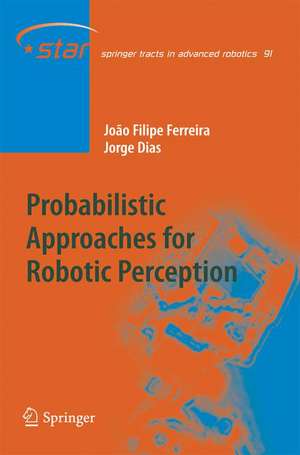
Probabilistic Approaches to Robotic Perception: Springer Tracts in Advanced Robotics, cartea 91
Autor João Filipe Ferreira, Jorge Miranda Diasen Limba Engleză Hardback – 11 sep 2013
The development of robotic domain by the 1980s spurred the convergence of automation to autonomy, and the field of robotics has consequently converged towards the field of artificial intelligence (AI). Since the end of that decade, the general public’s imagination has been stimulated by high expectations on autonomy, where AI and robotics try to solve difficult cognitive problems through algorithms developed from either philosophical and anthropological conjectures or incomplete notions of cognitive reasoning. Many of these developments do not unveil even a few of the processes through which biological organisms solve these same problems with little energy and computing resources. The tangible results of this research tendency were many robotic devices demonstrating good performance, but only under well-defined and constrained environments. The adaptability to different and more complex scenarios was very limited.
In this book, the application of Bayesian models and approaches are described in order to develop artificial cognitive systems that carry out complex tasks in real world environments, spurring the design of autonomous, intelligent and adaptive artificial systems, inherently dealing with uncertainty and the “irreducible incompleteness of models”.
Din seria Springer Tracts in Advanced Robotics
- 15%
 Preț: 430.39 lei
 - 18%
 Preț: 945.29 lei
 - 18%
 Preț: 924.60 lei
 -
 Preț: 460.34 lei
 -
 Preț: 434.53 lei
 - 15%
 Preț: 664.95 lei
 - 18%
 Preț: 812.83 lei
 - 20%
 Preț: 598.05 lei
 - 15%
 Preț: 664.24 lei
 - 18%
 Preț: 1030.20 lei
 - 18%
 Preț: 702.09 lei
 - 18%
 Preț: 1185.81 lei
 - 18%
 Preț: 914.52 lei
 - 15%
 Preț: 615.35 lei
 - 18%
 Preț: 1772.67 lei
 - 18%
 Preț: 856.49 lei
 - 18%
 Preț: 960.16 lei
 - 18%
 Preț: 748.16 lei
 - 20%
 Preț: 1006.30 lei
 - 15%
 Preț: 661.64 lei
 - 18%
 Preț: 946.97 lei
 - 15%
 Preț: 689.78 lei
 - 18%
 Preț: 981.70 lei
 - 15%
 Preț: 663.25 lei
 - 18%
 Preț: 806.73 lei
 - 18%
 Preț: 994.17 lei
 - 15%
 Preț: 683.19 lei
 - 15%
 Preț: 678.81 lei
 - 18%
 Preț: 1010.02 lei
 - 15%
 Preț: 673.55 lei
 - 18%
 Preț: 1018.07 lei
 - 18%
 Preț: 982.36 lei
 - 15%
 Preț: 663.90 lei
 - 15%
 Preț: 677.51 lei
 - 24%
 Preț: 926.35 lei
Preț: 588.02 lei
Preț vechi: 783.75 lei
-25%
Puncte Express: 882
Carte indisponibilă temporar
Livrare prin curier în România Termenul estimat este afișat lângă disponibilitate.
Transport gratuit pentru acest produs Plată online sau ramburs, în funcție de opțiunile comenzii.
Retur gratuit în 14 zile Comandă securizată și suport în română.
Specificații
ISBN-13: 9783319020051
ISBN-10: 3319020056
Pagini: 272
Ilustrații: XXIX, 242 p.
Dimensiuni: 160 x 241 x 20 mm
Greutate: 0.52 kg
Ediția:2014
Editura: Springer
Colecția Springer Tracts in Advanced Robotics
Seria Springer Tracts in Advanced Robotics
Locul publicării:Cham, Switzerland
ISBN-10: 3319020056
Pagini: 272
Ilustrații: XXIX, 242 p.
Dimensiuni: 160 x 241 x 20 mm
Greutate: 0.52 kg
Ediția:2014
Editura: Springer
Colecția Springer Tracts in Advanced Robotics
Seria Springer Tracts in Advanced Robotics
Locul publicării:Cham, Switzerland
V-ar putea interesa
-
 -39%Preț: 189.09 lei312.25 lei
 -
 Preț: 198.45 lei
 -
 Preț: 201.32 lei
 -
 The LEGO MINDSTORMS EV3 Discovery BookLaurens Valk-18%Preț: 216.13 lei264.86 lei
 -
 The LEGO MINDSTORMS EV3 LaboratoryDaniele Benedettelli-19%Preț: 215.56 lei264.52 lei
 -
 The LEGO Power Functions Idea Book, Volume 2Yoshihito IsogawaPreț: 170.52 lei
 -
 Make: FireTim DeaganPreț: 174.31 lei
 -
 DIY Drone and Quadcopter ProjectsMake the Editors ofPreț: 83.78 lei
 -
 Automation for RoboticsLuc Jaulin-9%Preț: 1018.80 lei1119.57 lei
 -
 Logistik-Wörterbuch. Dictionary of LogisticsVanessa Scott-Sabic-18%Preț: 838.28 lei1022.30 lei
Public țintă
ResearchCuprins
Probabilistic Modelling for Robotic Perception.- Probabilistic Approaches for Robotic Perception in Practice.
Textul de pe ultima copertă
This book tries to address the following questions: How should the uncertainty and incompleteness inherent to sensing the environment be represented and modelled in a way that will increase the autonomy of a robot? How should a robotic system perceive, infer, decide and act efficiently? These are two of the challenging questions robotics community and robotic researchers have been facing.
The development of robotic domain by the 1980s spurred the convergence of automation to autonomy, and the field of robotics has consequently converged towards the field of artificial intelligence (AI). Since the end of that decade, the general public’s imagination has been stimulated by high expectations on autonomy, where AI and robotics try to solve difficult cognitive problems through algorithms developed from either philosophical and anthropological conjectures or incomplete notions of cognitive reasoning. Many of these developments do not unveil even a few of the processes through which biological organisms solve these same problems with little energy and computing resources. The tangible results of this research tendency were many robotic devices demonstrating good performance, but only under well-defined and constrained environments. The adaptability to different and more complex scenarios was very limited.
In this book, the application of Bayesian models and approaches are described in order to develop artificial cognitive systems that carry out complex tasks in real world environments, spurring the design of autonomous, intelligent and adaptive artificial systems, inherently dealing with uncertainty and the “irreducible incompleteness of models”.
The development of robotic domain by the 1980s spurred the convergence of automation to autonomy, and the field of robotics has consequently converged towards the field of artificial intelligence (AI). Since the end of that decade, the general public’s imagination has been stimulated by high expectations on autonomy, where AI and robotics try to solve difficult cognitive problems through algorithms developed from either philosophical and anthropological conjectures or incomplete notions of cognitive reasoning. Many of these developments do not unveil even a few of the processes through which biological organisms solve these same problems with little energy and computing resources. The tangible results of this research tendency were many robotic devices demonstrating good performance, but only under well-defined and constrained environments. The adaptability to different and more complex scenarios was very limited.
In this book, the application of Bayesian models and approaches are described in order to develop artificial cognitive systems that carry out complex tasks in real world environments, spurring the design of autonomous, intelligent and adaptive artificial systems, inherently dealing with uncertainty and the “irreducible incompleteness of models”.
Caracteristici
Provides an overview of robotic perception systems and how human behavior has been a challenge for robotic researchers Introduction to the use of probabilistic tools to implement robotic perception, adding to it working examples and case studies Focuses on multisensory perception and the action-perception loop addressing the topic of probabilistic approaches to robotics