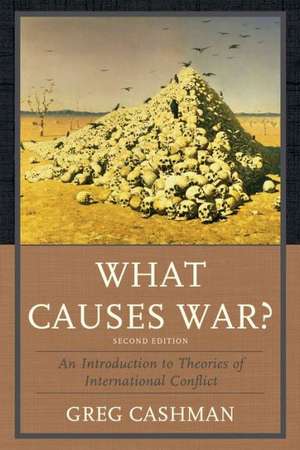
What Causes War?: An Introduction to Theories of International Conflict: Rowman & Littlefield Publishers
Autor Greg Cashmanen Limba Engleză Paperback – 29 iul 2013
Among the questions he explores are: Are humans aggressive by nature? Do individual differences among leaders matter? How might poor decision making procedures lead to war? Why do leaders engage in seemingly risky and irrational policies that end in war? Why do states with internal conflicts seem to become entangled in wars with their neighbors? What roles do nationalism and ethnicity play in international conflict? What kinds of countries are most likely to become involved in war? Why have certain pairs of countries been particularly war-prone over the centuries? Can strong states deter war? Can we find any patterns in the way that war breaks out? How do balances of power or changes in balances of power make war more likely? Do social scientists currently have an answer to the question of what causes war?
Cashman examines theories of war at the individual, substate, nation-state, dyadic, and international systems level of analysis. Written in a clear and accessible style, this interdisciplinary text will be essential reading for all students of international relations.
Din seria Rowman & Littlefield Publishers
-
 Preț: 113.82 lei
 - 13%
 Preț: 155.38 lei
 -
 Preț: 109.93 lei
 - 20%
 Preț: 370.93 lei
 - 19%
 Preț: 323.76 lei
 - 26%
 Preț: 223.03 lei
 - 19%
 Preț: 321.01 lei
 - 21%
 Preț: 307.35 lei
 - 20%
 Preț: 190.98 lei
 - 24%
 Preț: 255.02 lei
 - 16%
 Preț: 109.26 lei
 - 31%
 Preț: 351.69 lei
 - 15%
 Preț: 127.13 lei
 - 23%
 Preț: 320.61 lei
 - 19%
 Preț: 324.21 lei
 - 30%
 Preț: 355.24 lei
 - 23%
 Preț: 258.39 lei
 -
 Preț: 402.96 lei
 - 23%
 Preț: 275.97 lei
 - 24%
 Preț: 275.28 lei
 - 31%
 Preț: 351.50 lei
 - 22%
 Preț: 323.28 lei
 - 32%
 Preț: 373.39 lei
 - 34%
 Preț: 842.33 lei
 - 19%
 Preț: 314.30 lei
 - 23%
 Preț: 354.68 lei
 - 21%
 Preț: 128.84 lei
 - 30%
 Preț: 774.75 lei
 - 23%
 Preț: 278.65 lei
 - 23%
 Preț: 259.97 lei
 - 19%
 Preț: 344.02 lei
 - 32%
 Preț: 594.45 lei
 - 31%
 Preț: 566.85 lei
 - 22%
 Preț: 358.54 lei
 - 19%
 Preț: 322.03 lei
 - 16%
 Preț: 148.06 lei
 - 22%
 Preț: 360.79 lei
 - 19%
 Preț: 323.37 lei
 - 31%
 Preț: 414.61 lei
 - 25%
 Preț: 344.18 lei
 - 30%
 Preț: 703.64 lei
 - 14%
 Preț: 152.49 lei
 - 30%
 Preț: 827.47 lei
 - 19%
 Preț: 316.66 lei
 - 23%
 Preț: 276.77 lei
 - 29%
 Preț: 709.89 lei
 - 23%
 Preț: 262.16 lei
 - 19%
 Preț: 335.82 lei
Preț: 533.69 lei
Preț vechi: 744.20 lei
-28%
Puncte Express: 801
Carte disponibilă
Livrare economică 02-16 noiembrie
Livrare prin curier în România Termenul estimat este afișat lângă disponibilitate.
Transport gratuit pentru acest produs Plată online sau ramburs, în funcție de opțiunile comenzii.
Retur gratuit în 14 zile Comandă securizată și suport în română.
Specificații
ISBN-13: 9780742566514
ISBN-10: 074256651X
Pagini: 607
Ilustrații: 7 b/w illustrations; 11 tables; 3 textboxes
Dimensiuni: 204 x 278 x 34 mm
Greutate: 1.27 kg
Ediția:2nd Edition.
Editura: Bloomsbury Publishing
Colecția Rowman & Littlefield
Seria Rowman & Littlefield Publishers
Locul publicării:New York, United States
ISBN-10: 074256651X
Pagini: 607
Ilustrații: 7 b/w illustrations; 11 tables; 3 textboxes
Dimensiuni: 204 x 278 x 34 mm
Greutate: 1.27 kg
Ediția:2nd Edition.
Editura: Bloomsbury Publishing
Colecția Rowman & Littlefield
Seria Rowman & Littlefield Publishers
Locul publicării:New York, United States
Cuprins
Chapter 1: Empirical Theory and the Causes of War
Chapter 2: The Individual Level of Analysis, Part I: Human Aggression
Chapter 3: The Individual Level of Analysis, Part II: Psychological Explanations for War
Chapter 4: The Substate Level of Analysis: Group Decision Making
Chapter 5: The State Level of Analysis, Part I: Political, Economic, and Demographic Factors
Chapter 6: The State Level of Analysis, Part II: Internal Conflicts, Nationalism, and War Weariness
Chapter 7: The Dyadic Level of Analysis, Part I: The Nature of Dyads-Really Bad Dyads and Pretty Good Dyads
Chapter 8: The Dyadic Level of Analysis, Part II: International Interactions
Chapter 9: The Dyadic Level of Analysis, Part III: Game Theory, Bargaining, and Deterrence Theory
Chapter 10: The International System Level of Analysis, Part I: Realism, Anarchy, and the Balance of Power
Chapter 11: The International System Level of Analysis, Part II: Power Dynamics, Cyclical Theories, and Historical-Structural Theories of War
Chapter 12: Constructivism: A Digression
Chapter 13: Conclusion
Bibliography
Chapter 2: The Individual Level of Analysis, Part I: Human Aggression
Chapter 3: The Individual Level of Analysis, Part II: Psychological Explanations for War
Chapter 4: The Substate Level of Analysis: Group Decision Making
Chapter 5: The State Level of Analysis, Part I: Political, Economic, and Demographic Factors
Chapter 6: The State Level of Analysis, Part II: Internal Conflicts, Nationalism, and War Weariness
Chapter 7: The Dyadic Level of Analysis, Part I: The Nature of Dyads-Really Bad Dyads and Pretty Good Dyads
Chapter 8: The Dyadic Level of Analysis, Part II: International Interactions
Chapter 9: The Dyadic Level of Analysis, Part III: Game Theory, Bargaining, and Deterrence Theory
Chapter 10: The International System Level of Analysis, Part I: Realism, Anarchy, and the Balance of Power
Chapter 11: The International System Level of Analysis, Part II: Power Dynamics, Cyclical Theories, and Historical-Structural Theories of War
Chapter 12: Constructivism: A Digression
Chapter 13: Conclusion
Bibliography
Recenzii
Greg Cashman thoroughly examines the validity and reliability of empirical findings and the theories of international relations they attempt to test. He is clear, balanced, and precise. Every student of world politics ought to own this book.
Cashman takes a comprehensive look at the various factors thought to contribute to the outbreak of war. Using a levels of analysis approach, he presents an exhaustive set of theories at the individual, substate, state, dyadic, and international levels. Following the explanation of each theory, Cashman presents the empirical record supporting and/or refuting the theories. In this second edition, the book has been expanded to include the growing body of literature examining the causes of war. Further, Cashman has added more depth to the theoretical discussions by including throughout the book case illustrations that should help pique the interest of students. He has also added a chapter on constructivism reflecting an evolving field of study. This book presents a most comprehensive and up-to-date assessment of literature surrounding the causes of war. It is ideal for graduate and advanced undergraduates studying contemporary war. Summing Up: Highly recommended. Upper-division undergraduate, graduate, research, and professional collections.
Extraordinary! [Greg Cashman has] done a masterful job of examining, evaluating, and integrating this large, complex, inconsistent, and buzzing welter of literature. Sensible, intelligent, coherent, and nicely written.
Cashman takes a comprehensive look at the various factors thought to contribute to the outbreak of war. Using a levels of analysis approach, he presents an exhaustive set of theories at the individual, substate, state, dyadic, and international levels. Following the explanation of each theory, Cashman presents the empirical record supporting and/or refuting the theories. In this second edition, the book has been expanded to include the growing body of literature examining the causes of war. Further, Cashman has added more depth to the theoretical discussions by including throughout the book case illustrations that should help pique the interest of students. He has also added a chapter on constructivism reflecting an evolving field of study. This book presents a most comprehensive and up-to-date assessment of literature surrounding the causes of war. It is ideal for graduate and advanced undergraduates studying contemporary war. Summing Up: Highly recommended. Upper-division undergraduate, graduate, research, and professional collections.
Extraordinary! [Greg Cashman has] done a masterful job of examining, evaluating, and integrating this large, complex, inconsistent, and buzzing welter of literature. Sensible, intelligent, coherent, and nicely written.