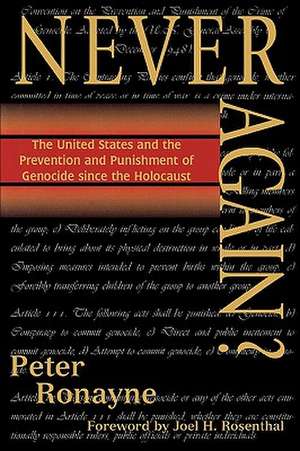
Never Again?: The United States and the Prevention and Punishment of Genocide since the Holocaust: Rowman & Littlefield Publishers
Cuvânt înainte de Joel H. Rosenthal Autor Peter Ronayneen Limba Engleză Paperback – 21 aug 2001
Din seria Rowman & Littlefield Publishers
-
 Preț: 113.89 lei
 - 13%
 Preț: 155.38 lei
 -
 Preț: 109.93 lei
 - 20%
 Preț: 370.93 lei
 - 19%
 Preț: 323.76 lei
 - 25%
 Preț: 228.52 lei
 - 28%
 Preț: 148.13 lei
 - 20%
 Preț: 191.09 lei
 - 24%
 Preț: 255.02 lei
 - 16%
 Preț: 109.26 lei
 - 31%
 Preț: 351.69 lei
 - 15%
 Preț: 127.13 lei
 - 22%
 Preț: 330.19 lei
 - 19%
 Preț: 324.21 lei
 - 30%
 Preț: 355.24 lei
 - 23%
 Preț: 258.39 lei
 -
 Preț: 402.96 lei
 - 23%
 Preț: 282.77 lei
 - 24%
 Preț: 275.28 lei
 - 31%
 Preț: 351.50 lei
 - 22%
 Preț: 331.09 lei
 - 32%
 Preț: 373.39 lei
 - 34%
 Preț: 842.33 lei
 - 18%
 Preț: 325.06 lei
 - 23%
 Preț: 363.28 lei
 - 21%
 Preț: 128.84 lei
 - 30%
 Preț: 774.75 lei
 - 23%
 Preț: 278.65 lei
 - 22%
 Preț: 266.38 lei
 - 19%
 Preț: 344.02 lei
 - 32%
 Preț: 594.45 lei
 - 31%
 Preț: 566.85 lei
 - 22%
 Preț: 367.22 lei
 - 19%
 Preț: 322.03 lei
 - 16%
 Preț: 148.06 lei
 - 21%
 Preț: 369.53 lei
 - 19%
 Preț: 323.37 lei
 - 20%
 Preț: 314.77 lei
 - 30%
 Preț: 424.70 lei
 - 25%
 Preț: 344.18 lei
 - 30%
 Preț: 703.64 lei
 - 14%
 Preț: 152.49 lei
 - 30%
 Preț: 847.72 lei
 - 19%
 Preț: 316.66 lei
 - 23%
 Preț: 283.57 lei
 - 29%
 Preț: 727.24 lei
 - 23%
 Preț: 262.16 lei
 - 19%
 Preț: 343.92 lei
Preț: 328.78 lei
Preț vechi: 404.50 lei
-19%
Puncte Express: 493
Carte tipărită la comandă
Livrare economică 07-21 decembrie
Livrare prin curier în România Termenul estimat este afișat lângă disponibilitate.
Transport gratuit de la 400.00 lei Plată online sau ramburs, în funcție de opțiunile comenzii.
Retur gratuit în 14 zile Comandă securizată și suport în română.
Specificații
ISBN-13: 9780742509221
ISBN-10: 0742509222
Pagini: 224
Dimensiuni: 149 x 227 x 14 mm
Greutate: 0.31 kg
Ediția:0240
Editura: Bloomsbury Publishing
Colecția Rowman & Littlefield
Seria Rowman & Littlefield Publishers
Locul publicării:New York, United States
ISBN-10: 0742509222
Pagini: 224
Dimensiuni: 149 x 227 x 14 mm
Greutate: 0.31 kg
Ediția:0240
Editura: Bloomsbury Publishing
Colecția Rowman & Littlefield
Seria Rowman & Littlefield Publishers
Locul publicării:New York, United States
V-ar putea interesa
-
 The HolocaustMartin GilbertPreț: 160.31 lei
 -
 Golden Harvest: Events at the Periphery of the HolocaustJan Tomasz Gross-21%Preț: 76.97 lei97.15 lei
 -
 -20%Preț: 261.58 lei326.55 lei
 -
 Genocide: A ReaderJens Meierhenrich-30%Preț: 1038.39 lei1479.23 lei
 -
 The Gestapo and German Society: Enforcing Racial Policy 1933-1945Robert Gellately-30%Preț: 621.42 lei887.67 lei
 -
 -17%Preț: 406.27 lei487.57 lei
 -
 Albert Speer: His Battle With TruthGitta Sereny-32%Preț: 98.58 lei145.85 lei
 -
 Hitler's Willing Executioners: Ordinary Germans and the HolocaustDaniel Goldhagen-24%Preț: 83.22 lei109.73 lei
 -
 -27%Preț: 68.51 lei93.23 lei
 -
 Preț: 131.17 lei
 -
 What Is Genocide?Martin ShawPreț: 159.91 lei
 -
 Preț: 151.65 lei
 -
 Under the Shadow of Death: Memoirs of a Survivor of the Armenian GenocideGarabed Hagop Aaronian-15%Preț: 209.75 lei247.03 lei
 -
 -27%Preț: 67.74 lei92.76 lei
 -
 -40%Preț: 68.36 lei114.73 lei
 -
 Preț: 201.47 lei
Cuprins
Chapter 1 Foreword
Chapter 2 Introduction: The United States in an Age of Genocide
Chapter 3 An Unconventional Debate: The United States and the Genocide Convention
Chapter 4 The United States and the Cambodian Tragedy
Chapter 5 The United States and Genocide in Bosnia
Chapter 6 Eyes Wide Shut: The United States and the Rwanda Genocide
Chapter 7 Conclusion: "Thus Can We Make It"
Chapter 8 Appendix
Chapter 9 Index
Chapter 2 Introduction: The United States in an Age of Genocide
Chapter 3 An Unconventional Debate: The United States and the Genocide Convention
Chapter 4 The United States and the Cambodian Tragedy
Chapter 5 The United States and Genocide in Bosnia
Chapter 6 Eyes Wide Shut: The United States and the Rwanda Genocide
Chapter 7 Conclusion: "Thus Can We Make It"
Chapter 8 Appendix
Chapter 9 Index
Recenzii
Peter Ronayne has provided us with a mirror. With unflinching candor, in the harsh light of reality, he has measured our behavior against our stated goals. While he does not like all that he sees, he does not succumb to despair. Skillfully avoiding the shoals of self-righteous moralism and self-defeating cynicism, this study is itself a moral act-a genuine inquiry into who we are and who we want to be.
This is a well-written, measured, and reflective survey of how far the United States' actions have fallen short of its rhetoric and potential, and the standards it applies to other states. This book very usefully illustrates both the negative and positiveconnections between US domestic and foreign policy issues. Despite the startling failures he documents, Ronayne also shows that important progress has been made, however slowly. His book is a sobering account of some of the human disasters of the lastcentury, but thankfully not despairing of the next...
In Never Again?, Peter Ronayne has, with feeling, insight, and extensive research, laid bare one of the tragic contradictions in modern U.S. foreign policy: the conflict between Americans' professed abhorrence of genocide and their resistance to action in the face of reality. Beginning with the 40 year delay in the U.S. ratification of the Genocide Convention, Ronayne demonstrates how politics, fear of involvement, and rationalization impeded immediate, forceful, and possibly effective intervention in the cases of Cambodia, Bosnia, and Rwanda. His book should be read by everyone who wants to understand these recent tragedies and share in Ronayne's indictment of the failure of a nation, rhetorically committed to human rights, to act to prevent some of the most brutal violations of those rights.
Peter Ronayne offers a sophisticated, balanced view of U.S. foreign policy in relation to genocide. Because it is so emotionally charged, genocide is often approached in ideological terms. Ronayne's great virtue in this book is that his observations are equally free of indifference and cant. He can, in other words, be trusted. Those who care about the ambiguities of U.S. diplomacy will find this policy-oriented study invaluable.
Ronayne provides a solid introduction to both the Genocide Convention and the difficulties inherent in the relationship between international criminal law and US foreign policy. He presents the issues clearly and accessibly and gives an objective portrayal of the multifaceted domestic and foreign concerns facing the US since the Second World War.
Prevention of genocide has become an accepted goal of U.S. foreign policy. This book is the first serious effort to understand how that norm evolved into a treaty.
...a valuable work.
This is a well-written, measured, and reflective survey of how far the United States' actions have fallen short of its rhetoric and potential, and the standards it applies to other states. This book very usefully illustrates both the negative and positiveconnections between US domestic and foreign policy issues. Despite the startling failures he documents, Ronayne also shows that important progress has been made, however slowly. His book is a sobering account of some of the human disasters of the lastcentury, but thankfully not despairing of the next...
In Never Again?, Peter Ronayne has, with feeling, insight, and extensive research, laid bare one of the tragic contradictions in modern U.S. foreign policy: the conflict between Americans' professed abhorrence of genocide and their resistance to action in the face of reality. Beginning with the 40 year delay in the U.S. ratification of the Genocide Convention, Ronayne demonstrates how politics, fear of involvement, and rationalization impeded immediate, forceful, and possibly effective intervention in the cases of Cambodia, Bosnia, and Rwanda. His book should be read by everyone who wants to understand these recent tragedies and share in Ronayne's indictment of the failure of a nation, rhetorically committed to human rights, to act to prevent some of the most brutal violations of those rights.
Peter Ronayne offers a sophisticated, balanced view of U.S. foreign policy in relation to genocide. Because it is so emotionally charged, genocide is often approached in ideological terms. Ronayne's great virtue in this book is that his observations are equally free of indifference and cant. He can, in other words, be trusted. Those who care about the ambiguities of U.S. diplomacy will find this policy-oriented study invaluable.
Ronayne provides a solid introduction to both the Genocide Convention and the difficulties inherent in the relationship between international criminal law and US foreign policy. He presents the issues clearly and accessibly and gives an objective portrayal of the multifaceted domestic and foreign concerns facing the US since the Second World War.
Prevention of genocide has become an accepted goal of U.S. foreign policy. This book is the first serious effort to understand how that norm evolved into a treaty.
...a valuable work.