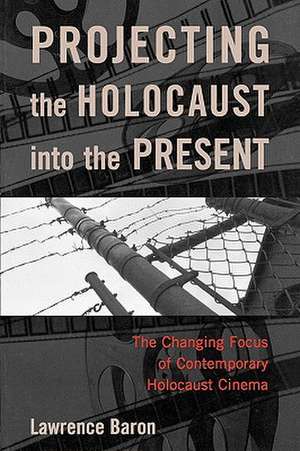
Projecting the Holocaust into the Present: The Changing Focus of Contemporary Holocaust Cinema: Rowman & Littlefield Publishers
Autor Lawrence Baronen Limba Engleză Paperback – noi 2005
Din seria Rowman & Littlefield Publishers
- 21%
 Preț: 313.38 lei
 - 24%
 Preț: 300.97 lei
 - 25%
 Preț: 338.47 lei
 - 25%
 Preț: 263.56 lei
 - 20%
 Preț: 324.11 lei
 - 24%
 Preț: 247.42 lei
 - 31%
 Preț: 608.85 lei
 - 20%
 Preț: 307.60 lei
 - 35%
 Preț: 806.74 lei
 -
 Preț: 362.61 lei
 - 32%
 Preț: 542.93 lei
 - 32%
 Preț: 569.39 lei
 - 26%
 Preț: 170.84 lei
 - 18%
 Preț: 919.38 lei
 - 21%
 Preț: 343.38 lei
 - 32%
 Preț: 336.76 lei
 - 21%
 Preț: 297.27 lei
 - 24%
 Preț: 264.89 lei
 - 20%
 Preț: 307.30 lei
 - 24%
 Preț: 266.80 lei
 - 20%
 Preț: 310.25 lei
 - 23%
 Preț: 309.77 lei
 - 24%
 Preț: 307.10 lei
 - 22%
 Preț: 294.43 lei
 - 23%
 Preț: 345.70 lei
 - 30%
 Preț: 742.02 lei
 - 31%
 Preț: 674.25 lei
 - 24%
 Preț: 249.03 lei
 - 26%
 Preț: 211.83 lei
 - 27%
 Preț: 213.55 lei
 - 21%
 Preț: 356.38 lei
 - 23%
 Preț: 343.53 lei
 - 25%
 Preț: 139.76 lei
 - 32%
 Preț: 395.90 lei
 - 20%
 Preț: 296.59 lei
 - 20%
 Preț: 301.15 lei
 - 35%
 Preț: 629.78 lei
 - 24%
 Preț: 264.99 lei
 - 30%
 Preț: 679.92 lei
 - 24%
 Preț: 251.02 lei
 - 20%
 Preț: 321.77 lei
 - 33%
 Preț: 408.40 lei
 - 24%
 Preț: 308.19 lei
Preț: 309.86 lei
Preț vechi: 386.96 lei
-20%
Puncte Express: 465
Carte tipărită la comandă
Livrare economică 08-22 iunie
Specificații
ISBN-13: 9780742543331
ISBN-10: 0742543331
Pagini: 320
Dimensiuni: 196 x 226 x 18 mm
Greutate: 0.42 kg
Editura: Bloomsbury Publishing
Colecția Rowman & Littlefield
Seria Rowman & Littlefield Publishers
Locul publicării:New York, United States
ISBN-10: 0742543331
Pagini: 320
Dimensiuni: 196 x 226 x 18 mm
Greutate: 0.42 kg
Editura: Bloomsbury Publishing
Colecția Rowman & Littlefield
Seria Rowman & Littlefield Publishers
Locul publicării:New York, United States
V-ar putea interesa
-
 Heinrich HimmlerPeter Longerich-19%Preț: 227.02 lei278.99 lei
 -
 -30%Preț: 405.83 lei583.23 lei
 -
 The Oxford Handbook of Genocide StudiesDonald Bloxham-6%Preț: 286.07 lei304.44 lei
 -
 -16%Preț: 142.62 lei169.28 lei
 -
 One Family's ShoahH. LindenbergerPreț: 371.81 lei
 -
 Auschwitz and AfterCharlotte DelboPreț: 142.72 lei
 -
 The Drowned And The SavedPrimo Levi-28%Preț: 63.51 lei88.48 lei
 -
 The Swastika's Darkening ShadowM. PenkowerPreț: 376.36 lei
 -
 -28%Preț: 64.10 lei88.83 lei
 -
 Preț: 88.98 lei
 -
 -41%Preț: 64.85 lei109.87 lei
 -
 -30%Preț: 489.42 lei701.53 lei
 -
 Introducing the HolocaustHaim BresheethPreț: 61.41 lei
Cuprins
Chapter 1 The Holocaust: A Cinematic Cataclysm?
Chapter 2 Picturing the Holocaust in the Past
Chapter 3 The Biopic: Personalizing Perpetrators, Victims, and Resisters
Chapter 4 Condemned Couples
Chapter 5 Serious Humor: Laughter as Lamentation
Chapter 6 The Children Are Watching: Holocaust Films for Youngsters
Chapter 7 Relevant Remembrances: Themes in Recent Holocaust Movies
Chapter 8 Projecting the Holocaust into the 21st Century
Chapter 2 Picturing the Holocaust in the Past
Chapter 3 The Biopic: Personalizing Perpetrators, Victims, and Resisters
Chapter 4 Condemned Couples
Chapter 5 Serious Humor: Laughter as Lamentation
Chapter 6 The Children Are Watching: Holocaust Films for Youngsters
Chapter 7 Relevant Remembrances: Themes in Recent Holocaust Movies
Chapter 8 Projecting the Holocaust into the 21st Century
Recenzii
Some authors provide sound scholarship, others supply detailed analysis, but few combine these accomplishments with prose that bridges the gap from the academic to the general reader. Historian Lawrence Baron has done just that while dealing with the often-controversial area of cinematic representations of the Holocaust. Because World War II genocide remains so dark a subject, it is easiest to see the era in high contrast black and white. This author points to the complexities of history, filmmaking, and cultural perceptions by contextualizing his work within classic films of the Shoah (from 1945-1979) while identifying trends and shifts in how stories of the Holocaust are now brought to the screen in the twenty-first century. Few previous works study more than the obvious contemporary movies, Schindler's List (1993) or Life is Beautiful (1997). This author looks at a wide range of films, including X-Men as "Holocaust pop metaphor" indicating that the shadow of past atrocities pervades our culture. Baron meticulously developed a database of films to discern changes in filmic Holocaust narratives.
Offers rich, detailed, and thoughtful analysis of international holocaust film by an author who has been teaching classes on Jewish History and the Holocaust for many years. . . . This is an important book on an important topic and should be in all film collections.
Combining scrupulous research and keen insight with prior film criticism and artistic, social, and historical information, Baron (history, San Diego State Univ.) renders this somber and difficult subject most accessible. The study is distinguished by thevarious schools of thought on how Holocaust subjects should or should not be treated on film. The author avoids repeating and recycling ideas, instead juxtaposing new findings and insights with established views, thereby delivering well-rounded and informative coverage of a dynamic subject with myriad facets and repercussions...An excellent resource for those interested in film or in political science, history, or psychology. Summing Up: Essential. Upper-division undergraduates through faculty and professionals..
Baron's study provides an excellent overview of recent movies dealing with the Holocaust. While broadening the common notion of "Holocaust cinema," Baron's cultural historicist approach casts light onto the increasingly larger role visual media play in the process of raising public awareness of historic events. Teachers and students of cultural, intellectual and film history will find the volume particularly helpful due to its format of individual film reviews, its nearly comprehensive filmography and its extensive bibliographical information.
A valuable addition to the extant scholarship on Holocaust cinema. . . . Baron's accessible and stimulating book fills in some significant gaps in studies of Holocaust feature films and is a useful reference for specialists as well as those with a more general interest in the subject.
[...] I wish to recommend this book without reservation to anyone even remotely interested in the subject. For me, it serves as reality check in my memory, and delineates what "bearing witness" means. To the reader, it may provide invaluable insights on what can be done to explain the inexplicable.
Some authors provide sound scholarship, others supply detailed analysis, but few combine these accomplishments with prose that bridges the gap from the academic to the general reader. Historian Lawrence Baron has done just that while dealing with the often-contorversial area of cinematic representations of the Holocaust.
Baron's well-researched, heavily annotated but still quite readable volume offers statistical analyses to indicate trends and genres which are then exemplified by detailed synopses and analyses of selected films within each category and decade, complete with reactions from critics, box office receipts, and awards bestowed.
Well-researched... quite readable
Offers rich, detailed, and thoughtful analysis of international holocaust film by an author who has been teaching classes on Jewish History and the Holocaust for many years. . . . This is an important book on an important topic and should be in all film collections.
Combining scrupulous research and keen insight with prior film criticism and artistic, social, and historical information, Baron (history, San Diego State Univ.) renders this somber and difficult subject most accessible. The study is distinguished by thevarious schools of thought on how Holocaust subjects should or should not be treated on film. The author avoids repeating and recycling ideas, instead juxtaposing new findings and insights with established views, thereby delivering well-rounded and informative coverage of a dynamic subject with myriad facets and repercussions...An excellent resource for those interested in film or in political science, history, or psychology. Summing Up: Essential. Upper-division undergraduates through faculty and professionals..
Baron's study provides an excellent overview of recent movies dealing with the Holocaust. While broadening the common notion of "Holocaust cinema," Baron's cultural historicist approach casts light onto the increasingly larger role visual media play in the process of raising public awareness of historic events. Teachers and students of cultural, intellectual and film history will find the volume particularly helpful due to its format of individual film reviews, its nearly comprehensive filmography and its extensive bibliographical information.
A valuable addition to the extant scholarship on Holocaust cinema. . . . Baron's accessible and stimulating book fills in some significant gaps in studies of Holocaust feature films and is a useful reference for specialists as well as those with a more general interest in the subject.
[...] I wish to recommend this book without reservation to anyone even remotely interested in the subject. For me, it serves as reality check in my memory, and delineates what "bearing witness" means. To the reader, it may provide invaluable insights on what can be done to explain the inexplicable.
Some authors provide sound scholarship, others supply detailed analysis, but few combine these accomplishments with prose that bridges the gap from the academic to the general reader. Historian Lawrence Baron has done just that while dealing with the often-contorversial area of cinematic representations of the Holocaust.
Baron's well-researched, heavily annotated but still quite readable volume offers statistical analyses to indicate trends and genres which are then exemplified by detailed synopses and analyses of selected films within each category and decade, complete with reactions from critics, box office receipts, and awards bestowed.
Well-researched... quite readable