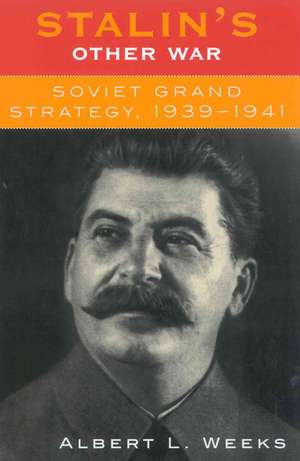
Stalin's Other War: Soviet Grand Strategy, 1939-1941: Rowman & Littlefield Publishers
Autor Albert L. Weeksen Limba Engleză Paperback – 16 apr 2003
Longtime Soviet expert Albert L. Weeks has studied the newly-released information and come to a different conclusion about the Soviet Union's pre-war buildup-it was not precaution against German invasion at all. In fact, Weeks argues, the evidence now suggests Soviet mobilization was aimed at an eventual invasion of Nazi Germany. The Soviets were quietly biding their time between 1939 and 1941, allowing the capitalist powers to destroy one another, all the while preparing for their own Westward march. Stalin, Weeks shows, wasn't waiting for a Nazi attack-Hitler simply beat him to the punch.
Din seria Rowman & Littlefield Publishers
- 21%
 Preț: 313.38 lei
 - 24%
 Preț: 300.97 lei
 - 25%
 Preț: 338.47 lei
 - 25%
 Preț: 263.56 lei
 - 20%
 Preț: 324.11 lei
 - 24%
 Preț: 247.42 lei
 - 31%
 Preț: 608.85 lei
 - 20%
 Preț: 307.60 lei
 - 35%
 Preț: 806.74 lei
 -
 Preț: 362.61 lei
 - 32%
 Preț: 542.93 lei
 - 32%
 Preț: 569.39 lei
 - 26%
 Preț: 170.84 lei
 - 18%
 Preț: 919.38 lei
 - 21%
 Preț: 343.38 lei
 - 32%
 Preț: 336.76 lei
 - 21%
 Preț: 297.27 lei
 - 24%
 Preț: 264.89 lei
 - 20%
 Preț: 307.30 lei
 - 24%
 Preț: 266.80 lei
 - 20%
 Preț: 310.25 lei
 - 23%
 Preț: 309.77 lei
 - 22%
 Preț: 294.43 lei
 - 23%
 Preț: 345.70 lei
 - 30%
 Preț: 742.02 lei
 - 31%
 Preț: 674.25 lei
 - 24%
 Preț: 249.03 lei
 - 26%
 Preț: 211.83 lei
 - 27%
 Preț: 213.55 lei
 - 21%
 Preț: 356.38 lei
 - 23%
 Preț: 343.53 lei
 - 25%
 Preț: 139.76 lei
 - 32%
 Preț: 395.90 lei
 - 20%
 Preț: 296.59 lei
 - 20%
 Preț: 309.86 lei
 - 20%
 Preț: 301.15 lei
 - 35%
 Preț: 629.78 lei
 - 24%
 Preț: 264.99 lei
 - 30%
 Preț: 679.92 lei
 - 24%
 Preț: 251.02 lei
 - 20%
 Preț: 321.77 lei
 - 33%
 Preț: 408.40 lei
 - 24%
 Preț: 308.19 lei
Preț: 307.10 lei
Preț vechi: 403.62 lei
-24%
Puncte Express: 461
Carte tipărită la comandă
Livrare economică 08-22 iunie
Specificații
ISBN-13: 9780742521926
ISBN-10: 0742521923
Pagini: 216
Dimensiuni: 149 x 228 x 12 mm
Greutate: 0.29 kg
Editura: Bloomsbury Publishing
Colecția Rowman & Littlefield
Seria Rowman & Littlefield Publishers
Locul publicării:New York, United States
ISBN-10: 0742521923
Pagini: 216
Dimensiuni: 149 x 228 x 12 mm
Greutate: 0.29 kg
Editura: Bloomsbury Publishing
Colecția Rowman & Littlefield
Seria Rowman & Littlefield Publishers
Locul publicării:New York, United States
V-ar putea interesa
-
 Warsaw 1920Adam ZamoyskiPreț: 74.79 lei
 -
 PolandAdam ZamoyskiPreț: 90.13 lei
 -
 The Fabled CoastSophia KingshillPreț: 118.76 lei
 -
 -12%Preț: 98.61 lei111.69 lei
 -
 Gas! Gas! Quick, Boys!Michael FreemantlePreț: 104.21 lei
 -
 Preț: 273.36 lei
 -
 -42%Preț: 92.33 lei158.21 leiRecomandat
 -
 The War that Ended Peace: How Europe abandoned peace for the First World WarProfessor Margaret MacMillan-18%Preț: 86.42 lei105.44 lei
 -
 Angela MerkelStefan Kornelius-10%Preț: 72.21 lei80.30 lei
 -
 Paris in QuotationsJaqueline MitchellPreț: 43.69 lei
 -
 Story of Hampton Court PalaceDavid SoudenPreț: 142.57 lei
Cuprins
Chapter 1 Introduction
Chapter 2 Soviet Expansionist Ideology: Propaganda or Blueprint?
Chapter 3 Prewar Diplomacy and the Comintern
Chapter 4 The Soviets' Pro-German Posture
Chapter 5 Nazi-Soviet Agreements (1939-40)
Chapter 6 Stalin Prepares for What Kind of War
Chapter 7 Stalin's Response to "Barbarossa"- I
Chapter 8 Stalin's Response to "Barbarossa"- II
Chapter 9 Conclusions
Chapter 10 Appendix 1: Stalin's Third Speech, May 5, 1941
Chapter 11 Appendix 2: May 15, 1941, Memorandum
Chapter 12 Appendix 3: Stalin's Speech to the Politburo, August 19, 1939
Chapter 13 Appendix 4: Russia's New History Textbooks
Chapter 2 Soviet Expansionist Ideology: Propaganda or Blueprint?
Chapter 3 Prewar Diplomacy and the Comintern
Chapter 4 The Soviets' Pro-German Posture
Chapter 5 Nazi-Soviet Agreements (1939-40)
Chapter 6 Stalin Prepares for What Kind of War
Chapter 7 Stalin's Response to "Barbarossa"- I
Chapter 8 Stalin's Response to "Barbarossa"- II
Chapter 9 Conclusions
Chapter 10 Appendix 1: Stalin's Third Speech, May 5, 1941
Chapter 11 Appendix 2: May 15, 1941, Memorandum
Chapter 12 Appendix 3: Stalin's Speech to the Politburo, August 19, 1939
Chapter 13 Appendix 4: Russia's New History Textbooks
Recenzii
Nazi Germany's invasion of Soviet Russia had immense consequences for the world, lasting into the 21st century. Albert Weeks has made imaginative use of recently released archives to shed new light on this crucial conflict. This book is a reminder that history is anything but static-it requires constant revision, in the light of new information and fresh perspective.
Stalin's Other War is an excellent study that thoroughly covers the subject matter under discussion, and Weeks provides an exceptionally good overview of the current state of the debate among Russian scholars who are making use of the new evidence that is progressively becoming available as the Soviet archives are opened to scholarly scrutiny. The book includes an excellent discussion of the issue of the supposed 'defensist' orientation of Soviet policy. Stalin's Other War presents substantial evidence that Soviet warplanning reflected its expansionist orientation. Provides an excellent update on the current status of a very contentious and important historical debate. Weeks does an excellent job of describing Soviet diplomatic and military strategy and supports his core arguments with solid evidence. Stalin's Other War is a sound contribution to the scholarly literature on the Soviet Union and a useful addition to the debate on the pre-Barbarossa relationship between two predatory empires.
Since the demise of the Soviet Union, new documents have surfaced which show, according to Albert Weeks in Stalin's Other War, one of our leading Sovietologists, that, on the contrary, Stalin had developed an offensive-war strategy against both Nazi Germany and the Western democracies as well. Mr. Weeks has produced a volume of history which is bound to stir controversy. Mr. Weeks's analysis of Soviet archives is a piece of scholarly revisionism of major significance.
This slender volume is a must study for scholars and history buffs on the Second World War, and, especially for skeptics who still doubt Stalin's aggressive designs. First of all, the author judiciously weighs the Russian and English-language sources. Second, he tells his history engrossingly. Third, he prints in appendices key documents that have previously not appeared in English, or which have been hard to find. Fourth, he relates-this is an outstanding contribution to understanding the current Russian state of mind-Russian textbook presentations on the controversial topic.
Recommended.
Stalin's Other War is an excellent study that thoroughly covers the subject matter under discussion, and Weeks provides an exceptionally good overview of the current state of the debate among Russian scholars who are making use of the new evidence that is progressively becoming available as the Soviet archives are opened to scholarly scrutiny. The book includes an excellent discussion of the issue of the supposed 'defensist' orientation of Soviet policy. Stalin's Other War presents substantial evidence that Soviet warplanning reflected its expansionist orientation. Provides an excellent update on the current status of a very contentious and important historical debate. Weeks does an excellent job of describing Soviet diplomatic and military strategy and supports his core arguments with solid evidence. Stalin's Other War is a sound contribution to the scholarly literature on the Soviet Union and a useful addition to the debate on the pre-Barbarossa relationship between two predatory empires.
Since the demise of the Soviet Union, new documents have surfaced which show, according to Albert Weeks in Stalin's Other War, one of our leading Sovietologists, that, on the contrary, Stalin had developed an offensive-war strategy against both Nazi Germany and the Western democracies as well. Mr. Weeks has produced a volume of history which is bound to stir controversy. Mr. Weeks's analysis of Soviet archives is a piece of scholarly revisionism of major significance.
This slender volume is a must study for scholars and history buffs on the Second World War, and, especially for skeptics who still doubt Stalin's aggressive designs. First of all, the author judiciously weighs the Russian and English-language sources. Second, he tells his history engrossingly. Third, he prints in appendices key documents that have previously not appeared in English, or which have been hard to find. Fourth, he relates-this is an outstanding contribution to understanding the current Russian state of mind-Russian textbook presentations on the controversial topic.
Recommended.