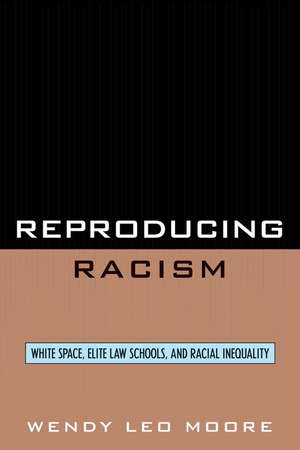
Reproducing Racism: White Space, Elite Law Schools, and Racial Inequality: Rowman & Littlefield Publishers
Autor Wendy Leo Mooreen Limba Engleză Paperback – 6 dec 2007
Din seria Rowman & Littlefield Publishers
-
 Preț: 111.16 lei
 - 13%
 Preț: 155.38 lei
 -
 Preț: 109.93 lei
 - 19%
 Preț: 322.03 lei
 - 19%
 Preț: 323.76 lei
 - 26%
 Preț: 223.03 lei
 - 19%
 Preț: 321.01 lei
 - 21%
 Preț: 307.35 lei
 - 21%
 Preț: 186.50 lei
 - 30%
 Preț: 703.64 lei
 - 19%
 Preț: 332.36 lei
 - 31%
 Preț: 351.69 lei
 - 15%
 Preț: 127.13 lei
 - 31%
 Preț: 566.85 lei
 - 19%
 Preț: 324.21 lei
 - 22%
 Preț: 360.79 lei
 - 23%
 Preț: 258.39 lei
 - 25%
 Preț: 344.18 lei
 - 23%
 Preț: 275.97 lei
 - 16%
 Preț: 109.26 lei
 - 31%
 Preț: 351.50 lei
 - 22%
 Preț: 323.28 lei
 - 32%
 Preț: 373.39 lei
 - 34%
 Preț: 842.33 lei
 - 19%
 Preț: 314.30 lei
 - 23%
 Preț: 354.68 lei
 - 21%
 Preț: 128.84 lei
 - 30%
 Preț: 774.75 lei
 - 23%
 Preț: 278.65 lei
 - 23%
 Preț: 259.97 lei
 - 23%
 Preț: 320.61 lei
 - 32%
 Preț: 594.45 lei
 - 20%
 Preț: 370.93 lei
 - 22%
 Preț: 358.54 lei
 - 30%
 Preț: 355.24 lei
 - 16%
 Preț: 148.06 lei
 - 19%
 Preț: 323.37 lei
 -
 Preț: 391.18 lei
 - 31%
 Preț: 414.61 lei
 - 24%
 Preț: 255.02 lei
 - 24%
 Preț: 275.28 lei
 - 14%
 Preț: 152.49 lei
 - 30%
 Preț: 827.47 lei
 - 19%
 Preț: 316.66 lei
 - 23%
 Preț: 276.77 lei
 - 29%
 Preț: 709.89 lei
 - 23%
 Preț: 262.16 lei
 - 19%
 Preț: 335.82 lei
Preț: 314.00 lei
Preț vechi: 407.08 lei
-23%
Puncte Express: 471
Carte tipărită la comandă
Livrare economică 09-23 noiembrie
Livrare prin curier în România Termenul estimat este afișat lângă disponibilitate.
Transport gratuit de la 400.00 lei Plată online sau ramburs, în funcție de opțiunile comenzii.
Retur gratuit în 14 zile Comandă securizată și suport în română.
Specificații
ISBN-13: 9780742560062
ISBN-10: 0742560066
Pagini: 216
Dimensiuni: 154 x 230 x 17 mm
Greutate: 0.33 kg
Editura: Bloomsbury Publishing
Colecția Rowman & Littlefield
Seria Rowman & Littlefield Publishers
Locul publicării:New York, United States
ISBN-10: 0742560066
Pagini: 216
Dimensiuni: 154 x 230 x 17 mm
Greutate: 0.33 kg
Editura: Bloomsbury Publishing
Colecția Rowman & Littlefield
Seria Rowman & Littlefield Publishers
Locul publicării:New York, United States
V-ar putea interesa
-
 -23%Preț: 275.97 lei360.71 lei
 -
 The Legal Foundations of Public AdministrationDonald D. Barry-29%Preț: 461.75 lei649.13 lei
 -
 -28%Preț: 251.30 lei349.49 lei
 -
 The Law of Libraries and ArchivesBryan M. Carson-34%Preț: 667.64 lei1007.86 lei
 -
 Waggish Coquetry in South Asian Street CommunicationAli R. Fatihi-33%Preț: 582.81 lei863.75 lei
 -
 A History of the World Cup: 1930-2018Clemente A. Lisi-22%Preț: 295.78 lei377.53 lei
 -
 -23%Preț: 258.39 lei336.04 lei
 -
 Campaign Finance ReformUnited States CongressPreț: 141.44 lei
 -
 Caribbean Drug TraffickingUnited States CongressPreț: 140.02 lei
 -
 Child Protection Review SystemUnited States CongressPreț: 140.60 lei
 -
 Child Abduction Prevention ACTUnited States CongressPreț: 139.15 lei
 -
 Preț: 139.78 lei
Cuprins
1 White Space 2 Introduction: Georgetown 'Dixie' 3 Historically White Law Schools and the Deep Structure of White Institutional Space 4 Legal Myths and the Discourse of Abstract Individualism 5 We Give Them the Moon, But Still They Complain: Colorblind Racism in the Law Schools 6 "Wow -You are Really Articulate": Law Students of Color Negotiating White Space 7 Still Asking Too Much 8 Conclusion: In the Elephant 9 Bibliography
Recenzii
Reproducing Racism provides a unique and probing glimpse into the racial structure of elite law schools. As a participant, observer, and insightful critic, Wendy Leo Moore provides a richly detailed picture of the everyday practices by which racial inequality is reproduced.
Despite the seemingly unblemished liberal skin of law schools, racist tendencies remain. In Reproducing Racism Wendy Leo Moore examines the continuing effects of racism at the institutional level, addressing how racially inclusive and exclusive 'white space' functions in law schools.
Professor Wendy Leo Moore in Reproducing Racism lifts the smokescreen on racism in two of the most prestigious law schools in the United States, making it very clear that race still structures law school access and acceptance, even among the so-called best and brightest. Well-written and finely argued, Reproducing Racism: White Space, Elite Law Schools, and Racial Inequality is a powerful contribution to our understanding of racism in the 21st century.
Everyone should read this book, a call to researchers to examine the reproduction of racism in other areas. Highly recommended.
There is a growing tendency to view our major institutions in the United States as being more racially inclusive and less racist. Wendy Leo Moore's meticulous study of two elite law schools shatters the myth that legal education takes place in a race neutral environment. This book is essential for anyone interested in understanding how white privilege is reproduced within the context of an ostensibly colorblind institutional setting.
Despite the seemingly unblemished liberal skin of law schools, racist tendencies remain. In Reproducing Racism Wendy Leo Moore examines the continuing effects of racism at the institutional level, addressing how racially inclusive and exclusive 'white space' functions in law schools.
Professor Wendy Leo Moore in Reproducing Racism lifts the smokescreen on racism in two of the most prestigious law schools in the United States, making it very clear that race still structures law school access and acceptance, even among the so-called best and brightest. Well-written and finely argued, Reproducing Racism: White Space, Elite Law Schools, and Racial Inequality is a powerful contribution to our understanding of racism in the 21st century.
Everyone should read this book, a call to researchers to examine the reproduction of racism in other areas. Highly recommended.
There is a growing tendency to view our major institutions in the United States as being more racially inclusive and less racist. Wendy Leo Moore's meticulous study of two elite law schools shatters the myth that legal education takes place in a race neutral environment. This book is essential for anyone interested in understanding how white privilege is reproduced within the context of an ostensibly colorblind institutional setting.