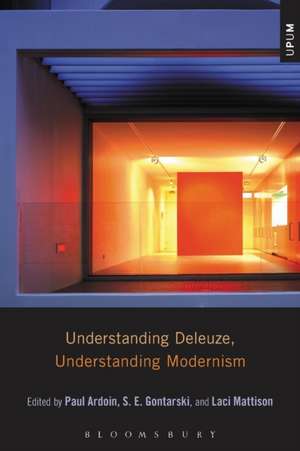
Understanding Deleuze, Understanding Modernism: Understanding Philosophy, Understanding Modernism
Editat de Paul Ardoin, Professor S. E. Gontarski, Dr. Laci Mattisonen Limba Engleză Paperback – 24 mar 2016
Gilles Deleuze himself rethought philosophical history with a series of books and essays on individual philosophers such as Kant, Spinoza, Leibniz, Nietzsche, and Bergson and authors such as Proust, Kafka, Beckett and Woolf, on the one hand, and Bacon, Messiaen, and Pollock, among others, in other arts. This volume acknowledges Deleuze's profound impact on a century of art and thought and the origin of that impact in his own understanding of modernism.
Understanding Deleuze, Understanding Modernism begins by "conceptualizing" Deleuze by offering close readings of some of his most important works. The contributors offer new readings that illuminate the context of Deleuze's work, either by reading one of Deleuze's texts against or in the context of his entire body of work or by challenging Deleuze's readings of other philosophers. A central section on Deleuze and his aesthetics maps the relationships between Deleuze's thought and modernist literature. The volume's final section features an extended glossary of Deleuze's key terms, with each definition having its own expert contributor.
Din seria Understanding Philosophy, Understanding Modernism
- 26%
 Preț: 244.70 lei
 - 24%
 Preț: 280.66 lei
 - 14%
 Preț: 265.87 lei
 - 16%
 Preț: 257.34 lei
 - 33%
 Preț: 900.92 lei
 - 24%
 Preț: 264.93 lei
 - 24%
 Preț: 251.81 lei
 - 24%
 Preț: 245.61 lei
 - 23%
 Preț: 266.26 lei
 - 25%
 Preț: 255.68 lei
 - 26%
 Preț: 214.91 lei
 - 42%
 Preț: 512.96 lei
 - 26%
 Preț: 214.50 lei
 - 22%
 Preț: 223.30 lei
 - 35%
 Preț: 630.72 lei
 -
 Preț: 211.00 lei
 - 28%
 Preț: 208.04 lei
 - 28%
 Preț: 208.89 lei
 - 36%
 Preț: 615.95 lei
 - 33%
 Preț: 582.43 lei
 - 26%
 Preț: 200.26 lei
 - 25%
 Preț: 214.32 lei
 - 32%
 Preț: 597.75 lei
 - 32%
 Preț: 584.10 lei
 - nou
 Preț: 592.57 lei
 - nou
 Preț: 214.33 lei
Preț: 279.08 lei
Preț vechi: 330.11 lei
-15%
Puncte Express: 419
Carte tipărită la comandă
Livrare economică 04-18 decembrie
Livrare prin curier în România Termenul estimat este afișat lângă disponibilitate.
Transport gratuit de la 400.00 lei Plată online sau ramburs, în funcție de opțiunile comenzii.
Retur gratuit în 14 zile Comandă securizată și suport în română.
Specificații
ISBN-13: 9781501325038
ISBN-10: 1501325035
Pagini: 300
Dimensiuni: 150 x 226 x 20 mm
Greutate: 0.4 kg
Ediția:NIPPOD
Editura: Bloomsbury Publishing
Colecția Bloomsbury Academic
Seria Understanding Philosophy, Understanding Modernism
Locul publicării:New York, United States
ISBN-10: 1501325035
Pagini: 300
Dimensiuni: 150 x 226 x 20 mm
Greutate: 0.4 kg
Ediția:NIPPOD
Editura: Bloomsbury Publishing
Colecția Bloomsbury Academic
Seria Understanding Philosophy, Understanding Modernism
Locul publicării:New York, United States
V-ar putea interesa
-
 Selected DiariesVirginia Woolf-17%Preț: 78.63 lei95.25 lei
 -
 Real Materialism: and Other EssaysGalen Strawson-12%Preț: 278.40 lei317.76 lei
 -
 Themes from G. E. Moore: New Essays in Epistemology and EthicsSusana Nuccetelli-30%Preț: 965.37 lei1380.36 lei
 -
 -11%Preț: 312.49 lei352.75 lei
 -
 Selected EssaysVirginia Woolf-18%Preț: 58.90 lei72.15 lei
 -
 Modernism and AfterJohn SmartPreț: 196.00 lei
 -
 Madness and CivilizationMichel FoucaultPreț: 110.80 lei
 -
 Margaret AtwoodMarion Wynne-DaviesPreț: 251.89 lei
 -
 Carol Ann DuffyDeryn Rees-JonesPreț: 195.42 lei
 -
 Adorno: A Guide for the PerplexedDr Alex Thomson-25%Preț: 1021.32 lei1356.18 lei
 -
 The Lost Thread: The Democracy of Modern FictionSteven Corcoran-20%Preț: 160.41 lei201.07 lei
 -
 Preț: 132.27 lei
 -
 R. G. Collingwood: A Research CompanionProfessor James Connelly-33%Preț: 1026.68 lei1527.78 lei
 -
 The Comedian as Critic: Greek Old Comedy and PoeticsDr Matthew Wright-25%Preț: 278.06 lei369.55 lei
 -
 Living CurrencyPierre Klossowski-45%Preț: 99.10 lei179.78 lei
 -
 Heidegger and the Place of EthicsDr Michael Lewis-16%Preț: 277.29 lei329.16 lei
 -
 George Orwell and ReligionProfessor Michael G. Brennan-25%Preț: 197.75 lei264.00 lei
 -
 -34%Preț: 220.68 lei333.04 lei
 -
 Ovid Heroides: A SelectionDr John GodwinPreț: 120.76 lei
 -
 Tacitus Annals I: A SelectionKatharine Radice-21%Preț: 135.81 lei172.07 lei
 -
 Virgil Aeneid X: A SelectionChristopher Tanfield-22%Preț: 108.92 lei139.84 lei
 -
 Cicero Pro Milone: A SelectionRobert West-23%Preț: 138.02 lei179.45 lei
 -
 Virgil Aeneid VIII: A SelectionDr Keith Maclennan-17%Preț: 108.76 lei131.14 lei
 -
 Shakespeare's Plants and Gardens: A DictionaryVivian ThomasPreț: 298.92 lei
 -
 Topophobia: A Phenomenology of AnxietyDylan Trigg-16%Preț: 198.25 lei236.23 lei
 -
 Gather Together In My NameDr Maya Angelou-27%Preț: 51.40 lei70.54 lei
Cuprins
Abbreviations
Contributors
Series Preface, Understanding Philosophy, Understanding Modernism
S. E. Gontarski, Paul Ardoin, and Laci Mattison
Introduction, Gilles Deleuze and the Staging of Philosophy
S. E. Gontarski, Florida State University, USA; Paul Ardoin, Florida State University, USA, and University of Antwerp, Belgium; and Laci Mattison, Florida State University, USA
Part 1 Conceptualizing Deleuze
1 Deleuze's Proust and Signs: The Literary Partial Object
Patrick M. Bray, Ohio State University, USA
2 Life as Method: The Invention of Problems in Deleuze's Bergsonism
Wahida Khandker, Manchester Metropolitan University, UK
3 Diagrammatic Modernism: Abstraction, Immanence, and the Positions of Style
Joe Hughes, University of Melbourne, Australia
4 Reading Anti-Oedipus: Literature, Schizophrenia, and Universal History
Aidan Tynan, Cardiff University, UK
5 On the Flyleaves of Modernism: Deleuze and Guattari's Kafka
Jason Skeet, Cardiff University, UK
6 Intensive Multiplicities in A Thousand Plateaus
Audrone Zukauskaite, Lithuanian Culture Research Institute and Vilnius University, Lithuania
7 The Movement-Image, The Time-Image, and the Paradoxes of Literary and Other
Modernisms
Garin Dowd, University of West London, UK
8 What Is Philosophy?, or Eternal Return
S. E. Gontarski, Florida State University, USA
9 Essays Critical and Clinical: The Book as a 'Whole'
Anthony Uhlmann, University of Western Sydney, Australia
Part 2 Deleuze and Aesthetics
10 "A strange respect for the individual": Gilles Deleuze and Hardy the Novelist
John Hughes, University of Gloucestershire, UK
11 Entangled in Nature: Deleuze's Modernism, Woolf's Philosophy, and Spinoza's
Ethology
Derek Ryan, University of Kent, UK
12 Dancing with Deleuze: Modernism and the Imperceptible Animal
Carrie Rohman, Lafayette College, USA
13 Henry Miller and Deleuze's "Strange Anglo-American Literature"
Andrew Marzoni, University of Minnesota, UK
14 Schizoanalytic Modernism: The Case of Antonin Artaud
Ian Buchanan, University of Wollongong, Australia
15 Deleuze's Perspectival Theory of Modernism and the Baroque
Christopher Langlois, University of Western Ontario, Toronto
16 Incorporeal Modernism
Claire Colebrook, Penn State University, USA
Part 3 Glossary
17 Abstract Machine
Aden L. Evens, Dartmouth College, USA
18 Affect
Mickey Vallee, University of Lethbridge, Canada
19 Assemblage
Justin Litaker, Purdue University, USA
20 Becoming
Jason Skeet, Cardiff University, UK
21 Body Without Organs
Ian Buchanan, University of Wollongong, Australia
22 Desire
Marco Altamirano, Louisiana State University, USA
23 Deterritorialization
John Mac Kilgore, Florida State University, USA
24 Memory
Nadine Boljkovac, Brown University, USA
25 Minor Literature
Christopher Langlois, University of Western Ontario, Canada
26 Plane of Immanence
Jon K. Shaw, Goldsmiths College, UK
27 Rhizome
Eugene W. Holland, Ohio State University, USA
28 Schizoanalysis
Anna Powell, Manchester Metropolitan University, UK
29 Stuttering
Mickey Vallee, University of Lethbridge, Canada
30 Time-Image
Nadine Boljkovac, Brown University, USA
Index
Contributors
Series Preface, Understanding Philosophy, Understanding Modernism
S. E. Gontarski, Paul Ardoin, and Laci Mattison
Introduction, Gilles Deleuze and the Staging of Philosophy
S. E. Gontarski, Florida State University, USA; Paul Ardoin, Florida State University, USA, and University of Antwerp, Belgium; and Laci Mattison, Florida State University, USA
Part 1 Conceptualizing Deleuze
1 Deleuze's Proust and Signs: The Literary Partial Object
Patrick M. Bray, Ohio State University, USA
2 Life as Method: The Invention of Problems in Deleuze's Bergsonism
Wahida Khandker, Manchester Metropolitan University, UK
3 Diagrammatic Modernism: Abstraction, Immanence, and the Positions of Style
Joe Hughes, University of Melbourne, Australia
4 Reading Anti-Oedipus: Literature, Schizophrenia, and Universal History
Aidan Tynan, Cardiff University, UK
5 On the Flyleaves of Modernism: Deleuze and Guattari's Kafka
Jason Skeet, Cardiff University, UK
6 Intensive Multiplicities in A Thousand Plateaus
Audrone Zukauskaite, Lithuanian Culture Research Institute and Vilnius University, Lithuania
7 The Movement-Image, The Time-Image, and the Paradoxes of Literary and Other
Modernisms
Garin Dowd, University of West London, UK
8 What Is Philosophy?, or Eternal Return
S. E. Gontarski, Florida State University, USA
9 Essays Critical and Clinical: The Book as a 'Whole'
Anthony Uhlmann, University of Western Sydney, Australia
Part 2 Deleuze and Aesthetics
10 "A strange respect for the individual": Gilles Deleuze and Hardy the Novelist
John Hughes, University of Gloucestershire, UK
11 Entangled in Nature: Deleuze's Modernism, Woolf's Philosophy, and Spinoza's
Ethology
Derek Ryan, University of Kent, UK
12 Dancing with Deleuze: Modernism and the Imperceptible Animal
Carrie Rohman, Lafayette College, USA
13 Henry Miller and Deleuze's "Strange Anglo-American Literature"
Andrew Marzoni, University of Minnesota, UK
14 Schizoanalytic Modernism: The Case of Antonin Artaud
Ian Buchanan, University of Wollongong, Australia
15 Deleuze's Perspectival Theory of Modernism and the Baroque
Christopher Langlois, University of Western Ontario, Toronto
16 Incorporeal Modernism
Claire Colebrook, Penn State University, USA
Part 3 Glossary
17 Abstract Machine
Aden L. Evens, Dartmouth College, USA
18 Affect
Mickey Vallee, University of Lethbridge, Canada
19 Assemblage
Justin Litaker, Purdue University, USA
20 Becoming
Jason Skeet, Cardiff University, UK
21 Body Without Organs
Ian Buchanan, University of Wollongong, Australia
22 Desire
Marco Altamirano, Louisiana State University, USA
23 Deterritorialization
John Mac Kilgore, Florida State University, USA
24 Memory
Nadine Boljkovac, Brown University, USA
25 Minor Literature
Christopher Langlois, University of Western Ontario, Canada
26 Plane of Immanence
Jon K. Shaw, Goldsmiths College, UK
27 Rhizome
Eugene W. Holland, Ohio State University, USA
28 Schizoanalysis
Anna Powell, Manchester Metropolitan University, UK
29 Stuttering
Mickey Vallee, University of Lethbridge, Canada
30 Time-Image
Nadine Boljkovac, Brown University, USA
Index
Recenzii
Understanding Deleuze, Understanding Modernism is a significant moment in the ongoing exploration of the relationship between Deleuze and modernism ... Although each essay focuses on a different aspect of Deleuze's philosophy and of modernist tendencies, there are overlappings and recurring themes in them, and together they offer a coherent, yet diverse image for the reader, a thorough and compelling critical engagement with Deleuze's modernism.
I love using Deleuze, even when I do not follow him systematically. I admire the infinite productivity of his concepts, the generosity of his culture and the intelligence of his readings, all of which are magnified by this compendium with its sharp definitions, astute contextualizations and a comprehensive glossary. It has already become invaluable for me. I can recommend it to readers interested in the interfaces between literature, philosophy, art and politics. The full power of Deleuze's mind shines here splendidly.
[This] is a wonderfully accessible guide to the texts and the issues involved. The introductions to Deleuze's major works, essays on his relation to key modernist writers, and dictionary style entries on key concepts make this an exceptionally useful resource. This book enlarges our understanding of modernism as well as our understanding of Deleuze.
The immediate usefulness of this series is in the editors' tripartite structure of close reading, contextualization, and key concepts from the philosophies of modernism. The second volume on the philosophy of Deleuze collates an exceptional range of scholars on Deleuze and/or Modernism, maintaining a nice balance between well heeled names and brilliant new voices.
Combining contributions from important established and emerging scholars, this carefully structured volume will no doubt prove a valuable interdisciplinary resource for Deleuzian initiates and newcomers alike. As well as demonstrating the import of Deleuze's philosophy for understanding the concept of modernism and modernist works, the strength of this book lies in its emphasis on the extent to which Deleuze's thought was formed by his encounters with key modernist figures from Proust and Bergson to Beckett and Woolf.
If you want to learn from some of the deepest and most original work on Deleuze, Guattari and literature available today, this is the book for you. If you are currently doing advanced research on Deleuze, Guattari and literature, this collection will be a valuable resource for studies and positions in relation to which your thesis should be critically situated. This collection is a long and rewarding set of essays on the different ways in which modernist works and the philosophy of Deleuze and Guattari can add to the resources for thinking through a condition that has now become post-human. It is not possible to do justice to each essay or to the excellent and very helpful glossary entries at the end of the book.
I love using Deleuze, even when I do not follow him systematically. I admire the infinite productivity of his concepts, the generosity of his culture and the intelligence of his readings, all of which are magnified by this compendium with its sharp definitions, astute contextualizations and a comprehensive glossary. It has already become invaluable for me. I can recommend it to readers interested in the interfaces between literature, philosophy, art and politics. The full power of Deleuze's mind shines here splendidly.
[This] is a wonderfully accessible guide to the texts and the issues involved. The introductions to Deleuze's major works, essays on his relation to key modernist writers, and dictionary style entries on key concepts make this an exceptionally useful resource. This book enlarges our understanding of modernism as well as our understanding of Deleuze.
The immediate usefulness of this series is in the editors' tripartite structure of close reading, contextualization, and key concepts from the philosophies of modernism. The second volume on the philosophy of Deleuze collates an exceptional range of scholars on Deleuze and/or Modernism, maintaining a nice balance between well heeled names and brilliant new voices.
Combining contributions from important established and emerging scholars, this carefully structured volume will no doubt prove a valuable interdisciplinary resource for Deleuzian initiates and newcomers alike. As well as demonstrating the import of Deleuze's philosophy for understanding the concept of modernism and modernist works, the strength of this book lies in its emphasis on the extent to which Deleuze's thought was formed by his encounters with key modernist figures from Proust and Bergson to Beckett and Woolf.
If you want to learn from some of the deepest and most original work on Deleuze, Guattari and literature available today, this is the book for you. If you are currently doing advanced research on Deleuze, Guattari and literature, this collection will be a valuable resource for studies and positions in relation to which your thesis should be critically situated. This collection is a long and rewarding set of essays on the different ways in which modernist works and the philosophy of Deleuze and Guattari can add to the resources for thinking through a condition that has now become post-human. It is not possible to do justice to each essay or to the excellent and very helpful glossary entries at the end of the book.