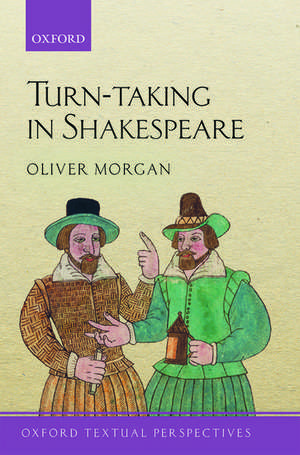
Turn-taking in Shakespeare: Oxford Textual Perspectives
Autor Oliver Morganen Limba Engleză Paperback – 21 aug 2019
Din seria Oxford Textual Perspectives
- 17%
 Preț: 198.05 lei
 - 16%
 Preț: 204.45 lei
 - 17%
 Preț: 179.08 lei
 - 15%
 Preț: 185.18 lei
 - 17%
 Preț: 177.53 lei
 - 17%
 Preț: 177.57 lei
 - 17%
 Preț: 181.00 lei
 - 16%
 Preț: 143.99 lei
 - 15%
 Preț: 148.78 lei
 - 13%
 Preț: 294.52 lei
 - 15%
 Preț: 141.03 lei
 - 16%
 Preț: 139.89 lei
 - 18%
 Preț: 202.80 lei
 - 13%
 Preț: 286.36 lei
 - 14%
 Preț: 247.25 lei
 - 17%
 Preț: 211.28 lei
 - 18%
 Preț: 209.81 lei
 - 17%
 Preț: 198.68 lei
 - 16%
 Preț: 208.98 lei
 -
 Preț: 198.15 lei
 - 18%
 Preț: 139.52 lei
 - 15%
 Preț: 142.89 lei
 - 24%
 Preț: 608.35 lei
Preț: 207.60 lei
Puncte Express: 311
Carte disponibilă
Livrare economică 05-10 noiembrie
Livrare prin curier în România Termenul estimat este afișat lângă disponibilitate.
Transport gratuit de la 400.00 lei Plată online sau ramburs, în funcție de opțiunile comenzii.
Retur gratuit în 14 zile Comandă securizată și suport în română.
Specificații
ISBN-13: 9780198836360
ISBN-10: 0198836368
Pagini: 300
Ilustrații: 5 Illustrations
Dimensiuni: 134 x 202 x 15 mm
Greutate: 0.38 kg
Editura: OUP OXFORD
Colecția OUP Oxford
Seria Oxford Textual Perspectives
Locul publicării:Oxford, United Kingdom
ISBN-10: 0198836368
Pagini: 300
Ilustrații: 5 Illustrations
Dimensiuni: 134 x 202 x 15 mm
Greutate: 0.38 kg
Editura: OUP OXFORD
Colecția OUP Oxford
Seria Oxford Textual Perspectives
Locul publicării:Oxford, United Kingdom
V-ar putea interesa
-
 Faith in ShakespeareRichard C. McCoy-20%Preț: 240.87 lei299.34 lei
 -
 -16%Preț: 172.84 lei206.25 lei
 -
 -31%Preț: 1040.18 lei1515.92 lei
 -
 Shakespeare's Early History Plays: From Chronicle to StageDominique Goy-Blanquet-33%Preț: 1248.21 lei1859.55 lei
 -
 -12%Preț: 297.32 lei339.53 lei
 -
 Shakespeare and the Idea of the BookCharlotte Scott-31%Preț: 738.75 lei1075.13 lei
 -
 Shakespeare's NamesLaurie Maguire-21%Preț: 504.55 lei642.46 lei
 -
 Shakespeare and the Origins of EnglishNeil Rhodes-21%Preț: 377.94 lei481.07 lei
 -
 Defining Shakespeare: Pericles as Test CaseMacDonald P. Jackson-33%Preț: 1200.08 lei1788.11 lei
 -
 Passing Strange: Shakespeare, Race, and Contemporary AmericaAyanna Thompson-17%Preț: 302.35 lei363.59 lei
 -
 Naming Thy NameElaine ScarryPreț: 114.11 lei
 -
 Preț: 147.59 lei
 -
 How Science Proved Edward de Vere was William ShakespeareDavid L. RoperPreț: 160.28 lei
 -
 Preț: 103.93 lei
 -
 Preț: 81.45 lei
 -
 A Bone to Pick: Feasting on Shakespeare's RemainsSidney Wade StoutPreț: 81.81 lei
 -
 Angel Day, the English Secretary, and the Seventeenth Earl of OxfordRobert Sean BrazilPreț: 119.26 lei
 -
 Preț: 60.26 lei
 -
 Shakespeare ConfidentialBerney, C. V.Preț: 111.40 lei
 -
 L'Affaire ShakespeareJacques BoulengerPreț: 56.18 lei
 -
 Shakespeare IdentifiedJ. Thomas LooneyPreț: 180.32 lei
 -
 Who Cares?: The Great British Health DebateGareth Mallon-5%Preț: 403.11 lei424.32 lei
 -
 Preț: 130.68 lei
 -
 Preț: 121.07 lei
 -
 Unreading ShakespeareDavid P. GontarPreț: 226.56 lei
Recenzii
This book was a joy to read because of the many colourful twists and turns of its critical language, because the author is a meticulous and imaginative close reader, and because the argument offers a very good model for stylistic micro-analysis as a mode in Shakespeare criticism. I hope that theatre practitioners, students in drama studio programs, and critics alike will find this book of use.
A galvanising new way of interpreting Renaissance plays. The mechanisms of dialogue - the sequencing of speakers, their interruptions, pauses, and failures to respond - open out new insights into character, dramaturgy, social relationships, and ideological structures. While the focus is on Shakespeare, and what Morgan stylishly argues is his brilliance in dialogue, the implications stretch to Renaissance drama more broadly.
Shakespeare has seldom been read with a combination of such tact and quantificatory precision ... Morgan's learning and ingenuity are considerable, and he shows beyond any shadow of a doubt that attentiveness to the conventions of conversational exchange (and to the occasions when these conventions are ignored) offers a fresh way of comprehending the plays.
A galvanising new way of interpreting Renaissance plays. The mechanisms of dialogue - the sequencing of speakers, their interruptions, pauses, and failures to respond - open out new insights into character, dramaturgy, social relationships, and ideological structures. While the focus is on Shakespeare, and what Morgan stylishly argues is his brilliance in dialogue, the implications stretch to Renaissance drama more broadly.
Shakespeare has seldom been read with a combination of such tact and quantificatory precision ... Morgan's learning and ingenuity are considerable, and he shows beyond any shadow of a doubt that attentiveness to the conventions of conversational exchange (and to the occasions when these conventions are ignored) offers a fresh way of comprehending the plays.
Notă biografică
Oliver Morgan is a Leverhulme Early Career Fellow at the University of Cambridge and a College Lecturer at Magdalene College. His research focuses on dialogue, both in the sense of fictionalised conversation (as in a play) and in the sense of literary exchange (as in an answer-poem or aparody).
Cuprins
- Introduction
- Part One: Sequence
- 1: Speaking when you're spoken to
- 2: Figures of dialogue
- 3: Apostrophising the king
- 4: Taking asides
- Part Two: Timing
- 5: Have I finished?
- 6: Aposiopesis and the comforts of rhetoric
- 7: The terminal comma
- 8: The play of line and turn
- Conclusion