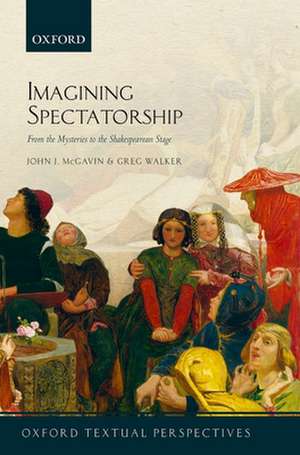
Imagining Spectatorship: From the Mysteries to the Shakespearean Stage: Oxford Textual Perspectives
Autor John J. McGavin, Greg Walkeren Limba Engleză Paperback – 21 apr 2016
Din seria Oxford Textual Perspectives
- 16%
 Preț: 204.45 lei
 - 17%
 Preț: 179.08 lei
 - 15%
 Preț: 185.18 lei
 - 17%
 Preț: 177.53 lei
 - 16%
 Preț: 181.93 lei
 - 16%
 Preț: 182.46 lei
 - 16%
 Preț: 143.99 lei
 - 15%
 Preț: 148.78 lei
 - 13%
 Preț: 294.52 lei
 - 15%
 Preț: 141.03 lei
 - 16%
 Preț: 139.97 lei
 - 18%
 Preț: 202.80 lei
 - 13%
 Preț: 286.36 lei
 - 14%
 Preț: 247.25 lei
 - 17%
 Preț: 211.28 lei
 - 18%
 Preț: 209.81 lei
 -
 Preț: 207.60 lei
 - 16%
 Preț: 203.32 lei
 - 16%
 Preț: 208.98 lei
 -
 Preț: 198.15 lei
 - 18%
 Preț: 139.52 lei
 - 15%
 Preț: 142.97 lei
 - 24%
 Preț: 608.35 lei
Preț: 198.05 lei
Preț vechi: 239.07 lei
-17%
Puncte Express: 297
Carte disponibilă
Livrare economică 13-18 noiembrie
Livrare prin curier în România Termenul estimat este afișat lângă disponibilitate.
Transport gratuit de la 400.00 lei Plată online sau ramburs, în funcție de opțiunile comenzii.
Retur gratuit în 14 zile Comandă securizată și suport în română.
Specificații
ISBN-13: 9780198768623
ISBN-10: 0198768621
Pagini: 224
Dimensiuni: 137 x 203 x 12 mm
Greutate: 0.25 kg
Editura: OUP OXFORD
Colecția OUP Oxford
Seria Oxford Textual Perspectives
Locul publicării:Oxford, United Kingdom
ISBN-10: 0198768621
Pagini: 224
Dimensiuni: 137 x 203 x 12 mm
Greutate: 0.25 kg
Editura: OUP OXFORD
Colecția OUP Oxford
Seria Oxford Textual Perspectives
Locul publicării:Oxford, United Kingdom
V-ar putea interesa
-
 The Classical Roman Reader: New Encounters with Ancient RomeKenneth J. AtchityPreț: 194.07 lei
 -
 Latin Word Order: Structured Meaning and InformationA. M. Devine-33%Preț: 940.43 lei1396.04 lei
 -
 The Oxford Anthology of Roman LiteraturePeter E. Knox-9%Preț: 406.63 lei446.93 lei
 -
 Sweet's Anglo-Saxon Reader in Prose and VerseHenry Sweet-18%Preț: 362.57 lei440.45 lei
 -
 The Second SophisticTim WhitmarshPreț: 227.66 lei
 -
 The Oxford Handbook of Tudor DramaThomas Betteridge-19%Preț: 318.97 lei395.07 lei
 -
 The Oxford Anthology of Tudor DramaGreg Walker-10%Preț: 381.40 lei425.11 lei
 -
 The Oxford Handbook of Medieval Literature in EnglishElaine Treharne-19%Preț: 316.37 lei390.51 lei
 -
 -31%Preț: 934.53 lei1356.79 lei
 -
 -20%Preț: 408.15 lei512.54 lei
 -
 -30%Preț: 490.52 lei695.98 lei
 -
 A Commentary on Horace: Odes Book IIIR. G. M. Nisbet-33%Preț: 1959.13 lei2925.32 lei
 -
 -28%Preț: 456.81 lei634.18 lei
 -
 -31%Preț: 707.55 lei1032.90 lei
 -
 -31%Preț: 727.03 lei1054.51 lei
 -
 -14%Preț: 660.59 lei768.13 lei
 -
 Hysterical Laughter: Four Ancient Comedies About WomenDavid Christenson-21%Preț: 299.27 lei378.80 lei
 -
 -34%Preț: 659.96 lei1005.82 lei
 -
 Ethics, Identity, and Community in Later Roman DeclamationNeil W. Bernstein-35%Preț: 626.06 lei960.03 lei
 -
 Preț: 274.31 lei
 -
 Plays of PersuasionGreg WalkerPreț: 338.12 lei
 -
 A Handbook to the Reception of Greek DramaBetine van Zyl Smit-23%Preț: 1182.97 lei1536.33 lei
 -
 Chaucer the AlchemistAlexander N Gabrovsky-18%Preț: 812.40 lei990.73 lei
 -
 Ovid on Cosmetics: Medicamina Faciei Femineae and Related TextsMarguerite Johnson-25%Preț: 192.15 lei256.52 lei
Recenzii
In sum, I recommend this volume ... For comparison, readers should consult more recent embodied cognitive scholarship, especially from scholars of early modern Hispanic literatures.
Imagining Spectatorship amounts to an innovative contribution to the scholarship on medieval and early modern theatrics. McGavin's and Walker's use of cognitive science within a broader framework of cultural, historical, and spatial theoretical methodologies allows us to gain further insight into a particular historical experience that has largely been inaccessible up until now.
Imagining Spectatorship amounts to an innovative contribution to the scholarship on medieval and early modern theatrics. McGavin's and Walker's use of cognitive science within a broader framework of cultural, historical, and spatial theoretical methodologies allows us to gain further insight into a particular historical experience that has largely been inaccessible up until now.
Notă biografică
Educated at the University of Edinburgh, John McGavin has spent his whole career in the University of Southampton, where he was recently appointed Emeritus Professor. He is a Fellow of the English Association, and is currently chair of the Executive Board of Records of Early English Drama, for which he is preparing a volume on South-East Scotland. He project-managed creation of the Early Modern London Theatres (EMLoT) database. He is a member of the English Association, the Southampton Centre for Medieval and Renaissance Culture, Medieval English Theatre, and the Scottish Text Society, and has held research fellowships in the universities of Edinburgh and Glasgow.Greg Walker is Regius Professor of Rhetoric and English Literature at the University of Edinburgh. Prior to that he was Professor of early-modern literature and culture at the University of Leicester. He has written extensively on the drama, poetry, and prose, and the political and religious history of the late medieval period and the sixteenth century in England and Scotland. He has edited the Oxford Anthology of Tudor Drama, and, is co-editor with Thomas Betteridge of The Oxford Handbook of Tudor Drama, and with Elaine Treharne of The Oxford Handbook of Medieval Literature in English.