
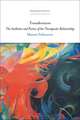
Transferences: The Aesthetics and Poetics of the Therapeutic Relationship: Psychoanalytic Horizons
Autor Dr. Maren Scheureren Limba Engleză Hardback – 3 oct 2019
Transferences argues that psychoanalysts as well as writers and other artists are fascinated by the therapeutic relationship because it provides a unique site to negotiate the narrative and artistic underpinnings of psychoanalysis and reflect and reinvent the aesthetic and poetic potentiality of art.
Din seria Psychoanalytic Horizons
- 11%
 Preț: 159.88 lei
 - 15%
 Preț: 149.39 lei
 - 26%
 Preț: 130.87 lei
 - nou
 Preț: 166.46 lei
 - 17%
 Preț: 157.73 lei
 - 16%
 Preț: 171.71 lei
 - 74%
 Preț: 131.66 lei
 - 33%
 Preț: 107.03 lei
 - 25%
 Preț: 245.62 lei
 - 25%
 Preț: 207.73 lei
 - 14%
 Preț: 134.00 lei
 - 25%
 Preț: 244.93 lei
 - 20%
 Preț: 162.39 lei
 - 20%
 Preț: 164.50 lei
 - 15%
 Preț: 165.88 lei
 - 26%
 Preț: 210.56 lei
 - 11%
 Preț: 426.10 lei
 - 40%
 Preț: 211.06 lei
 - 25%
 Preț: 242.31 lei
 - 24%
 Preț: 234.30 lei
 - 7%
 Preț: 168.83 lei
 - 23%
 Preț: 236.74 lei
 - 26%
 Preț: 206.09 lei
 - 24%
 Preț: 250.57 lei
 - 33%
 Preț: 580.87 lei
 - 26%
 Preț: 210.58 lei
 - 26%
 Preț: 214.41 lei
 - 24%
 Preț: 234.41 lei
Preț: 796.03 lei
Preț vechi: 1168.44 lei
-32%
Puncte Express: 1194
Carte tipărită la comandă
Livrare economică 07-21 decembrie
Livrare prin curier în România Termenul estimat este afișat lângă disponibilitate.
Transport gratuit pentru acest produs Plată online sau ramburs, în funcție de opțiunile comenzii.
Retur gratuit în 14 zile Comandă securizată și suport în română.
Specificații
ISBN-13: 9781501352447
ISBN-10: 150135244X
Pagini: 336
Dimensiuni: 140 x 216 mm
Greutate: 0.52 kg
Editura: Bloomsbury Publishing
Colecția Bloomsbury Academic
Seria Psychoanalytic Horizons
Locul publicării:New York, United States
ISBN-10: 150135244X
Pagini: 336
Dimensiuni: 140 x 216 mm
Greutate: 0.52 kg
Editura: Bloomsbury Publishing
Colecția Bloomsbury Academic
Seria Psychoanalytic Horizons
Locul publicării:New York, United States
Cuprins
Acknowledgments
Part I. Introduction
1 Psychoanalysis and the Arts
2 The Therapeutic Relationship
Part II. Discourses in Dialogue: The Aesthetics and Poetics of Therapeutic Relationships
3 The Art of the Therapeutic Relationship: Psychoanalytic Aesthetics
4 Art as (Therapeutic) Relationship: Relational Models of Creativity, Reading, and Interpretation
Part III. Reading Relationships: Therapy in Literature, Theater, and Television
5 "I'm Telling Everything": Psychoanalytic Gameply in Philip Roth's Portnoy's Complaint
6 "A Gap, a Hole, a Darkness": Epistemic Desire in J. M. Coetzee's Life & Times of Michael K
7 "To Keep the Sultan Amused": Scheherazadian Narration in Margaret Atwood's Alias Grace
8 "Act It Out, If You Like": Anti- and Stage-Psychiatry in Peter Shaffer's Equus
9 "Locked in a Room, Listening": Talk-Show Therapy and Co-Construction in In Treatment
Part IV. In Conclusion
Works Cited
Notes
Index
Part I. Introduction
1 Psychoanalysis and the Arts
2 The Therapeutic Relationship
Part II. Discourses in Dialogue: The Aesthetics and Poetics of Therapeutic Relationships
3 The Art of the Therapeutic Relationship: Psychoanalytic Aesthetics
4 Art as (Therapeutic) Relationship: Relational Models of Creativity, Reading, and Interpretation
Part III. Reading Relationships: Therapy in Literature, Theater, and Television
5 "I'm Telling Everything": Psychoanalytic Gameply in Philip Roth's Portnoy's Complaint
6 "A Gap, a Hole, a Darkness": Epistemic Desire in J. M. Coetzee's Life & Times of Michael K
7 "To Keep the Sultan Amused": Scheherazadian Narration in Margaret Atwood's Alias Grace
8 "Act It Out, If You Like": Anti- and Stage-Psychiatry in Peter Shaffer's Equus
9 "Locked in a Room, Listening": Talk-Show Therapy and Co-Construction in In Treatment
Part IV. In Conclusion
Works Cited
Notes
Index
Recenzii
Maren Scheurer has written a fascinating study of the central role of transference in the complex interactions among psychoanalysis, literature, theater, and television. She succeeds admirably in her analysis of literary and filmic representations of psychoanalysis. She writes authoritatively, yet she is never authoritarian or dogmatic. Transference is a pioneering study of the relationship between psychoanalysis and the arts.
Maren Scheurer holds the theoretical, poetic, and emotional in a marvelously creative tension in this ambitious, engaging, and wide-ranging study. The central psychoanalytic concept of 'transference' is opened up to reveal the many potential transformations (and 'transferences') through and across the arts and psychoanalysis as therapeutic practice. Scheurer encourages us to think about creativity, and its crises, the anxiety of interpretation, and also of critique; above all, to enjoy the (as yet unknown) possibilities offered by relational dynamics. As the character Gina, from the TV series In Treatment, says: 'you can't observe yourself through your own binoculars.' The study will be of interest to academic researchers and clinical practitioners; but also, I think, to anyone interested in human relations, stories, and storytelling.
The comparisons and contrasts that Scheurer draws between psychoanalysis and literary, theatrical, film, and television art are extensive, penetrating, and insightful. One distinctive feature of this book is the painstaking and fascinating detail the author brings to the task of showing how psychoanalysis and the above-mentioned art (which she refers to as the humanities) illuminate each other, creating a synergetic 'third' between them that furthers the legitimacy of each while reinstating the irreplaceable importance of subjective narratives. I would expect this book to excite the interests of literary and film scholars, students and critics as well as psychoanalysts, psychotherapists and professors of psychology, as it delineates several intriguing perspectives around 'story telling' and narration in general.
Maren Scheurer holds the theoretical, poetic, and emotional in a marvelously creative tension in this ambitious, engaging, and wide-ranging study. The central psychoanalytic concept of 'transference' is opened up to reveal the many potential transformations (and 'transferences') through and across the arts and psychoanalysis as therapeutic practice. Scheurer encourages us to think about creativity, and its crises, the anxiety of interpretation, and also of critique; above all, to enjoy the (as yet unknown) possibilities offered by relational dynamics. As the character Gina, from the TV series In Treatment, says: 'you can't observe yourself through your own binoculars.' The study will be of interest to academic researchers and clinical practitioners; but also, I think, to anyone interested in human relations, stories, and storytelling.
The comparisons and contrasts that Scheurer draws between psychoanalysis and literary, theatrical, film, and television art are extensive, penetrating, and insightful. One distinctive feature of this book is the painstaking and fascinating detail the author brings to the task of showing how psychoanalysis and the above-mentioned art (which she refers to as the humanities) illuminate each other, creating a synergetic 'third' between them that furthers the legitimacy of each while reinstating the irreplaceable importance of subjective narratives. I would expect this book to excite the interests of literary and film scholars, students and critics as well as psychoanalysts, psychotherapists and professors of psychology, as it delineates several intriguing perspectives around 'story telling' and narration in general.