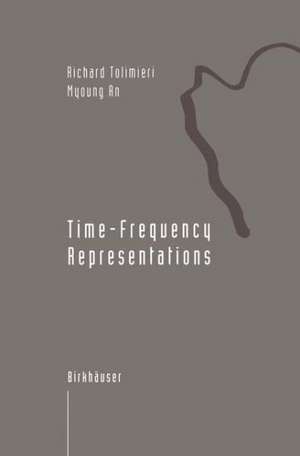
Time-Frequency Representations: Applied and Numerical Harmonic Analysis
Autor Richard Tolimieri, Myoung Anen Limba Engleză Hardback – 18 dec 1997
Din seria Applied and Numerical Harmonic Analysis
-
 Preț: 412.83 lei
 -
 Preț: 422.34 lei
 - 15%
 Preț: 687.12 lei
 - 15%
 Preț: 648.10 lei
 - 15%
 Preț: 670.35 lei
 - 15%
 Preț: 678.37 lei
 -
 Preț: 425.06 lei
 - 17%
 Preț: 490.75 lei
 -
 Preț: 394.98 lei
 -
 Preț: 417.98 lei
 - 15%
 Preț: 668.72 lei
 - 15%
 Preț: 679.46 lei
 - 18%
 Preț: 693.76 lei
 - 15%
 Preț: 680.36 lei
 - 15%
 Preț: 669.27 lei
 - 24%
 Preț: 646.32 lei
 - 32%
 Preț: 589.01 lei
 -
 Preț: 376.97 lei
 - 15%
 Preț: 525.30 lei
 - 15%
 Preț: 672.01 lei
 -
 Preț: 390.25 lei
 - 21%
 Preț: 583.02 lei
 -
 Preț: 424.20 lei
 -
 Preț: 407.65 lei
 - 24%
 Preț: 594.27 lei
 -
 Preț: 411.45 lei
 -
 Preț: 390.01 lei
 - 5%
 Preț: 1174.50 lei
 - 24%
 Preț: 597.60 lei
 -
 Preț: 401.66 lei
 - 18%
 Preț: 1147.27 lei
 - 18%
 Preț: 991.26 lei
 -
 Preț: 403.77 lei
 - 15%
 Preț: 609.75 lei
 -
 Preț: 393.95 lei
 - 18%
 Preț: 1165.29 lei
 - 18%
 Preț: 1014.41 lei
 - 15%
 Preț: 571.61 lei
 - 15%
 Preț: 555.16 lei
 - 15%
 Preț: 680.81 lei
 - 24%
 Preț: 934.46 lei
Preț: 649.75 lei
Preț vechi: 764.41 lei
-15%
Puncte Express: 975
Carte tipărită la comandă
Livrare economică 28 noiembrie-12 decembrie
Livrare prin curier în România Termenul estimat este afișat lângă disponibilitate.
Transport gratuit pentru acest produs Plată online sau ramburs, în funcție de opțiunile comenzii.
Retur gratuit în 14 zile Comandă securizată și suport în română.
Specificații
ISBN-13: 9780817639181
ISBN-10: 0817639187
Pagini: 304
Ilustrații: XIV, 284 p.
Dimensiuni: 160 x 241 x 22 mm
Greutate: 0.62 kg
Ediția:1998
Editura: birkhäuser
Colecția Applied and Numerical Harmonic Analysis
Seria Applied and Numerical Harmonic Analysis
Locul publicării:Boston, MA, United States
ISBN-10: 0817639187
Pagini: 304
Ilustrații: XIV, 284 p.
Dimensiuni: 160 x 241 x 22 mm
Greutate: 0.62 kg
Ediția:1998
Editura: birkhäuser
Colecția Applied and Numerical Harmonic Analysis
Seria Applied and Numerical Harmonic Analysis
Locul publicării:Boston, MA, United States
V-ar putea interesa
-
 -40%Preț: 886.80 lei1474.59 lei
 -
 Play ActingLuke Dixon-22%Preț: 190.49 lei244.03 lei
 -
 Preț: 230.24 lei
 -
 Optimization by Vector Space MethodsDavid G. Luenberger-9%Preț: 983.19 lei1080.43 lei
 -
 Thermodynamic Tables in SI (Metric) UnitsR. W. HaywoodPreț: 408.37 lei
 -
 Self-Assembling SystemsLi-Tang Yan-23%Preț: 910.48 lei1182.44 lei
 -
 -27%Preț: 703.09 lei963.14 lei
 -
 Timber Designers Manual 3eOzelton-9%Preț: 709.66 lei779.84 lei
 -
 Preț: 339.16 lei
 -
 Making Simple AutomataRobert RacePreț: 100.20 lei
Public țintă
ResearchCuprins
1 Review of algebra.- 1.1 Introduction.- 1.2 Definitions and examples of groups.- 1.3 Subgroups, cosets, and quotients.- 1.4 Ideals.- 1.5 Mappings.- 1.6 Finitely generated abelian groups.- References.- 2 Linear algebra and abelian groups.- 2.1 Introduction.- 2.2 Vector space L(A).- 3 Fourier transform over A.- 3.1 Introduction.- 3.2 Character groups.- 3.3 Character formulas.- 3.4 Duality theory.- 3.5 Character group basis.- 3.6 Fourier transform.- 3.7 Shift and multiplication operators.- References.- Problems.- 4 Poisson summation formula.- 4.1 Introduction.- 4.2 Statement and proof.- 4.3 Fourier transform of periodic functions.- 4.4 Periodization-decimation operators.- References.- Problems.- 5 Zak transform.- 5.1 Introduction.- 5.2 Fourier analysis on A x A*.- 5.3 Zak transform.- 5.4 Functional equation.- 5.5 Fourier and Zak transform.- 5.6 Isometry.- 5.7 Algorithm for computing Zak transform.- References.- Problems.- 6 Weyl-Heisenberg systems.- 6.1 Introduction.- 6.2 Translates.- 6.3 W-H systems.- 6.4 Sampling rates.- 6.5 Divide-and-conquer.- References.- Problems.- 7 Zak transform and W-H systems.- 7.1 Introduction.- 7.2 Basic results.- 7.3 Fundamental formulas.- 7.4 Zak space characterization of W-H systems.- 7.5 Zero set characterization.- Problems.- 8 Algorithms for W-H systems.- 8.1 Introduction.- 8.2 Critical sampling algorithm.- 8.3 Integer over-sampling algorithm.- 8.4 General over-sampling algorithm.- References.- Problems.- 9 Orthogonal projection theorem.- 9.1 Introduction.- 9.2 Orthogonal projection algorithm.- 9.3 Iterative W-H coefficient set algorithm.- 10 Cross-ambiguity function.- 10.1 Introduction.- 10.2 Basic results.- 10.3 Direct algorithm.- 10.4 Critical sampling algorithm.- 10.5 Integer over-sampling algorithm.- 10.6 General divide-and-conquer algorithm.- References.- Problems.- 11 Ambiguity surfaces.- 11.1 Introduction.- 11.2 Fourier transform of ambiguity surfaces.- 11.3 Formulas D1 and D2.- References.- 12 Orthonormal W-H systems.- 12.1 Introduction.- 12.2 Orthonormal W-H systems.- References.- Problems.- 13 Duality.- 13.1 Introduction.- 13.2 Biorthogonal.- 13.3 Algorithms for computing biorthogonals.- References.- Problems.- 14 Frames.- 14.1 Introduction.- 14.2 Frame Operator.- 14.3 Frames.- 14.4 Frame biorthogonals.- 14.5 Operator interpretation.- 14.6 Tight frames.- References.- 15 Implementation.- 15.1 Introduction.- 15.2 Tensor product.- 15.3 Multidimensional arrays.- 15.4 Computing the Zak transform.- References.- Problems.- 16 Algebra of multirate structures.- 16.1 Introduction.- 16.2 Algebra.- 16.3 Exact sequences.- 16.4 Main theorem.- 16.5 Representatives mapping theorem.- 16.6 Integer matrices.- References.- Problems.- 17 Multirate structures.- 17.1 Introduction.- 17.2 Decimation operator.- 17.3 Polyphase representation.- 17.4 Integer rate bands.- 17.5 Reduction theorems.- 17.6 Decimators and expanders.- References.- 18 A Time-frequency search for stock market anomalies.- 18.1 Introduction.- 18.2 Time-frequency trees.- 18.3 Analysis of the log-differenced DJIA and S&P 500 data.- References.
Recenzii
"On the one side, the book seems to be dedicated to theory-interested specialists in the area of harmonic analysis, on the other side the last chapter shows that highly theoretical constructs can efficiently be used in modern applications." —Simulation News Europe
"[The book], devoted to the subject of time-frequency representation, shows that there are still many interesting and useful aspects of Gabor analysis, in particular, in the discrete setting." —Zentralblatt Math
"[The book], devoted to the subject of time-frequency representation, shows that there are still many interesting and useful aspects of Gabor analysis, in particular, in the discrete setting." —Zentralblatt Math