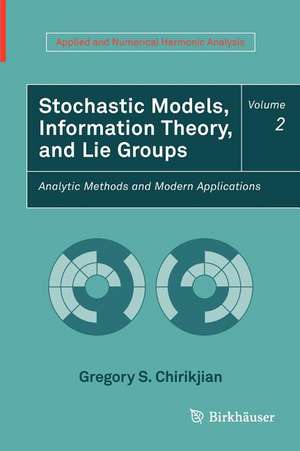
Stochastic Models, Information Theory, and Lie Groups, Volume 2: Applied and Numerical Harmonic Analysis
Autor Gregory S. Chirikjianen Limba Engleză Hardback – 15 noi 2011
Remarcăm relevanța academică imediată a volumului Stochastic Models, Information Theory, and Lie Groups, Volume 2 pentru programele de studii avansate în matematică aplicată, inginerie și științe fizice. Într-un peisaj editorial unde procesele stocastice și geometria diferențială sunt tratate adesea ca discipline izolate, această lucrare semnată de Gregory S. Chirikjian propune o sinteză rară, esențială pentru cercetarea modernă în robotică și procesarea semnalelor. Ediția de față, publicată de birkhäuser în seria Applied and Numerical Harmonic Analysis, transformă rigoarea teoretică în instrumente de modelare a fenomenelor fizice complexe.
Structura volumului reflectă o progresie logică de la fundament la aplicație. Primele capitole reiau și aprofundează proprietățile grupurilor Lie, integrarea și analiza Fourier, pentru ca ulterior să introducă mecanica statistică și teoria ergodică. Considerăm că punctul forte al acestei abordări este integrarea teoriei informației direct în cadrul geometric al grupurilor Lie, culminând cu studii de caz despre locomoție și percepție ca forme de comunicare peste pachete de fibre principale.
Cititorii familiarizați cu Geometric Theory of Information de Frank Nielsen vor aprecia modul în care acest volum trece dincolo de instrumentele geometrice pure, ancorând analiza informației în dinamica proceselor stocastice pe varietăți. Totodată, față de lucrarea sa anterioară, Engineering Applications of Noncommutative Harmonic Analysis, Gregory S. Chirikjian extinde aici cadrul de lucru de la analiza armonică spre o teorie unificată a propagării erorilor și analizei statistice multivariate. Este o tranziție de la aplicarea unei tehnici matematice specifice către un sistem complet de modelare probabilistică în spații neeuclidiene.
Din seria Applied and Numerical Harmonic Analysis
-
 Preț: 386.38 lei
 - 15%
 Preț: 635.01 lei
 - 15%
 Preț: 617.60 lei
 -
 Preț: 382.30 lei
 -
 Preț: 391.16 lei
 - 15%
 Preț: 622.70 lei
 - 15%
 Preț: 629.48 lei
 -
 Preț: 425.64 lei
 -
 Preț: 394.52 lei
 - 15%
 Preț: 624.00 lei
 - 15%
 Preț: 619.19 lei
 - 15%
 Preț: 623.70 lei
 - 15%
 Preț: 627.94 lei
 - 15%
 Preț: 628.73 lei
 - 24%
 Preț: 646.32 lei
 - 32%
 Preț: 565.17 lei
 -
 Preț: 376.97 lei
 - 15%
 Preț: 486.08 lei
 - 15%
 Preț: 627.06 lei
 -
 Preț: 390.25 lei
 -
 Preț: 393.17 lei
 - 21%
 Preț: 583.02 lei
 -
 Preț: 380.41 lei
 - 15%
 Preț: 513.45 lei
 - 15%
 Preț: 469.77 lei
 -
 Preț: 385.64 lei
 -
 Preț: 372.67 lei
 - 5%
 Preț: 1123.31 lei
 - 23%
 Preț: 573.34 lei
 -
 Preț: 382.87 lei
 - 18%
 Preț: 1021.88 lei
 - 18%
 Preț: 919.68 lei
 - 20%
 Preț: 323.22 lei
 - 15%
 Preț: 609.75 lei
 -
 Preț: 379.14 lei
 - 18%
 Preț: 1085.68 lei
 - 18%
 Preț: 966.54 lei
 - 15%
 Preț: 533.65 lei
 - 15%
 Preț: 629.14 lei
 - 24%
 Preț: 897.29 lei
Preț: 640.51 lei
Preț vechi: 753.55 lei
-15%
Carte tipărită la comandă
Livrare economică 06-20 iunie
Specificații
ISBN-10: 0817649433
Pagini: 464
Ilustrații: XXVII, 435 p.
Dimensiuni: 183 x 260 x 31 mm
Greutate: 1.06 kg
Ediția:1st Edition
Editura: birkhäuser
Colecția Applied and Numerical Harmonic Analysis
Seria Applied and Numerical Harmonic Analysis
Locul publicării:Boston, MA, United States
V-ar putea interesa
-
 Preț: 424.94 lei
 -
 -15%Preț: 521.51 lei613.54 lei
 -
 Lectures on Modular Forms. (AM–48), Volume 48Robert C. GunningPreț: 469.42 lei
 -
 Complex Analytic SetsE. M. Chirka-18%Preț: 904.99 lei1103.65 lei
 -
 Vector-Valued Functions and their ApplicationsChuang-Gan Hu-15%Preț: 615.97 lei724.67 lei
 -
 Stochastic Models, Information Theory, and Lie Groups, Volume 1Gregory S. Chirikjian-15%Preț: 580.90 lei683.40 lei
 -
 Classical Complex AnalysisLiang-Shin Hahn-27%Preț: 905.60 lei1240.55 lei
 -
 Complex Analysis and ApplicationsAlan Jeffrey-18%Preț: 903.88 lei1102.30 lei
 -
 Instabilities, Chaos and Turbulence (2nd Edition)Paul Manneville-18%Preț: 680.51 lei829.89 lei
 -
 Enhancing Assessments of Space Mission AssuranceBrien AlkirePreț: 262.03 lei
 -
 Preț: 298.04 lei
 -
 Computing the Zeros of Analytic FunctionsPeter KravanjaPreț: 216.63 lei
 -
 Sharp Real-Part TheoremsGershon KresinPreț: 259.37 lei
 -
 -18%Preț: 1188.09 lei1448.88 lei
 -
 Complex AnalysisMurali RaoPreț: 336.74 lei
Public țintă
GraduateDe ce să citești această carte
Recomandăm acest volum studenților de la nivel masterat și doctorat, precum și cercetătorilor care doresc să stăpânească intersecția dintre geometria diferențială și procesele stocastice. Veți câștiga o înțelegere profundă a modului în care simetria (grupurile Lie) și incertitudinea (stocastica) interacționează în sistemele fizice și robotice. Este un instrument fundamental pentru cei care dezvoltă algoritmi de navigare sau sisteme de comunicare complexe unde eroarea de propagare nu este liniară.
Cuprins
Textul de pe ultima copertă
Volume 1 establishes the geometric and statistical foundations required to understand the fundamentals of continuous-time stochastic processes, differential geometry, and the probabilistic foundations of information theory. Volume 2 delves deeper into relationships between these topics, including stochastic geometry, geometric aspects of the theory of communications and coding, multivariate statistical analysis, and error propagation on Lie groups.
Key features and topics of Volume 2:
* The author reviews the concept of—and functions and integration on—Lie groups with many concrete examples.
* Extensive exercises and motivating examples make the work suitable as a textbook for use in courses that emphasize applied stochastic processes on Lie groups or geometric aspects of probability and statistics.
* Specific application areas are explored, including biomolecular statistical mechanics and information-driven motion in robotics.
* The concrete presentation style makes it easy for readers to obtain numerical solutions for their own problems; the emphasis is on how to calculate quantities rather than how to prove theorems.
* Modern problems at the interface of mechanics, control theory, and communications are handled in a unified framework and multiple directions for future research are explored.
Stochastic Models, Information Theory, and Lie Groups will beof interest to advanced undergraduate and graduate students, researchers, and practitioners working in applied mathematics, the physical sciences, and engineering.