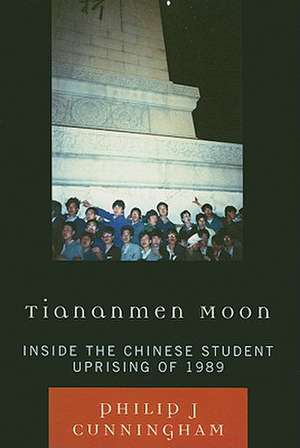
Tiananmen Moon: Inside the Chinese Student Uprising of 1989: Asian Voices
Autor Philip J Cunninghamen Limba Engleză Paperback – 16 noi 2010
| Toate formatele și edițiile | Preț | Express |
|---|---|---|
| Paperback (2) | 295.68 lei 6-8 săpt. | |
| Bloomsbury Publishing – 16 noi 2010 | 295.68 lei 6-8 săpt. | |
| Bloomsbury Publishing – 5 mai 2014 | 299.18 lei 6-8 săpt. |
Din seria Asian Voices
- nou
 Preț: 172.55 lei
 -
 Preț: 337.12 lei
 - 31%
 Preț: 625.63 lei
 - 19%
 Preț: 308.16 lei
 - 19%
 Preț: 305.44 lei
 - 20%
 Preț: 216.24 lei
 - 21%
 Preț: 209.83 lei
 - 19%
 Preț: 321.46 lei
 - 34%
 Preț: 600.92 lei
 - 25%
 Preț: 210.48 lei
 - 25%
 Preț: 210.21 lei
 - 23%
 Preț: 243.42 lei
 - 18%
 Preț: 294.49 lei
 - 11%
 Preț: 353.89 lei
 - 19%
 Preț: 322.10 lei
 - 13%
 Preț: 210.29 lei
 - 19%
 Preț: 300.11 lei
 - 25%
 Preț: 209.73 lei
 - 23%
 Preț: 257.34 lei
 - 21%
 Preț: 209.32 lei
 - 21%
 Preț: 211.82 lei
 - 22%
 Preț: 206.83 lei
 - 19%
 Preț: 313.36 lei
 - 19%
 Preț: 307.00 lei
 - 23%
 Preț: 263.01 lei
 - 28%
 Preț: 336.32 lei
 - 18%
 Preț: 317.45 lei
 - 34%
 Preț: 577.37 lei
 - 19%
 Preț: 293.31 lei
 - 23%
 Preț: 173.08 lei
 - 31%
 Preț: 335.68 lei
 - 22%
 Preț: 206.83 lei
 - 23%
 Preț: 256.83 lei
 - 26%
 Preț: 263.30 lei
 - 18%
 Preț: 295.75 lei
Preț: 295.68 lei
Preț vechi: 361.67 lei
-18%
Puncte Express: 444
Preț estimativ în valută:
52.34€ • 61.15$ • 45.42£
52.34€ • 61.15$ • 45.42£
Carte tipărită la comandă
Livrare economică 25 februarie-11 martie
Preluare comenzi: 021 569.72.76
Specificații
ISBN-13: 9780742566736
ISBN-10: 0742566730
Pagini: 293
Dimensiuni: 155 x 232 x 20 mm
Greutate: 0.52 kg
Editura: Bloomsbury Publishing
Colecția Rowman & Littlefield Publishers
Seria Asian Voices
Locul publicării:New York, United States
ISBN-10: 0742566730
Pagini: 293
Dimensiuni: 155 x 232 x 20 mm
Greutate: 0.52 kg
Editura: Bloomsbury Publishing
Colecția Rowman & Littlefield Publishers
Seria Asian Voices
Locul publicării:New York, United States
Cuprins
Part 1 New Moon
Chapter 2 May 3: In Search of the Real China
Chapter 3 May 4: The New May Fourth Spirit
Chapter 4 May 10: Ten Thousand Bicycles
Part 5 Waxing Moon
Chapter 6 May 13: Hunger Strike
Chapter 7 May 14: Laying Claim to the Square
Chapter 8 May 15: Looking for Gorbachev
Chapter 9 May 16: Working-Class Heroes
Chapter 10 May 17: Rising Tide of Rebellion
Chapter 11 May 18: Everyone an Emperor
Chapter 12 May 19: Breaking the Fast
Part 13 Waning Moon
Chapter 14 May 20: Martial Law
Chapter 15 May 22: Provincial Vagabonds
Chapter 16 May 23: Egg on the Face of Mao
Chapter 17 May 24: Tiananmen Headquarters
Chapter 18 May 26: Radical Camp
Chapter 19 May 28: Last Will and Testament
Chapter 20 May 28: Clandestine Interview
Chapter 21 May 28: Going Underground
Chapter 22 May 28: Midnight Rendezvous
Part 23 No Moon
Chapter 24 June 2: Troops Are Coming
Chapter 25 June 3: Of Tanks and Men
Chapter 26 June 3: Eve of Destruction
Chapter 27 June 4: The Sky Is Crying
Chapter 2 May 3: In Search of the Real China
Chapter 3 May 4: The New May Fourth Spirit
Chapter 4 May 10: Ten Thousand Bicycles
Part 5 Waxing Moon
Chapter 6 May 13: Hunger Strike
Chapter 7 May 14: Laying Claim to the Square
Chapter 8 May 15: Looking for Gorbachev
Chapter 9 May 16: Working-Class Heroes
Chapter 10 May 17: Rising Tide of Rebellion
Chapter 11 May 18: Everyone an Emperor
Chapter 12 May 19: Breaking the Fast
Part 13 Waning Moon
Chapter 14 May 20: Martial Law
Chapter 15 May 22: Provincial Vagabonds
Chapter 16 May 23: Egg on the Face of Mao
Chapter 17 May 24: Tiananmen Headquarters
Chapter 18 May 26: Radical Camp
Chapter 19 May 28: Last Will and Testament
Chapter 20 May 28: Clandestine Interview
Chapter 21 May 28: Going Underground
Chapter 22 May 28: Midnight Rendezvous
Part 23 No Moon
Chapter 24 June 2: Troops Are Coming
Chapter 25 June 3: Of Tanks and Men
Chapter 26 June 3: Eve of Destruction
Chapter 27 June 4: The Sky Is Crying
Recenzii
In offering a candid view of the student leadership based on his interviews and interactions with the protestors, Cunningham's account reveals the dissent and factionalism within the student ranks. A welcome addition to our understanding of a convoluted and perplexing historical black mark that media and scholarly pundits have only begun to unravel after nearly two decades of silence, this book will be appreciated by both interested general readers and scholars.
Cunningham, an American-born Asia specialist, was living on campus at Beijing Normal University during the weeks-long popular uprising that ended with the deaths of hundreds of Chinese students and intellectuals on June 4. The historic and bloody event-still the object of a 'soul-chilling silence' by Chinese officials-has been much written about in the West, but Cunningham offers the intriguing point of view of a Chinese speaker who both took part in the demonstrations and covered them as a freelance journalist for the BBC. His vivid, highly personal account begins in early May, when he joined Chinese students in orderly sit-ins at the New China News Agency to protest the lack of press freedom. Amid campus rivalries, the uprising grew to include a bicycle demonstration, slogan-shouting in front of the People's Daily offices and a mid-May hunger strike that gave new urgency to the protest. Cunningham re-creates the headiness of the time and the hopefulness of young Chinese wearing headbands and carrying red flags and hand-painted posters. His many extended conversations with student leaders and others reveal the frequent mistrust among the demonstrators as well as their shared grievances over corruption and class privilege in Chinese society. As the war of nerves between protesters and government officials heated up, Cunningham experienced his own inner turmoil as a Westerner who was highly sympathetic to the uprising but nonetheless viewed with suspicion by many in the crowd. He concludes with an account of the violent government crackdown. The author says the upheaval at Tiananmen accelerated reform, and he remains in awe of the 'remarkably peaceful, transformative, and uplifting weeks' that preceded the arrival of troops and tanks. His inside view of these chaotic days offers a deeper understanding of the yearning for freedom that drove youths and workers into the streets of a closed society. A fresh perspective mainly for students and specialists.
Tiananmen Moon is at its best when Mr. Cunningham captures the disarray as the protests evolved and especially as the massacre began. . . . [Cunningham] deals with events that cannot be discussed in China today. The media censorship is so strong that students have little idea of what their counterparts did 20 years ago. But more than a million Beijingers had publicly supported the students, and memories must linger in the minds of many, not only in the capital but throughout the country.
A superior-and often brilliant-writer. . . . [Cunningham] presents richly drawn characters and dramatic threads that pull us in like a novel, while providing remarkable yet organic insights. In Tiananmen Moon, Cunningham's high points-which are many-are equal to the best of any nonfiction author writing today. The book is not just a well-wrought story, though; it is a seamless blend of memoir and history, past and present, narrative and reflection, gemlike description and unadorned information. . . . Tiananmen Moon provides the . . . steady, reflective, nuanced eye of someone who knows China and is not afraid to let the truth fall where it may.
Philip Cunningham wrote his journal-like book with such honesty and power of observation that he captured my imagination. Tiananmen Moon is a fascinating look not so much at a series of events, but at the incomprehensible nation of China itself. Like Philip Cunningham, we'll never be able to fully understand it, but Tiananmen Moon is a good place to start.
Offers fascinating detail of the events and glorious description. . . . Tiananmen Moon is a valuable addition to the literature of that Beijing Spring.
[A] splendid firsthand account that anyone interested in modern China should read. Cunningham evokes powerfully the smells, sounds and shifting mood on the streets, making the reader feel like one is there alongside him as he tries to figure out what is going on, where the protests are heading and how the peaceful movement morphs into bloodshed. . . . This memoir serves as a moving tribute to all those young Chinese who risked so much to better their world. . . . In finally publishing this animated chronicle, he challenges two decades of organized forgetting and revisionism concerning what happened and what was at stake in 1989.
There is great attention to detail, recounting Cunningham's student life, simple pleasures in a developing country with strict government controls. One highlight of Tiananmen Moon is a fascinating interview with protest leader Chai Ling. Like Cunningham himself, the reader begins as an outsider to the movement and gets drawn further and further in, first out of curiosity and then a sense of solidarity. The author-friends with students and other liberal Chinese, and fluent in Chinese-gets as far inside perhaps as a Western eye can get. His account, accessible and readable, is a foreign perspective-perhaps being partially outside the frame helps to see the greater picture at times, to ask the right questions-but one with an insider's fondness for and grasp of China's idiosyncrasies. It is deeply personal and the reader invests much in the outcome, a tribute to Cunningham's highly convincing and moving recounting of events. This is a ground-level view of the struggle, not just ring-side but inside.
Philip J Cunningham's experiences, as portrayed in Tiananmen Moon: Inside the Chinese Student Uprising of 1989, provide another perspective to approach 4 June: memories as related by ordinary people who participated in the uprising. His vantage point, then as a foreign student, makes his observation unique and invaluable. . . . As one of the participants in the 1989 uprising, I believe that ordinary people who participated-intellectuals, merchants, workers, farmers, and even the military-played a very important role. . . . In fact, the real force that drove students at that time to uphold their courage and enthusiasm, to steer the movement to a new stage, came from vast popular support . . . which is so clearly portrayed in Cunningham's book. This is why Cunningham's observations are invaluable. What he provides us with is a personal account, partly as insider and partly as outsider. He tries to give readers a picture of different reactions from different levels of society about the movement and what ordinary people felt during that time. He has succeeded admirably.
An exciting window on China and the Chinese; an important story and a valuable contribution to contemporary Chinese history.
There is no American more qualified to write about China today than Philip Cunningham. He speaks and reads Chinese, his descriptive writing evokes a clear sense of place and time. He was one of the marchers back in 1989 during the student movement and crackdown at Tiananmen Square. His book, written with the dual perspective of a participant in the movement and as a freelancer working with the international press, is the first and last word on that historic and horrific moment in the rise of modern China.
Cunningham, an American-born Asia specialist, was living on campus at Beijing Normal University during the weeks-long popular uprising that ended with the deaths of hundreds of Chinese students and intellectuals on June 4. The historic and bloody event-still the object of a 'soul-chilling silence' by Chinese officials-has been much written about in the West, but Cunningham offers the intriguing point of view of a Chinese speaker who both took part in the demonstrations and covered them as a freelance journalist for the BBC. His vivid, highly personal account begins in early May, when he joined Chinese students in orderly sit-ins at the New China News Agency to protest the lack of press freedom. Amid campus rivalries, the uprising grew to include a bicycle demonstration, slogan-shouting in front of the People's Daily offices and a mid-May hunger strike that gave new urgency to the protest. Cunningham re-creates the headiness of the time and the hopefulness of young Chinese wearing headbands and carrying red flags and hand-painted posters. His many extended conversations with student leaders and others reveal the frequent mistrust among the demonstrators as well as their shared grievances over corruption and class privilege in Chinese society. As the war of nerves between protesters and government officials heated up, Cunningham experienced his own inner turmoil as a Westerner who was highly sympathetic to the uprising but nonetheless viewed with suspicion by many in the crowd. He concludes with an account of the violent government crackdown. The author says the upheaval at Tiananmen accelerated reform, and he remains in awe of the 'remarkably peaceful, transformative, and uplifting weeks' that preceded the arrival of troops and tanks. His inside view of these chaotic days offers a deeper understanding of the yearning for freedom that drove youths and workers into the streets of a closed society. A fresh perspective mainly for students and specialists.
Tiananmen Moon is at its best when Mr. Cunningham captures the disarray as the protests evolved and especially as the massacre began. . . . [Cunningham] deals with events that cannot be discussed in China today. The media censorship is so strong that students have little idea of what their counterparts did 20 years ago. But more than a million Beijingers had publicly supported the students, and memories must linger in the minds of many, not only in the capital but throughout the country.
A superior-and often brilliant-writer. . . . [Cunningham] presents richly drawn characters and dramatic threads that pull us in like a novel, while providing remarkable yet organic insights. In Tiananmen Moon, Cunningham's high points-which are many-are equal to the best of any nonfiction author writing today. The book is not just a well-wrought story, though; it is a seamless blend of memoir and history, past and present, narrative and reflection, gemlike description and unadorned information. . . . Tiananmen Moon provides the . . . steady, reflective, nuanced eye of someone who knows China and is not afraid to let the truth fall where it may.
Philip Cunningham wrote his journal-like book with such honesty and power of observation that he captured my imagination. Tiananmen Moon is a fascinating look not so much at a series of events, but at the incomprehensible nation of China itself. Like Philip Cunningham, we'll never be able to fully understand it, but Tiananmen Moon is a good place to start.
Offers fascinating detail of the events and glorious description. . . . Tiananmen Moon is a valuable addition to the literature of that Beijing Spring.
[A] splendid firsthand account that anyone interested in modern China should read. Cunningham evokes powerfully the smells, sounds and shifting mood on the streets, making the reader feel like one is there alongside him as he tries to figure out what is going on, where the protests are heading and how the peaceful movement morphs into bloodshed. . . . This memoir serves as a moving tribute to all those young Chinese who risked so much to better their world. . . . In finally publishing this animated chronicle, he challenges two decades of organized forgetting and revisionism concerning what happened and what was at stake in 1989.
There is great attention to detail, recounting Cunningham's student life, simple pleasures in a developing country with strict government controls. One highlight of Tiananmen Moon is a fascinating interview with protest leader Chai Ling. Like Cunningham himself, the reader begins as an outsider to the movement and gets drawn further and further in, first out of curiosity and then a sense of solidarity. The author-friends with students and other liberal Chinese, and fluent in Chinese-gets as far inside perhaps as a Western eye can get. His account, accessible and readable, is a foreign perspective-perhaps being partially outside the frame helps to see the greater picture at times, to ask the right questions-but one with an insider's fondness for and grasp of China's idiosyncrasies. It is deeply personal and the reader invests much in the outcome, a tribute to Cunningham's highly convincing and moving recounting of events. This is a ground-level view of the struggle, not just ring-side but inside.
Philip J Cunningham's experiences, as portrayed in Tiananmen Moon: Inside the Chinese Student Uprising of 1989, provide another perspective to approach 4 June: memories as related by ordinary people who participated in the uprising. His vantage point, then as a foreign student, makes his observation unique and invaluable. . . . As one of the participants in the 1989 uprising, I believe that ordinary people who participated-intellectuals, merchants, workers, farmers, and even the military-played a very important role. . . . In fact, the real force that drove students at that time to uphold their courage and enthusiasm, to steer the movement to a new stage, came from vast popular support . . . which is so clearly portrayed in Cunningham's book. This is why Cunningham's observations are invaluable. What he provides us with is a personal account, partly as insider and partly as outsider. He tries to give readers a picture of different reactions from different levels of society about the movement and what ordinary people felt during that time. He has succeeded admirably.
An exciting window on China and the Chinese; an important story and a valuable contribution to contemporary Chinese history.
There is no American more qualified to write about China today than Philip Cunningham. He speaks and reads Chinese, his descriptive writing evokes a clear sense of place and time. He was one of the marchers back in 1989 during the student movement and crackdown at Tiananmen Square. His book, written with the dual perspective of a participant in the movement and as a freelancer working with the international press, is the first and last word on that historic and horrific moment in the rise of modern China.