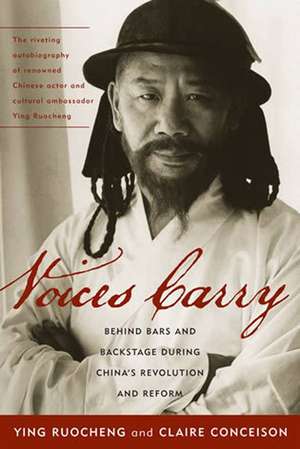
Voices Carry: Behind Bars and Backstage during China's Revolution and Reform: Asian Voices
Autor Ying Ruocheng, Claire Conceisonen Limba Engleză Paperback – 17 oct 2008
A founding member of the Beijing People's Art Theatre, Ying Ruocheng helped open its doors to Sino-American exchange when he brought Arthur Miller to China to stage Death of a Salesman in 1983, playing the role of Willy Loman in his own translation of the play. Simultaneously a "spy" for his own government and a cultural ambassador for countless foreigners and fellow countrymen, Ying lived out his life as a bridge between China and the West, gaining a singular perspective on matters related to culture and politics.
While suffering from cirrhosis of the liver during the final decade of his life, Ying Ruocheng reflected on his experiences, collaborating with coauthor Claire Conceison to tell his story. Together, they take the reader on an exhilarating journey from Manchu wrestling matches to missionary schools, from behind prison bars to behind the scenes at ground-breaking stage performances, and from public moments of international recognition to private moments of intimacy and despair.
Din seria Asian Voices
- 18%
 Preț: 381.20 lei
 - 38%
 Preț: 109.90 lei
 - 21%
 Preț: 187.01 lei
 - 19%
 Preț: 333.04 lei
 - 19%
 Preț: 322.24 lei
 - 28%
 Preț: 220.25 lei
 - 19%
 Preț: 324.21 lei
 - 28%
 Preț: 220.85 lei
 - 28%
 Preț: 221.84 lei
 - 30%
 Preț: 495.65 lei
 - 25%
 Preț: 218.37 lei
 - 23%
 Preț: 277.06 lei
 - 19%
 Preț: 338.98 lei
 - 25%
 Preț: 221.35 lei
 - 24%
 Preț: 183.92 lei
 - 19%
 Preț: 316.43 lei
 - 25%
 Preț: 217.58 lei
 - 28%
 Preț: 220.96 lei
 - 23%
 Preț: 270.93 lei
 - 34%
 Preț: 632.52 lei
 - 25%
 Preț: 220.06 lei
 - 24%
 Preț: 253.69 lei
 - 17%
 Preț: 324.63 lei
 - 19%
 Preț: 322.75 lei
 - 20%
 Preț: 326.82 lei
 - 11%
 Preț: 372.01 lei
 - 25%
 Preț: 228.72 lei
 - 34%
 Preț: 658.85 lei
 - 30%
 Preț: 352.88 lei
 - 22%
 Preț: 305.85 lei
 - 17%
 Preț: 219.52 lei
 -
 Preț: 351.61 lei
 - 30%
 Preț: 353.06 lei
 - 21%
 Preț: 310.54 lei
 - 24%
 Preț: 268.03 lei
 - 23%
 Preț: 278.14 lei
Preț: 338.89 lei
Preț vechi: 417.45 lei
-19%
Puncte Express: 508
Carte tipărită la comandă
Livrare economică 18 noiembrie-02 decembrie
Livrare prin curier în România Termenul estimat este afișat lângă disponibilitate.
Transport gratuit de la 400.00 lei Plată online sau ramburs, în funcție de opțiunile comenzii.
Retur gratuit în 14 zile Comandă securizată și suport în română.
Specificații
ISBN-13: 9780742555556
ISBN-10: 0742555550
Pagini: 246
Dimensiuni: 148 x 226 x 18 mm
Greutate: 0.45 kg
Editura: Bloomsbury Publishing
Colecția Rowman & Littlefield
Seria Asian Voices
Locul publicării:New York, United States
ISBN-10: 0742555550
Pagini: 246
Dimensiuni: 148 x 226 x 18 mm
Greutate: 0.45 kg
Editura: Bloomsbury Publishing
Colecția Rowman & Littlefield
Seria Asian Voices
Locul publicării:New York, United States
Cuprins
Introduction
Part I: The Adventures of Prison Life
Chapter 1: My First Year Behind Bars
Chapter 2: The Prison at Jixian
Part II: Family History and Early Education
Chapter 3: The Ying Legacy
Chapter 4: A Princely Childhood
Part III: Professional Life in Arts and Politics
Chapter 5: My Stage Career
Chapter 6: Cultural Diplomacy
Epilogue
Part I: The Adventures of Prison Life
Chapter 1: My First Year Behind Bars
Chapter 2: The Prison at Jixian
Part II: Family History and Early Education
Chapter 3: The Ying Legacy
Chapter 4: A Princely Childhood
Part III: Professional Life in Arts and Politics
Chapter 5: My Stage Career
Chapter 6: Cultural Diplomacy
Epilogue
Recenzii
This 'collaborative autobiography' reveals Ying as a complex and contradictory figure: Catholic and communist, artist and informant, actor and politician. Although Ying's insights from within the Cultural Revolution are fascinating, of equal value are both his view of the US and the echoes of the history of modern China as filtered through his personal history-not to mention his wit and warmth. This book will prove of interest far beyond theater and Asian studies. Highly recommended.
A gem, not to be missed by any student of Chinese culture or politics. . . . The passages on prison are among the most detailed and vivid we have in the literature. And throughout the volume there is a refreshing bluntness. . . . Voices Carry has been a major project for Conceison, a labor of love, persistence, and understanding. She has gone to great lengths to offer context in endnotes for readers who may need them. It is hard to think of any US-PRC literary collaboration more complex and valuable than this one, or to think of a personal cultural bridge between the PRC and the West as active and influential as Ying . . . it is quite clear Ying had his faults, but I found the book totally engaging.
Ying's vitality, ingenuity, humor, and creativity as an artist and a larger-than-life character are in full display, making the book a great joy to read. . . . Conceison should also be commended for skillfully and fluidly weaving Ying's life together in the chapters and for corroborating, supplementing, or occasionally correcting Ying's memories with historical records and/or recounts from family members in her introduction, epilogue, and thirty-five pages of endnotes. . . . Her serious scholarship is augmented by skillful writing and organization.
A truly excellent book. It is full of information and insight into the life of a wonderfully generous and learned human being, a most unusual Chinese and man of the theatre, a man who understood the theatre both of his own country and of the West, and who had highly practical and valuable experience in both. As for the author whose job was to transmit this character to a readership, her knowledge and feeling for her subject is exemplary, as is her ability to write that kind of English that conveys his character and views sympathetically and truthfully. This is not only a lively read but also a convincing one.
A must-read for anyone interested in the performing arts. Furthermore, [celebrated Chinese actor Ying Ruocheng's] life touched on fascinating aspects of Chinese history and society seldom discussed. What happened to the Manchus after the 1911 revolution? What was it like being a Catholic in those years? How did (and perhaps does) the government collect information on foreigners? How does it treat its political prisoners? How are personnel decisions made? This book is one man's attempt to make sense of cataclysmic events.
For readers unfamiliar with the history of the performing arts in China, Voices Carry provides a window into modern Chinese theatre through the life story of a man integral to its development. For specialists in Chinese drama, Ying's behind-the-scenes perspective and Conceison's detailed annotations shed new light on landmark plays like Lao She's Teahouse (1957). Every reader will have the pleasure of discovering Ying through his own depiction of the key events in his remarkable life. Conceison writes fondly of her time spent with Ying: 'Each of these conversations over the course of a decade was indeed like having a fireside chat with a best friend' (xvii). While I never had the good fortune of meeting Ying Ruocheng in person, Voices Carry enables me to feel that I, too, have enjoyed such a chat.
An autobiography of a key figure in post-1949 China is a welcome addition to enrich our understanding of how theatre came to be a vital institution in modern Chinese life. Readers looking for such insights will be intrigued by this idiosyncratic autobiographical account, not least because it sheds new light on Ying Ruocheng's dual role as government informant and cultural ambassador in East-West relations.
Ying Ruocheng was an extraordinary individual, a man of integrity and creativity whose story must be more widely known. Through this brilliant collaborative telling with Claire Conceison, we understand how he inspired so many and we learn how the arts can impact world events.
This autobiography of Ying Ruocheng offers us a rare treat: a completely new vantage point from which to view twentieth-century China. Ying was a Manchu and a Catholic, an actor and a translator, a political prisoner and a vice minister of culture, as well as being a man of subtlety and wit. Claire Conceison has done us a real service in making this unusual life available to the general reader.
Ying Ruocheng is, of course, a star in China. . . . [He] is not only a translator and actor but of necessity a kind of diplomat. . . . He has been my rock, a man of double consciousness, Eastern and Western, literary and show business.
Praise from a reader of the Chinese edition:
I lost track of time and spent half the night reading in order to finish. I feel that Mr. Ying's mind is very sharp; he is quick-witted and wise to the ways of the world. Additionally, he hasn't lost his innocence and frank disposition, and that is hard to come by.
Praise from a reader of the Chinese edition:
Voices Carry is the best book I have read of late. In fact, I read it all at once without sleep or rest. Ying Ruocheng's spirited accomplishments while in prison took my breath away. I have read quite a few works describing life in prison. I have to say that Ying Ruocheng's touched me most deeply. One cannot be idle at any time; being idle is the most unbearable thing. I feel this is true. Optimistic people will fare better in life.
Praise from a reader of the Chinese edition:
When I got to the passage where Ying is in prison and steals a carrot, I laughed out loud. If you're eating a stolen carrot, you can't possibly share it among eight people. Creating joy when in the midst of hardship, and on a regular basis, this is a man who has so much passion for life!
A gem, not to be missed by any student of Chinese culture or politics. . . . The passages on prison are among the most detailed and vivid we have in the literature. And throughout the volume there is a refreshing bluntness. . . . Voices Carry has been a major project for Conceison, a labor of love, persistence, and understanding. She has gone to great lengths to offer context in endnotes for readers who may need them. It is hard to think of any US-PRC literary collaboration more complex and valuable than this one, or to think of a personal cultural bridge between the PRC and the West as active and influential as Ying . . . it is quite clear Ying had his faults, but I found the book totally engaging.
Ying's vitality, ingenuity, humor, and creativity as an artist and a larger-than-life character are in full display, making the book a great joy to read. . . . Conceison should also be commended for skillfully and fluidly weaving Ying's life together in the chapters and for corroborating, supplementing, or occasionally correcting Ying's memories with historical records and/or recounts from family members in her introduction, epilogue, and thirty-five pages of endnotes. . . . Her serious scholarship is augmented by skillful writing and organization.
A truly excellent book. It is full of information and insight into the life of a wonderfully generous and learned human being, a most unusual Chinese and man of the theatre, a man who understood the theatre both of his own country and of the West, and who had highly practical and valuable experience in both. As for the author whose job was to transmit this character to a readership, her knowledge and feeling for her subject is exemplary, as is her ability to write that kind of English that conveys his character and views sympathetically and truthfully. This is not only a lively read but also a convincing one.
A must-read for anyone interested in the performing arts. Furthermore, [celebrated Chinese actor Ying Ruocheng's] life touched on fascinating aspects of Chinese history and society seldom discussed. What happened to the Manchus after the 1911 revolution? What was it like being a Catholic in those years? How did (and perhaps does) the government collect information on foreigners? How does it treat its political prisoners? How are personnel decisions made? This book is one man's attempt to make sense of cataclysmic events.
For readers unfamiliar with the history of the performing arts in China, Voices Carry provides a window into modern Chinese theatre through the life story of a man integral to its development. For specialists in Chinese drama, Ying's behind-the-scenes perspective and Conceison's detailed annotations shed new light on landmark plays like Lao She's Teahouse (1957). Every reader will have the pleasure of discovering Ying through his own depiction of the key events in his remarkable life. Conceison writes fondly of her time spent with Ying: 'Each of these conversations over the course of a decade was indeed like having a fireside chat with a best friend' (xvii). While I never had the good fortune of meeting Ying Ruocheng in person, Voices Carry enables me to feel that I, too, have enjoyed such a chat.
An autobiography of a key figure in post-1949 China is a welcome addition to enrich our understanding of how theatre came to be a vital institution in modern Chinese life. Readers looking for such insights will be intrigued by this idiosyncratic autobiographical account, not least because it sheds new light on Ying Ruocheng's dual role as government informant and cultural ambassador in East-West relations.
Ying Ruocheng was an extraordinary individual, a man of integrity and creativity whose story must be more widely known. Through this brilliant collaborative telling with Claire Conceison, we understand how he inspired so many and we learn how the arts can impact world events.
This autobiography of Ying Ruocheng offers us a rare treat: a completely new vantage point from which to view twentieth-century China. Ying was a Manchu and a Catholic, an actor and a translator, a political prisoner and a vice minister of culture, as well as being a man of subtlety and wit. Claire Conceison has done us a real service in making this unusual life available to the general reader.
Ying Ruocheng is, of course, a star in China. . . . [He] is not only a translator and actor but of necessity a kind of diplomat. . . . He has been my rock, a man of double consciousness, Eastern and Western, literary and show business.
Praise from a reader of the Chinese edition:
I lost track of time and spent half the night reading in order to finish. I feel that Mr. Ying's mind is very sharp; he is quick-witted and wise to the ways of the world. Additionally, he hasn't lost his innocence and frank disposition, and that is hard to come by.
Praise from a reader of the Chinese edition:
Voices Carry is the best book I have read of late. In fact, I read it all at once without sleep or rest. Ying Ruocheng's spirited accomplishments while in prison took my breath away. I have read quite a few works describing life in prison. I have to say that Ying Ruocheng's touched me most deeply. One cannot be idle at any time; being idle is the most unbearable thing. I feel this is true. Optimistic people will fare better in life.
Praise from a reader of the Chinese edition:
When I got to the passage where Ying is in prison and steals a carrot, I laughed out loud. If you're eating a stolen carrot, you can't possibly share it among eight people. Creating joy when in the midst of hardship, and on a regular basis, this is a man who has so much passion for life!