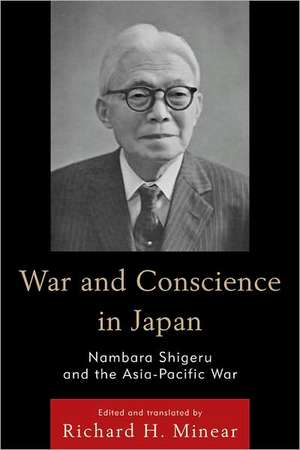
War and Conscience in Japan: Nambara Shigeru and the Asia-Pacific War: Asian Voices
Autor Nambara Shigeru Editat de Richard H. Minearen Limba Engleză Hardback – 16 dec 2010
Din seria Asian Voices
- 18%
 Preț: 381.20 lei
 - 38%
 Preț: 109.90 lei
 - 21%
 Preț: 187.01 lei
 - 19%
 Preț: 333.04 lei
 - 19%
 Preț: 322.24 lei
 - 28%
 Preț: 220.25 lei
 - 19%
 Preț: 338.89 lei
 - 19%
 Preț: 324.21 lei
 - 28%
 Preț: 220.85 lei
 - 28%
 Preț: 221.84 lei
 - 30%
 Preț: 495.65 lei
 - 25%
 Preț: 218.37 lei
 - 23%
 Preț: 277.06 lei
 - 19%
 Preț: 338.98 lei
 - 25%
 Preț: 221.35 lei
 - 24%
 Preț: 183.92 lei
 - 19%
 Preț: 316.43 lei
 - 25%
 Preț: 217.58 lei
 - 28%
 Preț: 220.96 lei
 - 23%
 Preț: 270.93 lei
 - 25%
 Preț: 220.06 lei
 - 24%
 Preț: 253.69 lei
 - 17%
 Preț: 324.63 lei
 - 19%
 Preț: 322.75 lei
 - 20%
 Preț: 326.82 lei
 - 11%
 Preț: 372.01 lei
 - 25%
 Preț: 228.72 lei
 - 34%
 Preț: 658.85 lei
 - 30%
 Preț: 352.88 lei
 - 22%
 Preț: 305.85 lei
 - 17%
 Preț: 219.52 lei
 -
 Preț: 351.61 lei
 - 30%
 Preț: 353.06 lei
 - 21%
 Preț: 310.54 lei
 - 24%
 Preț: 268.03 lei
 - 23%
 Preț: 278.14 lei
Preț: 632.52 lei
Preț vechi: 957.96 lei
-34%
Puncte Express: 949
Carte tipărită la comandă
Livrare economică 23 noiembrie-07 decembrie
Livrare prin curier în România Termenul estimat este afișat lângă disponibilitate.
Transport gratuit pentru acest produs Plată online sau ramburs, în funcție de opțiunile comenzii.
Retur gratuit în 14 zile Comandă securizată și suport în română.
Specificații
ISBN-13: 9780742568136
ISBN-10: 074256813X
Pagini: 230
Dimensiuni: 163 x 238 x 21 mm
Greutate: 0.46 kg
Ediția:New.
Editura: Bloomsbury Publishing
Colecția Rowman & Littlefield
Seria Asian Voices
Locul publicării:New York, United States
ISBN-10: 074256813X
Pagini: 230
Dimensiuni: 163 x 238 x 21 mm
Greutate: 0.46 kg
Ediția:New.
Editura: Bloomsbury Publishing
Colecția Rowman & Littlefield
Seria Asian Voices
Locul publicării:New York, United States
Cuprins
Translator's Introduction: War and Conscience in Japan: Nambara Shigeru and the Asia-Pacific War
Part I: Nambara's Writings and Speeches before Japan's Surrender
"University Autonomy," September 5, 1938
"The Essence of the University," April 1941
"The State and Scholarship," Fall 1942
"The Mission of Scholars and Students," May 1945
"The Theme of Goethe's Faust," May 1945
Part II: Nambara's Poetic Diary, 1936-45
Ideal Forms: A Poetic Diary
Part III: Nambara's Speeches after Japan's Surrender
"The Mission of Scholars and Students," September 1945
"The Construction of the New Japan," November 1945
"The Creation of a New Japanese Culture," February 11, 1946
"Mourning the Students Who Died in the War," March 30, 1946
"The Emperor's Birthday," April 29, 1946
"What Will Revive the Homeland," September 30, 1946
"Truth Will Be the Final Victor," December 1951
"You Who Inherit the Legacy of the Students Who Died in the War," November 1963
Part I: Nambara's Writings and Speeches before Japan's Surrender
"University Autonomy," September 5, 1938
"The Essence of the University," April 1941
"The State and Scholarship," Fall 1942
"The Mission of Scholars and Students," May 1945
"The Theme of Goethe's Faust," May 1945
Part II: Nambara's Poetic Diary, 1936-45
Ideal Forms: A Poetic Diary
Part III: Nambara's Speeches after Japan's Surrender
"The Mission of Scholars and Students," September 1945
"The Construction of the New Japan," November 1945
"The Creation of a New Japanese Culture," February 11, 1946
"Mourning the Students Who Died in the War," March 30, 1946
"The Emperor's Birthday," April 29, 1946
"What Will Revive the Homeland," September 30, 1946
"Truth Will Be the Final Victor," December 1951
"You Who Inherit the Legacy of the Students Who Died in the War," November 1963
Recenzii
Provide[s] a unique lens through which readers can view Nambara's intellectual resistance to the totalitarian state and his anguish over the war. The introduction offers . . . rich historical context for the selected works before, during and after World War II. . . . The editor's diligence and talent has produced a set of primary sources in English for understanding Nambara Shigeru's political thought and conveying the genuine and nuanced voice of an intellectual in wartime Japan. It is a valuable book and should serve as a reference for researchers who are interested in the intellectual and political history of modern Japan. . . . Nambara's poems in Japanese and Minear's lucid and elegant translations will be welcomed by students of Japanese literature.
Among all that is valuable in this welcome volume, it is a special delight to have the generous selection from Nambara's poetic diary, which allows us to follow Nambara's intellectual and emotional struggles during the war almost day by day. Minear makes available to us Nambara's example of thoughtful patriotism at a time when we ourselves need such models most.
Minear gives English-language readers access for the first time to key writings by one of twentieth-century Japan's most important public intellectuals. These careful, lucid translations of Nambara's dissident poetic diary from the years 1936-1945 and of his famously inspirational wartime and postwar speeches bring us one man's struggle to serve both nation and conscience in tumultuous times.
Minear combines two scholarly interests: the intellectuals in the Imperial universities, whom he first studied in his Japanese Tradition and Western Law (1970), and the Pacific War, which he first examined in Victor's Justice: The Tokyo War Crimes Trial (1971). With an enviable fluency in translating both the jargon of the professors and the tanka poetic form, he has given us another nuanced perspective on Japanese history.
Among all that is valuable in this welcome volume, it is a special delight to have the generous selection from Nambara's poetic diary, which allows us to follow Nambara's intellectual and emotional struggles during the war almost day by day. Minear makes available to us Nambara's example of thoughtful patriotism at a time when we ourselves need such models most.
Minear gives English-language readers access for the first time to key writings by one of twentieth-century Japan's most important public intellectuals. These careful, lucid translations of Nambara's dissident poetic diary from the years 1936-1945 and of his famously inspirational wartime and postwar speeches bring us one man's struggle to serve both nation and conscience in tumultuous times.
Minear combines two scholarly interests: the intellectuals in the Imperial universities, whom he first studied in his Japanese Tradition and Western Law (1970), and the Pacific War, which he first examined in Victor's Justice: The Tokyo War Crimes Trial (1971). With an enviable fluency in translating both the jargon of the professors and the tanka poetic form, he has given us another nuanced perspective on Japanese history.