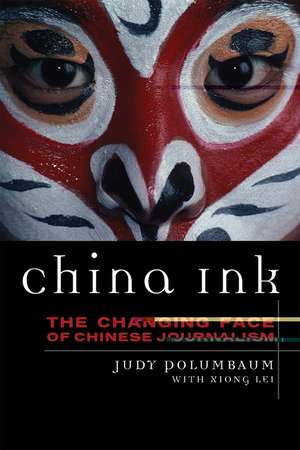
China Ink: The Changing Face of Chinese Journalism: Asian Voices
Autor Judy Polumbaumen Limba Engleză Paperback – 29 mai 2008
The author's extended and frank conversations with journalists from a range of news outlets reveal diversity, passion, humor, and optimism that belie the stereotype of journalists as cogs in a rigidly controlled machine. Neither dissidents nor paragons but rather people working day in and day out within China's existing and evolving media, these talented and ambitious reporters open new windows to understanding Chinese journalism and intellectual life. Some of their tales could happen only in China; others will resonate with readers everywhere. As the first book to explore experiences and ideas of everyday journalists who are helping to shape their rapidly changing country, this unique and timely work will appeal to all those interested in China's dynamic society.
Din seria Asian Voices
- 18%
 Preț: 381.20 lei
 - 38%
 Preț: 109.90 lei
 - 21%
 Preț: 188.13 lei
 - 19%
 Preț: 333.04 lei
 - 19%
 Preț: 322.24 lei
 - 28%
 Preț: 220.25 lei
 - 19%
 Preț: 338.89 lei
 - 19%
 Preț: 324.21 lei
 - 28%
 Preț: 220.85 lei
 - 28%
 Preț: 221.84 lei
 - 30%
 Preț: 495.65 lei
 - 25%
 Preț: 218.37 lei
 - 23%
 Preț: 277.06 lei
 - 19%
 Preț: 338.98 lei
 - 25%
 Preț: 221.35 lei
 - 24%
 Preț: 188.43 lei
 - 19%
 Preț: 316.43 lei
 - 25%
 Preț: 217.58 lei
 - 28%
 Preț: 220.96 lei
 - 23%
 Preț: 270.93 lei
 - 34%
 Preț: 632.52 lei
 - 25%
 Preț: 220.06 lei
 - 24%
 Preț: 253.69 lei
 - 17%
 Preț: 324.63 lei
 - 19%
 Preț: 322.75 lei
 - 20%
 Preț: 326.82 lei
 - 11%
 Preț: 372.01 lei
 - 25%
 Preț: 228.72 lei
 - 34%
 Preț: 658.85 lei
 - 30%
 Preț: 352.88 lei
 - 22%
 Preț: 305.85 lei
 - 17%
 Preț: 219.52 lei
 -
 Preț: 351.61 lei
 - 30%
 Preț: 353.06 lei
 - 21%
 Preț: 310.54 lei
 - 23%
 Preț: 278.14 lei
Preț: 268.03 lei
Preț vechi: 353.29 lei
-24%
Puncte Express: 402
Carte tipărită la comandă
Livrare economică 01-15 decembrie
Livrare prin curier în România Termenul estimat este afișat lângă disponibilitate.
Transport gratuit de la 400.00 lei Plată online sau ramburs, în funcție de opțiunile comenzii.
Retur gratuit în 14 zile Comandă securizată și suport în română.
Specificații
ISBN-13: 9780742556683
ISBN-10: 0742556689
Pagini: 201
Dimensiuni: 155 x 229 x 15 mm
Greutate: 0.33 kg
Editura: Bloomsbury Publishing
Colecția Rowman & Littlefield
Seria Asian Voices
Locul publicării:New York, United States
ISBN-10: 0742556689
Pagini: 201
Dimensiuni: 155 x 229 x 15 mm
Greutate: 0.33 kg
Editura: Bloomsbury Publishing
Colecția Rowman & Littlefield
Seria Asian Voices
Locul publicării:New York, United States
Cuprins
Part 1 Preface by Aryeh Neier
Part 2 Introduction by Judy Polumbaum
Part 3 Part one: The changing establishment
Part 4 Chapter 1: In all my time as a journalist, there's been no moment I didn't think about those four words: freedom of the press. Wang Jun, Outlook Weekly
Part 5 Chapter 2: Some of my male competitors might have been very capable, but nobody had a passion stronger than mine. Zhou Yijun, Xinhua News Agency
Part 6 Chapter 3: The question is how to be professional, how to be fair to your interviewees, how to make balanced reports, how to convey different voices and different sides. Lin Gu, China Features
Part 7 Chapter 4: Compared to other jobs, a journalist's work is always fresh, as the sun is new every day. Gong Wen, People's Daily
Part 8 Chapter 5: We do not represent ourselves as a mouthpiece-other media may have that concept, but not us. Tan Hongkai, China Daily
Part 9 Chapter 6: If you are not allowed to speak, you can stay silent, or laugh. But you shouldn't tell lies. Jin Yongquan, China Youth News
Part 10 Part two: Into the fray
Part 11 Chapter 7: Why do we go after news? Because the news is there. Li Yang, China Newsweek
Part 12 Chapter 8: If you have ideals, you'll be happy in journalism. Although you'll face many vexations, you'll reap lots of spiritual rewards. Liu Jianqiang, Southern Weekend
Part 13 Chapter 9: Being a journalist is not a job or a profession, but a lifestyle. It is beyond man's will. Hu Zhibin, The First
Part 14 Chapter 10: My greatest challenge in work is gaining knowledge, since you never know what kind of people and what sorts of things you'll run into the next day. Zhan Minhui, Beijing News
Part 15 Part three: In the niches
Part 16 Chapter 11: I don't have to write about things I don't want to write about, or report things I don't wish to report. Lu Yi, Sanlian Life Weekly
Part 17 Chapter 12: Journalists who report on minority affairs, in addition to truly reflecting facts and having morals and conscience, must have the capacity for love and compassion. Yang Jin, Nationalities Pictorial
Part 18 Chapter 13: Sports reporting can be about very small things; a story that provides something practical and beneficial doesn't have to be of great significance. Zhang Xuguang, China Sports News
Part 19 Chapter 14: To many athletes, journalists are a headache because they ask meaningless questions and intrude on their lives. Ma Yin, Titan News
Part 20 Part four: Over the air
Part 21 Chapter 15: I go out reporting every day, sometimes doing three or four pieces in a day. My time is not my own. Liu Qian, China Central Television
Part 22 Chapter 16: Sometimes I'll feel good about my work, and it gets trashed. Ai Da, Beijing Television
Part 23 Chapter 17: Live talk programs are one-to-one, although the one could be millions of listeners. When I talk to them, I feel I'm talking to an individual. Xiang Fei, China National Radio
Part 24 Part five: New configurations
Part 25 Chapter 18: There's no need to be discouraged; there are always things one can accomplish. Wang Shuo, Finance & Economics Magazine
Part 26 Chapter 19: Our biggest challenge is the uncertainty of the future of print media. Liu Zouwei, 21st Century Business Herald
Part 27 Chapter 20: My background actually makes it harder to arrive at elementary knowledge-so only now can I learn the simplest principles and regain some common sense. Zhang Lixian, Readers Warehouse
Part 2 Introduction by Judy Polumbaum
Part 3 Part one: The changing establishment
Part 4 Chapter 1: In all my time as a journalist, there's been no moment I didn't think about those four words: freedom of the press. Wang Jun, Outlook Weekly
Part 5 Chapter 2: Some of my male competitors might have been very capable, but nobody had a passion stronger than mine. Zhou Yijun, Xinhua News Agency
Part 6 Chapter 3: The question is how to be professional, how to be fair to your interviewees, how to make balanced reports, how to convey different voices and different sides. Lin Gu, China Features
Part 7 Chapter 4: Compared to other jobs, a journalist's work is always fresh, as the sun is new every day. Gong Wen, People's Daily
Part 8 Chapter 5: We do not represent ourselves as a mouthpiece-other media may have that concept, but not us. Tan Hongkai, China Daily
Part 9 Chapter 6: If you are not allowed to speak, you can stay silent, or laugh. But you shouldn't tell lies. Jin Yongquan, China Youth News
Part 10 Part two: Into the fray
Part 11 Chapter 7: Why do we go after news? Because the news is there. Li Yang, China Newsweek
Part 12 Chapter 8: If you have ideals, you'll be happy in journalism. Although you'll face many vexations, you'll reap lots of spiritual rewards. Liu Jianqiang, Southern Weekend
Part 13 Chapter 9: Being a journalist is not a job or a profession, but a lifestyle. It is beyond man's will. Hu Zhibin, The First
Part 14 Chapter 10: My greatest challenge in work is gaining knowledge, since you never know what kind of people and what sorts of things you'll run into the next day. Zhan Minhui, Beijing News
Part 15 Part three: In the niches
Part 16 Chapter 11: I don't have to write about things I don't want to write about, or report things I don't wish to report. Lu Yi, Sanlian Life Weekly
Part 17 Chapter 12: Journalists who report on minority affairs, in addition to truly reflecting facts and having morals and conscience, must have the capacity for love and compassion. Yang Jin, Nationalities Pictorial
Part 18 Chapter 13: Sports reporting can be about very small things; a story that provides something practical and beneficial doesn't have to be of great significance. Zhang Xuguang, China Sports News
Part 19 Chapter 14: To many athletes, journalists are a headache because they ask meaningless questions and intrude on their lives. Ma Yin, Titan News
Part 20 Part four: Over the air
Part 21 Chapter 15: I go out reporting every day, sometimes doing three or four pieces in a day. My time is not my own. Liu Qian, China Central Television
Part 22 Chapter 16: Sometimes I'll feel good about my work, and it gets trashed. Ai Da, Beijing Television
Part 23 Chapter 17: Live talk programs are one-to-one, although the one could be millions of listeners. When I talk to them, I feel I'm talking to an individual. Xiang Fei, China National Radio
Part 24 Part five: New configurations
Part 25 Chapter 18: There's no need to be discouraged; there are always things one can accomplish. Wang Shuo, Finance & Economics Magazine
Part 26 Chapter 19: Our biggest challenge is the uncertainty of the future of print media. Liu Zouwei, 21st Century Business Herald
Part 27 Chapter 20: My background actually makes it harder to arrive at elementary knowledge-so only now can I learn the simplest principles and regain some common sense. Zhang Lixian, Readers Warehouse
Recenzii
China Ink is a fascinating window onto the world in which Chinese journalists operate. Among the book's most striking revelations is the wide variety of personalities, tactics, values, and aspirations with which they approach their task.
Not only are the journalists included here highly ethical and aware, they're also largely upbeat. . . . Polumbaum's subjects are open and persuasive, and each oral history has charm and detail to spare.
This book makes for fascinating and very timely reading.. Polumbaum and Xiong's interviewees provide a vivid series of snapshots that enable us to gain a feeling for the fast pace of change [in the journalistic realm].. China Ink's great virtue is that it offers rich and interesting primary material that, to the best of my knowledge, cannot be found anywhere else, at least in English.
Innumerable pundits have vied to pronounce upon the social and cultural development of the Chinese, but Polumbaum's approach-letting her subjects speak for themselves-appears to be the one now needed most. After putting her interviewees into context with a concise introduction, she simply lets each one recount their own story in a dedicated chapter, resisting the temptation to analyze and conclude, and eschewing clichés such as the prediction that the free market will break down censorship entirely. What results is an unadorned snapshot of a moment in Chinese media, both intimate and unusual.
By reading China Ink you will learn more about Chinese media, building codes, swimming and diving, censorship, and writing styles than you could in ten different books-and all of it through the eyes, ears, and pens of significant Chinese journalists. China Ink is both a primer for the beginner and a reinforcement for the frequent visitor and scholar.
Not only are the journalists included here highly ethical and aware, they're also largely upbeat. . . . Polumbaum's subjects are open and persuasive, and each oral history has charm and detail to spare.
This book makes for fascinating and very timely reading.. Polumbaum and Xiong's interviewees provide a vivid series of snapshots that enable us to gain a feeling for the fast pace of change [in the journalistic realm].. China Ink's great virtue is that it offers rich and interesting primary material that, to the best of my knowledge, cannot be found anywhere else, at least in English.
Innumerable pundits have vied to pronounce upon the social and cultural development of the Chinese, but Polumbaum's approach-letting her subjects speak for themselves-appears to be the one now needed most. After putting her interviewees into context with a concise introduction, she simply lets each one recount their own story in a dedicated chapter, resisting the temptation to analyze and conclude, and eschewing clichés such as the prediction that the free market will break down censorship entirely. What results is an unadorned snapshot of a moment in Chinese media, both intimate and unusual.
By reading China Ink you will learn more about Chinese media, building codes, swimming and diving, censorship, and writing styles than you could in ten different books-and all of it through the eyes, ears, and pens of significant Chinese journalists. China Ink is both a primer for the beginner and a reinforcement for the frequent visitor and scholar.