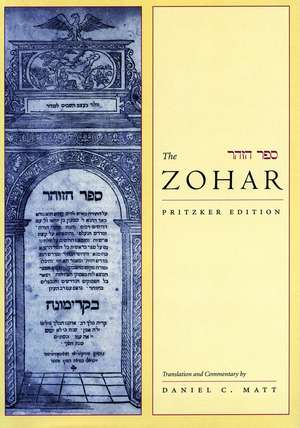
The Zohar: Pritzker Edition, Volume Two: The Zohar: Pritzker Edition, cartea 2
Traducere de Daniel Matten Limba Engleză Hardback – 31 dec 2003
Analizând ediția Pritzker publicată de Stanford University Press, observăm un efort academic fără precedent în spațiul studiilor iudaice. The Zohar, volumul șapte, continuă misiunea începută de Daniel Matt de a oferi prima traducere în limba engleză realizată integral după un text critic în aramaică, reconstruit minuțios din manuscrise originale. Spre deosebire de versiunile anterioare care se bazau pe ediții tipărite adesea corupte, această serie restabilește rigoarea filologică necesară unui text de o asemenea complexitate.
Apreciem în mod deosebit structura acestui volum, unde comentariul exegetic ocupă un loc central la baza fiecărei pagini. Acesta nu doar că traduce termenii, dar decodifică sistemul complex al celor zece sefirot — etapele vieții interioare divine — transformând lectura dintr-o simplă parcurgere de text mistic într-o experiență de studiu profund. The Zohar nu este un tratat arid, ci se prezintă sub forma unui „roman mistic” în care Rabbi Shim'on bar Yohai și însoțitorii săi explorează dealurile Galileii, revelând straturi ascunse ale Torei.
Comparabil cu The Essential Zohar de Rav Yehuda Berg în ceea ce privește dorința de a face accesibile învățăturile cabalistice, volumul de față se distinge prin rigoarea academică și aparatul critic vast, fiind actualizat pentru cerințele cercetării contemporane. Dacă în The Essential Kabbalah, Daniel Matt oferea o introducere sintetică în misticismul evreiesc, în seria The Zohar: Pritzker Edition el livrează textul sursă în toată splendoarea sa arhaică, facilitând o înțelegere directă a modului în care figurile biblice devin proiecții ale dinamicii divine.

Preț: 399.37 lei
Carte disponibilă
Livrare economică 07-21 noiembrie
Specificații
ISBN-10: 0804748683
Pagini: 472
Dimensiuni: 178 x 254 x 36 mm
Greutate: 1.05 kg
Ediția:Twenty-Third edition
Editura: Stanford University Press
Colecția Stanford University Press
Seria The Zohar: Pritzker Edition
V-ar putea interesa
-
 Biblical Myth and Rabbinic MythmakingMichael Fishbane-31%Preț: 530.19 lei764.05 lei
 -
 Early Yiddish Texts 1100-1750: With Introduction and CommentaryJerold C. Frakes-21%Preț: 433.01 lei545.13 lei
 -
 -35%Preț: 882.82 lei1354.14 lei
 -
 -31%Preț: 905.67 lei1312.13 lei
 -
 Reading Jewish Religious TextsEliezer SegalPreț: 437.08 lei
 -
 The Cambridge Genizah CollectionsStefan C. ReifPreț: 495.34 lei
 -
 The JPS Bible Commentary: RuthTamara Cohn EskenaziPreț: 307.41 lei
 -
 Preț: 212.33 lei
 -
 Path of Kabbalah: Revealing the Hidden WisdomMichael LaitmanPreț: 204.61 lei
 -
 Preț: 326.05 lei
 -
 Preț: 358.53 lei
 -
 Moscow′s Heavy Shadow – The Violent Collapse of the USSRIsaac Mckean ScarboroughPreț: 454.59 lei
 -
 Preț: 192.03 lei
 -
 Preț: 247.94 lei
 -
 Holy Sobriety in Modern Russia – A Faith Healer and His FollowersKimberly Page HerrlingerPreț: 422.81 lei
 -
 Preț: 281.19 lei
 -
 Preț: 286.00 lei
 -
 Preț: 245.53 lei
 -
 Preț: 206.57 lei
 -
 EhyehArthur GreenPreț: 116.16 lei
 -
 Speaking Torah Vol 2Arthur GreenPreț: 220.45 lei
 -
 Kabbalah Made EasyMaggy WhitehousePreț: 38.57 lei
 -
 The TorahJoel N. LohrPreț: 77.93 lei
De ce să citești această carte
Această ediție este esențială pentru cercetătorii iudaismului și pentru cei interesați de misticismul comparat. Cititorul câștigă acces la un text critic restaurat, beneficiind de explicații detaliate care transformă limbajul metaforic al Cabalei într-un sistem coerent de gândire. Este singura resursă care permite studiul Zoharului la un nivel academic, menținând în același timp frumusețea narativă a textului original.
Despre autor
Daniel Matt este unul dintre cei mai respectați specialiști contemporani în Cabala. Profesor și traducător de renume, Matt a dedicat peste două decenii proiectului monumental de traducere a Zoharului pentru Stanford University Press. Opera sa anterioară include lucrări de referință precum The Essential Kabbalah, tradusă în numeroase limbi, care a servit drept punte între mediul academic și publicul larg. Expertiza sa în aramaica medievală și în exegeza mistică i-a permis să identifice și să corecteze erorile de transmitere din manuscrisele istorice, oferind o perspectivă clară asupra tradiției esoterice evreiești.
Descriere scurtă
The Zohar's commentary is composed in the form of a mystical novel. The hero is Rabbi Shim'on son of Yohai, a saintly disciple of Rabbi Akiva who lived in the second century in the land of Israel. In the Zohar, Rabbi Shim'on and his companions wander through the hills of Galilee, discovering and sharing secrets of Torah.
On one level, biblical figures such as Abraham and Sarah are the main characters, and the mystical companions interpret their words, actions, and personalities. On a deeper level, the text of the Bible is simply the starting point, a springboard for the imagination. For example, when God commands Abraham, Lekh lekha, Go forth... to the land that I will show you (Genesis 12:1), Rabbi El'azar ignores idiomatic usage and insists on reading the words more literally than they were intended, hyperliterally: Lekh lekha, Go to yourself! Search deep within to discover your true self.
At times, the companions themselves become the main characters, and we read about their dramatic mystical sessions with Rabbi Shim'on or their adventures on the road, for example, an encounter with a cantankerous old donkey driver who turns out to be a master of wisdom in disguise.
Ultimately, the plot of the Zohar focuses on the ten sefirot, the various stages of God's inner life, aspects of divine personality, both feminine and masculine. By penetrating the literal surface of the Torah, the mystical commentators transform the biblical narrative into a biography of God. The entire Torah is read as one continuous divine name, expressing divine being. Even a seemingly insignificant verse can reveal the inner dynamics of the sefirot—how God feels, responds and acts, how She and He (the divine feminine and masculine) relate intimately with each other and with the world.
Recenzii
—Koret Jewish Book Award,
Philosophy and Thought, 2003-2004,
The Zohar: Pritzker Edition, Volumes I and II
—Journal of the American Academy of Religion
Notă biografică
Textul de pe ultima copertă
“While translation may be an art, it can also be genuine scholarship of the highest order. . . . Restoring the Zohar to our comprehension, these volumes are a monumental contribution to the history of Jewish thought.”
—Koret Jewish Book Award,
Philosophy and Thought, 2003-2004,
The Zohar: Pritzker Edition, Volumes I and II
Descriere
Please see the Zohar Home Page for ancillary materials, including the publication schedule, press release, Aramaic text, questions, and answers.