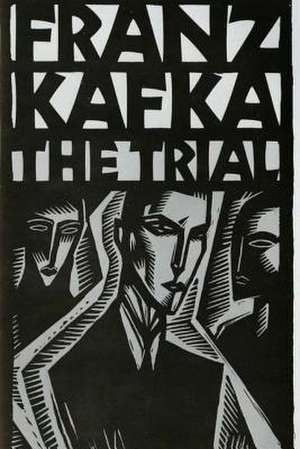
The Trial
Autor Franz Kafka Editat de Editors, Jven Limba Engleză Paperback
Preț: 84.27 lei
Carte tipărită la comandă
Livrare economică 07-21 decembrie
Specificații
ISBN-10: 1981719679
Pagini: 276
Dimensiuni: 152 x 229 x 15 mm
Greutate: 0.37 kg
V-ar putea interesa
-
 Jab, Jab, Jab, Right HookGary VaynerchukPreț: 128.18 lei
 -
 Foucault's PendulumUmberto Eco-27%Preț: 69.96 lei96.34 lei
 -
 ChokeChuck Palahniuk-18%Preț: 58.96 lei72.22 lei
 -
 The Handmaid's TaleMargaret Atwood-18%Preț: 59.78 lei72.48 lei
 -
 Breakfast of ChampionsKurt Vonnegut-25%Preț: 59.64 lei79.20 lei
 -
 In Cold BloodTruman Capote-24%Preț: 60.01 lei79.39 lei
 -
 On the RoadJack Kerouac-25%Preț: 59.42 lei79.39 lei
 -
 The PlagueAlbert Camus-26%Preț: 58.49 lei78.83 lei
 -
 The Art of WarSun Tzu-18%Preț: 76.58 lei93.40 lei
 -
 Confessions of a MaskYukio Mishima-26%Preț: 57.53 lei78.09 lei
 -
 The Man in the High CastlePhilip K. Dick-19%Preț: 58.03 lei71.30 lei
 -
 The Catcher in the RyeJ. D. SalingerPreț: 54.48 lei
 -
 EmbassytownChina Mieville-32%Preț: 54.11 lei80.12 lei
 -
 -26%Preț: 80.62 lei108.69 lei
 -
 -29%Preț: 88.26 lei123.82 lei
 -
 Discipline and PunishMichel FoucaultPreț: 105.22 lei
 -
 Post OfficeCharles BukowskiPreț: 77.97 lei
 -
 Preț: 52.09 lei
 -
 UlyssesJames JoycePreț: 41.38 lei
 -
 Parade's EndFord Madox FordPreț: 28.01 lei
 -
 Age of InnocenceEdith WhartonPreț: 28.01 lei
Notă biografică
Descriere
'Someone must have been telling tales about Josef K. for one morning, without having done anything wrong, he was arrested.'A successful professional man wakes up one morning to find himself under arrest for an offence which is never explained. The mysterious court which conducts his trial is outwardly co-operative, but capable of horrific violence. Faced with this ambiguous authority, Josef K. gradually succumbs to its psychological pressure. He consults various advisers without escaping his fate. Was there some way out that he failed to see? Kafka's unfinished novel has been read as a study of political power, apessimistic religious parable, or a crime novel where the accused man is himself the problem.One of the iconic figures of modern world literature, Kafka writes about universal problems of guilt, responsibility, and freedom; he offers no solutions, but provokes his readers to arrive at meanings of their own. This new edition includes the fragmentary chapters that were omitted from the main text, in a translation that is both natural and exact, and an introduction that illuminates the novel and its author. ABOUT THE SERIES: For over 100 years Oxford World's Classics has made available the widest range of literature from around the globe. Each affordable volume reflects Oxford's commitment to scholarship, providing the most accurate text plus a wealth of other valuable features, including expert introductions by leading authorities, helpful notes to clarify the text, up-to-date bibliographies for further study, and much more.
Recenzii
—Walter Benjamin
“Breon Mitchell’s translation is an accomplishment of the highest order that will honor Kafka far into the twenty-first century.”
—Walter Abish, author of How German Is It