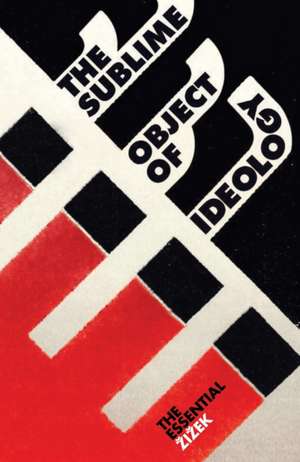
The Sublime Object of Ideology: Essential Zizek
Autor Slavoj Zizeken Limba Engleză Paperback – 2009

Preț: 116.34 lei
Nou
Puncte Express: 175
Preț estimativ în valută:
20.58€ • 23.98$ • 17.97£
20.58€ • 23.98$ • 17.97£
Carte disponibilă
Livrare economică 29 decembrie 25 - 12 ianuarie 26
Livrare express 12-18 decembrie pentru 20.11 lei
Preluare comenzi: 021 569.72.76
Specificații
ISBN-13: 9781844673001
ISBN-10: 1844673006
Pagini: 304
Dimensiuni: 125 x 193 x 21 mm
Greutate: 0.25 kg
Ediția:2
Editura: Verso Books
Seria Essential Zizek
ISBN-10: 1844673006
Pagini: 304
Dimensiuni: 125 x 193 x 21 mm
Greutate: 0.25 kg
Ediția:2
Editura: Verso Books
Seria Essential Zizek
V-ar putea interesa
-
 Papers and JournalsVictor Eremita-19%Preț: 97.18 lei119.25 lei
 -
 One-Way Street and Other WritingsWalter BenjaminPreț: 75.39 lei
 -
 Anti-OedipusGilles DeleuzePreț: 120.67 lei
 -
 Philosophical Correspondence, 1759-1799Immanuel KantPreț: 365.68 lei
 -
 The Dharma BumsJack Kerouac-21%Preț: 48.11 lei61.09 lei
 -
 Truth and Existence – A Philosophical InquiryMichael GelvenPreț: 267.99 lei
 -
 Infinite JestDavid Foster Wallace-23%Preț: 83.35 lei108.35 lei
 -
 The Ego and the IdSigmund FreudPreț: 20.32 lei
 -
 Preț: 254.26 lei
 -
 The Tao of PoohBenjamin HoffPreț: 61.39 lei
 -
 Preț: 88.34 lei
 -
 Anthony Bourdain's Hungry GhostsAnthony Bourdain-18%Preț: 108.74 lei133.36 lei
 -
 -25%Preț: 185.95 lei248.06 lei
 -
 The DhammapadaGil FronsdalPreț: 67.42 lei
 -
 Ghosts of My LifeMark FisherPreț: 103.52 lei
 -
 The DivideJason Hickel-19%Preț: 61.93 lei76.58 lei
 -
 Living in the End TimesSlavoj ZizekPreț: 120.22 lei
 -
 EthicsBenedict de SpinozaPreț: 35.78 lei
 -
 The RepublicPlatoPreț: 36.04 lei
 -
 Roads To SantiagoCees Nooteboom-20%Preț: 71.55 lei89.52 lei
Notă biografică
Slavoj Žižek is a Slovenian philosopher and cultural critic. He is a professor at the European Graduate School, International Director of the Birkbeck Institute for the Humanities, Birkbeck College, University of London, and a senior researcher at the Institute of Sociology, University of Ljubljana, Slovenia. His books include Living in the End Times, First as Tragedy, Then as Farce, In Defense of Lost Causes, four volumes of the Essential Žižek, and many more.
Recenzii
“The Elvis of cultural theory.”—Chronicle of Higher Education
“The giant of Ljubljana provides the best intellectual high since Anti-Oedipus.”—The Village Voice
“The most formidably brilliant exponent of psychoanalysis, indeed of cultural theory in general, to have emerged in many decades.”—Terry Eagleton
“Unafraid of confrontation and with a near limitless grasp of pop symbolism”—The Times
“Žižek is a thinker who regards nothing as outside his field: the result is deeply interesting and provocative.”—Guardian
“Žižek is one of the few living writers to combine theoretical rigor with compulsive readability.”—Publishers Weekly
“Žižek leaves no social or cultural phenomenon untheorized, and is master of the counterintuitive observation”—New Yorker
“The giant of Ljubljana provides the best intellectual high since Anti-Oedipus.”—The Village Voice
“The most formidably brilliant exponent of psychoanalysis, indeed of cultural theory in general, to have emerged in many decades.”—Terry Eagleton
“Unafraid of confrontation and with a near limitless grasp of pop symbolism”—The Times
“Žižek is a thinker who regards nothing as outside his field: the result is deeply interesting and provocative.”—Guardian
“Žižek is one of the few living writers to combine theoretical rigor with compulsive readability.”—Publishers Weekly
“Žižek leaves no social or cultural phenomenon untheorized, and is master of the counterintuitive observation”—New Yorker