
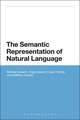
The Semantic Representation of Natural Language: Bloomsbury Studies in Theoretical Linguistics
Autor Michael Levison, Greg Lessard, Craig Thomas, Matthew Donalden Limba Engleză Hardback – 19 dec 2012
| Toate formatele și edițiile | Preț | Express |
|---|---|---|
| Paperback (1) | 265.33 lei 6-8 săpt. | |
| Bloomsbury Publishing – 25 iun 2014 | 265.33 lei 6-8 săpt. | |
| Hardback (1) | 1037.73 lei 6-8 săpt. | |
| Bloomsbury Publishing – 19 dec 2012 | 1037.73 lei 6-8 săpt. |


Preț: 1037.73 lei
Preț vechi: 1398.49 lei
-26% Nou
Puncte Express: 1557
Preț estimativ în valută:
183.68€ • 214.11$ • 160.63£
183.68€ • 214.11$ • 160.63£
Carte tipărită la comandă
Livrare economică 21 ianuarie-04 februarie 26
Preluare comenzi: 021 569.72.76
Specificații
ISBN-13: 9781441162533
ISBN-10: 1441162534
Pagini: 352
Dimensiuni: 156 x 234 x 18 mm
Greutate: 0.54 kg
Ediția:New.
Editura: Bloomsbury Publishing
Colecția Bloomsbury Academic
Seria Bloomsbury Studies in Theoretical Linguistics
Locul publicării:London, United Kingdom
ISBN-10: 1441162534
Pagini: 352
Dimensiuni: 156 x 234 x 18 mm
Greutate: 0.54 kg
Ediția:New.
Editura: Bloomsbury Publishing
Colecția Bloomsbury Academic
Seria Bloomsbury Studies in Theoretical Linguistics
Locul publicării:London, United Kingdom
V-ar putea interesa
-
 The Age of Spiritual MachinesRay Kurzweil-20%Preț: 98.41 lei123.01 lei
 -
 -18%Preț: 477.90 lei582.79 lei
 -
 Donald Michie: machine intelligence, biology and moreAshwin Srinivasan-28%Preț: 367.74 lei512.04 lei
 -
 -36%Preț: 51.23 lei80.45 lei
 -
 Gaussian Processes for Machine LearningCarl Edward Rasmussen-28%Preț: 326.87 lei454.74 lei
 -
 -20%Preț: 136.96 lei171.21 lei
 -
 Pattern Recognition and Machine LearningChristopher M Bishop-20%Preț: 554.36 lei692.95 lei
 -
 The Elements of Statistical LearningTrevor Hastie-20%Preț: 511.16 lei638.95 lei
 -
 -20%Preț: 404.64 lei505.80 lei
 -
 Statistical Machine TranslationPhilipp Koehn-20%Preț: 576.96 lei721.20 lei
 -
 Text-to-Speech SynthesisPaul Taylor-14%Preț: 693.88 lei806.84 lei
 -
 Preț: 482.15 lei
 -
 -9%Preț: 705.78 lei775.59 lei
 -
 Designing Voice User InterfacesCathy Pearl-20%Preț: 179.61 lei224.51 lei
 -
 Computational IntelligenceAlexandru Floares-41%Preț: 885.85 lei1513.14 lei
 -
 -31%Preț: 512.30 lei744.01 lei
 -
 -20%Preț: 885.17 lei1106.46 lei
 -
 Introducing Artificial Intelligence: A Graphic GuideHenry Brighton-20%Preț: 52.37 lei65.47 lei
 -
 -20%Preț: 288.90 lei361.13 lei
Caracteristici
Posits onomasiological (top-down) framework with meaning at its core and linguistic realization secondary.
Notă biografică
Michael Levison is a Professor Emeritus in the School of Computing at Queen's University,Canada.Greg Lessard is a Professor in the Department of French Studies at Queen's University, Canada.Craig Thomas earned his PhD from the School of Computing at Queen's University, Canada, in2010 under the supervision of Michael Levison and Greg Lessard.Matthew Donald earned his MSc from the School of Computing at Queen's University, Canada, in2006 under the direction of Michael Levison and Greg Lessard.
Cuprins
List of FiguresList of TablesPrefaceTypographical Conventions1. Introduction2. Basic Concepts3. Previous Approaches4. Semantic Expressions: Introduction5. Formal Issues6. Semantic Expressions: Basic Features7. Advanced Features8. Applications: Capture9. Three Little Pigs10. Applications CreationBibliographyIndex
Recenzii
Levison et al. present a useful meaning representation framework ... superior in both human-readability (especially by non-specialists) and in its representation of discourse structures beyond the sentence-level. These are important features and ... contribute to the greater usefulness of this framework for non-computational linguists.
[This book] provides a practical formal representation of the meaning of expressions of natural language, from basic semantic units to texts, which, commendably, relies closely on recent results within various contemporary theories and applications within lexical semantics, such as componential analysis, conceptual structures ... as well as various truth-conditional approaches to sentence meaning.
At last a book on natural language semantics that tackles semantics all the way up to texts of considerable length and fictional statements. The proposed formalism brings together well tried solutions for specific linguistic phenomena with a structural approach based on programming languages that makes it user friendly and gives it tremendous expressive power. A very useful contribution for natural language generation and the representation of narrative.
Semantic Representations of Natural Language provides a highly suggestive survey of the multiple relationships between semantic analysis and computational formalization of natural language and narratives, offering a vivid, nearly kaleidoscopic, theoretically comprehensive and strongly argued synthesis of a long lasting team approach. Even literature researchers concerned with the digital analysis of textuality will read this monograph with the greatest interest.
Genuine interdisciplinary research between linguistics, literary studies and computational approaches is rare. The research detailed here is an example of such interdisciplinary collaboration at its best. Technical, but enjoyable, this is a book to be read and thought about as it opens many new vistas.
[This book] provides a practical formal representation of the meaning of expressions of natural language, from basic semantic units to texts, which, commendably, relies closely on recent results within various contemporary theories and applications within lexical semantics, such as componential analysis, conceptual structures ... as well as various truth-conditional approaches to sentence meaning.
At last a book on natural language semantics that tackles semantics all the way up to texts of considerable length and fictional statements. The proposed formalism brings together well tried solutions for specific linguistic phenomena with a structural approach based on programming languages that makes it user friendly and gives it tremendous expressive power. A very useful contribution for natural language generation and the representation of narrative.
Semantic Representations of Natural Language provides a highly suggestive survey of the multiple relationships between semantic analysis and computational formalization of natural language and narratives, offering a vivid, nearly kaleidoscopic, theoretically comprehensive and strongly argued synthesis of a long lasting team approach. Even literature researchers concerned with the digital analysis of textuality will read this monograph with the greatest interest.
Genuine interdisciplinary research between linguistics, literary studies and computational approaches is rare. The research detailed here is an example of such interdisciplinary collaboration at its best. Technical, but enjoyable, this is a book to be read and thought about as it opens many new vistas.