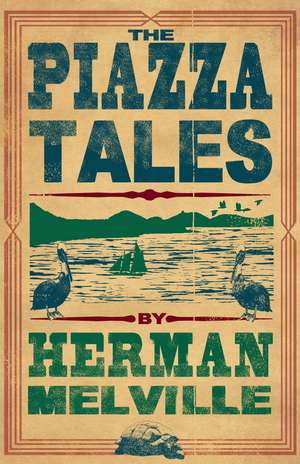
The Piazza Tales
Autor Herman Melvilleen Limba Engleză Paperback – 26 iul 2018
Also included in this volume are 'The Lightning-Rod Man', 'The Bell Tower' and a story written especially for the collection, 'The Piazza'. Taken together, these tales, in their masterful use of irony and concision, display the author of Moby Dick at his most uncompromising and compelling.
Preț: 58.01 lei
Puncte Express: 87
Carte disponibilă
Livrare economică 07-21 noiembrie
Livrare express 27-31 octombrie pentru 22.39 lei
Livrare prin curier în România Termenul estimat este afișat lângă disponibilitate.
Transport gratuit de la 400.00 lei Plată online sau ramburs, în funcție de opțiunile comenzii.
Retur gratuit în 14 zile Comandă securizată și suport în română.
Specificații
ISBN-13: 9781847497222
ISBN-10: 1847497225
Pagini: 224
Dimensiuni: 126 x 196 x 24 mm
Greutate: 0.27 kg
Editura: ALMA BOOKS
Locul publicării:London, United Kingdom
ISBN-10: 1847497225
Pagini: 224
Dimensiuni: 126 x 196 x 24 mm
Greutate: 0.27 kg
Editura: ALMA BOOKS
Locul publicării:London, United Kingdom
V-ar putea interesa
-
 Preț: 28.01 lei
 -
 Great Short Works of Herman MelvilleHerman MelvillePreț: 121.42 lei
 -
 Billy Budd, Bartleby, and Other StoriesHerman Melville-18%Preț: 59.52 lei72.52 lei
 -
 Herman Melville: A Very Short IntroductionMaurice S. Lee-20%Preț: 56.65 lei70.82 lei
 -
 Billy Budd, Sailor and Selected TalesHerman Melville-16%Preț: 55.63 lei66.50 lei
 -
 Melville's Short NovelsHerman MelvillePreț: 123.11 lei
 -
 Bartleby and Benito CerenoHerman MelvillePreț: 38.86 lei
 -
 The World's Greatest Short StoriesJames DaleyPreț: 47.60 lei
 -
 TypeeHerman MelvillePreț: 52.01 lei
 -
 The Essential Tales and Poems of Edgar Allan PoeEdgar Allan Poe-15%Preț: 95.12 lei112.23 lei
 -
 Preț: 294.46 lei
 -
 Edgar Allan Poe's Classic Tales of Mystery and ImaginationEdgar Allan PoePreț: 112.33 lei
 -
 Tales and PoemsEdgar Allan Poe-33%Preț: 53.12 lei79.52 lei
 -
 -21%Preț: 233.39 lei294.96 lei
 -
 The Raven & Other WritingsEdgar Allan PoePreț: 52.89 leiRecomandat
 -
 All The Sad Young MenF. Scott FitzgeraldPreț: 57.30 lei
 -
 -5%Preț: 63.35 lei66.57 lei
 -
 BartlebyFerdinand SchunckPreț: 37.85 lei
Recenzii
It is Melville who establishes the benchmark for what the short story can attain and allows us to set the standards by which all the other great writers of the form can be measured.
Cuprins
Acknowledgements
Introduction
Herman Melville: A Brief Chronology
A Note on the Text
The Piazza Tales
Introduction
Herman Melville: A Brief Chronology
A Note on the Text
The Piazza Tales
- “The Piazza”
- “Bartleby”
- “Benito Cereno”
- “The Lightning-Rod Man”
- “The Encantadas; or Enchanted Isles”
- “The Bell-Tower”
- From Herman Melville, “Hawthorne and his Mosses” (1850)
- From Edgar Allan Poe, Review of Nathaniel Hawthorne’s Twice-Told Tales (1842)
- Review of The Piazza Tales in United States Democratic Review (September 1856)
- Nathaniel Hawthorne, Preface to The House of the Seven Gables (1852)
- From Amasa Delano, Narrative of Voyages and Travels in the Northern and Southern Hemispheres (1817)
- From Frederick Douglass, The Heroic Slave (1853)
- From George Lippard, New York, Its Upper Ten and Lower Million (1854)
- From John Quincy Adams, Argument of John Quincy Adams (1841)
- The Slave Deck of the Bark “Wildfire,” Brought into Key West on April 30, 1860
- Alfred, Lord Tennyson, “Mariana” (1830)
- “Inscription for the Back of a Bank-Note” (1853)
- Matthew 5:38–48, King James Bible
- Job 3:1–26, King James Bible
- Judges 4:4–22, King James Bible
- From Charles Darwin, Journal of Researches (1839)
- From Jonathan Edwards, A Careful and Strict Inquiry into the Modern Prevailing Notions of that Freedom of Will (1754)
- sFrom Joseph Priestley, The Doctrine of Philosophical Necessity Illustrated (1777)
Notă biografică
Herman Melville (1819-1891) was an American novelist, short story writer, and poet, best known for his novel ""Moby-Dick."" Here is a detailed overview of his life and literary career, with a focus on his work ""Omoo: A Narrative of Adventures in the South Seas."". Melville was born into a well-to-do family, but his father's financial troubles and death left the family in difficult circumstances. His formal education was sporadic, but he was an avid reader and self-educated in literature and writing. Melville's time at sea profoundly influenced his writing. He worked on several ships, including a whaler, which provided material for his sea narratives. Melville's first two books, ""Typee"" (1846) and ""Omoo"" (1847), were well-received, offering romanticized accounts of his adventures in the South Seas. A narrative of his experiences in the Marquesas Islands. A sequel to ""Typee,"" ""Omoo"" recounts his subsequent adventures in the South Seas, focusing on his time on Tahiti and the surrounding islands. Melville's work was largely forgotten by the time of his death but was rediscovered in the early 20th century. ""Moby-Dick"" and his other works gained recognition for their complexity and depth. Today, Melville is considered one of the greatest American writers, with his work studied for its themes of humanity, nature, and the metaphysical.
Herman Melville's life and career were marked by early adventures and literary success, followed by a period of neglect and posthumous recognition. His contributions to American literature, particularly through works like ""Typee,"" ""Omoo,"" and ""Moby-Dick,"" have left a lasting impact.