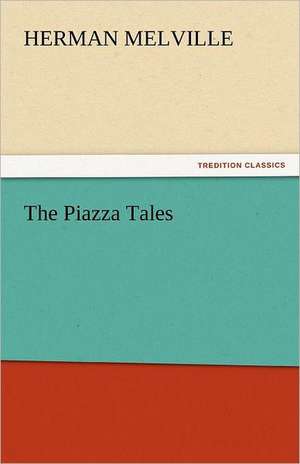
The Piazza Tales
Autor Herman Melvilleen Limba Engleză Paperback – 7 noi 2011
Preț: 185.87 lei
Puncte Express: 279
Carte disponibilă
Livrare economică 16-30 noiembrie
Livrare prin curier în România Termenul estimat este afișat lângă disponibilitate.
Transport gratuit de la 400.00 lei Plată online sau ramburs, în funcție de opțiunile comenzii.
Retur gratuit în 14 zile Comandă securizată și suport în română.
Specificații
ISBN-13: 9783842448865
ISBN-10: 3842448864
Pagini: 244
Dimensiuni: 133 x 203 x 18 mm
Greutate: 0.24 kg
Editura: TREDITION CLASSICS
ISBN-10: 3842448864
Pagini: 244
Dimensiuni: 133 x 203 x 18 mm
Greutate: 0.24 kg
Editura: TREDITION CLASSICS
V-ar putea interesa
-
 Tales of the Jazz AgeF. Scott FitzgeraldPreț: 28.01 lei
 -
 Great Short Works of Herman MelvilleHerman MelvillePreț: 121.42 lei
 -
 Billy Budd, Bartleby, and Other StoriesHerman Melville-18%Preț: 59.58 lei72.52 lei
 -
 Herman Melville: A Very Short IntroductionMaurice S. Lee-20%Preț: 56.65 lei70.82 lei
 -
 Billy Budd, Sailor and Selected TalesHerman Melville-15%Preț: 56.24 lei66.50 lei
 -
 Melville's Short NovelsHerman MelvillePreț: 123.11 lei
 -
 Bartleby and Benito CerenoHerman MelvillePreț: 38.86 lei
 -
 The World's Greatest Short StoriesJames DaleyPreț: 47.90 lei
 -
 TypeeHerman MelvillePreț: 52.01 lei
 -
 The Essential Tales and Poems of Edgar Allan PoeEdgar Allan Poe-15%Preț: 95.64 lei112.23 lei
 -
 Preț: 294.46 lei
 -
 Edgar Allan Poe's Classic Tales of Mystery and ImaginationEdgar Allan PoePreț: 112.33 lei
 -
 Tales and PoemsEdgar Allan Poe-33%Preț: 53.66 lei79.52 lei
 -
 -21%Preț: 233.52 lei294.96 lei
 -
 The Raven & Other WritingsEdgar Allan PoePreț: 53.21 leiRecomandat
 -
 All The Sad Young MenF. Scott FitzgeraldPreț: 57.30 lei
 -
 -5%Preț: 63.35 lei66.57 lei
 -
 BartlebyFerdinand SchunckPreț: 37.84 lei
Descriere
Descriere de la o altă ediție sau format:
Herman Melville’s The Piazza Tales is the only collection of short fiction that he published in his lifetime, and it includes his two most famous short stories, “Bartleby, the Scrivener” and “Benito Cereno,” along with the less well-known but deeply engaging sketches of the Galapagos Islands that make up “The Encantadas,” as well as three more short stories: “The Piazza,” “The Bell-Tower,” and “The Lightning-Rod Man.” This new edition places these stories in the context of nineteenth-century debates over slavery, free will and determinism, science and technology, and the nature and value of literary artistry. The stories in The Piazza Tales demonstrate the global range of Melville’s cultural and aesthetic concerns, as Melville set his stories in locales ranging from rural western Massachusetts and Wall Street in the United States to the Pacific coast of South America and southern Europe.
This edition is especially concerned with Melville’s engagement with both political questions related to slavery and imperialism and aesthetic questions germane to the short-story tradition as developed by his near-contemporaries Nathaniel Hawthorne and Edgar Allan Poe.
Herman Melville’s The Piazza Tales is the only collection of short fiction that he published in his lifetime, and it includes his two most famous short stories, “Bartleby, the Scrivener” and “Benito Cereno,” along with the less well-known but deeply engaging sketches of the Galapagos Islands that make up “The Encantadas,” as well as three more short stories: “The Piazza,” “The Bell-Tower,” and “The Lightning-Rod Man.” This new edition places these stories in the context of nineteenth-century debates over slavery, free will and determinism, science and technology, and the nature and value of literary artistry. The stories in The Piazza Tales demonstrate the global range of Melville’s cultural and aesthetic concerns, as Melville set his stories in locales ranging from rural western Massachusetts and Wall Street in the United States to the Pacific coast of South America and southern Europe.
This edition is especially concerned with Melville’s engagement with both political questions related to slavery and imperialism and aesthetic questions germane to the short-story tradition as developed by his near-contemporaries Nathaniel Hawthorne and Edgar Allan Poe.
Recenzii
Herman Melville’s The Piazza Tales is the only collection of short fiction that he published in his lifetime, and it includes his two most famous short stories, “Bartleby, the Scrivener” and “Benito Cereno,” along with the less well-known but deeply engaging sketches of the Galapagos Islands that make up “The Encantadas,” as well as three more short stories: “The Piazza,” “The Bell-Tower,” and “The Lightning-Rod Man.” This new edition places these stories in the context of nineteenth-century debates over slavery, free will and determinism, science and technology, and the nature and value of literary artistry. The stories in The Piazza Tales demonstrate the global range of Melville’s cultural and aesthetic concerns, as Melville set his stories in locales ranging from rural western Massachusetts and Wall Street in the United States to the Pacific coast of South America and southern Europe.
This edition is especially concerned with Melville’s engagement with both political questions related to slavery and imperialism and aesthetic questions germane to the short-story tradition as developed by his near-contemporaries Nathaniel Hawthorne and Edgar Allan Poe.
“At last! Although the stories in The Piazza Tales have been collected and anthologized before, only in this version, with Brian Yothers’s meticulous editing, general introduction, and selection of contextual readings, do we get the book Herman Melville envisioned—for twenty-first-century readers and students. Yothers presents a seasoned novelist, but an experimental writer of tales, laboring within a hectic magazine economy and changing literary history forever. He also exhibits a Melville who responds vigorously to contemporary debates over slavery, urbanization, capitalism, and changing gender roles, and who engages with nineteenth-century science, philosophy, and religion, as well as with a transatlantic cast of canonical and popular authors. Prepare to be delighted and surprised by a Melville you may not have known existed.” — Wyn Kelley, Massachusetts Institute of Technology
“In this new Broadview Press edition of Melville’s original 1856 version of The Piazza Tales, Brian Yothers provides a valuable classroom edition that includes reviews, sources and allusions, and other contemporary writings on the art of the story, on slavery and inequality, on science and philosophy, and on other topics of importance to an understanding of the diverse worlds embodied in these tales. Yothers’s illuminating introduction highlights the distinctive character of each of the stories while adroitly placing them in the context of Melville’s personal history and career as a fiction writer and poet, making an eloquent case for reading all six stories together for their imaginative variety and skillful artistry. For teachers of Melville, this compact volume fills a long-standing need.” — Christopher Sten, George Washington University
“This new edition makes a strong claim to become the Piazza Tales of choice in the undergraduate classroom. … The appendices feature many inspired choices that will amplify the literary and historical resonance of The Piazza Tales without encumbering students with lengthy supplementary readings.” — Dawn Coleman, Leviathan
This edition is especially concerned with Melville’s engagement with both political questions related to slavery and imperialism and aesthetic questions germane to the short-story tradition as developed by his near-contemporaries Nathaniel Hawthorne and Edgar Allan Poe.
“At last! Although the stories in The Piazza Tales have been collected and anthologized before, only in this version, with Brian Yothers’s meticulous editing, general introduction, and selection of contextual readings, do we get the book Herman Melville envisioned—for twenty-first-century readers and students. Yothers presents a seasoned novelist, but an experimental writer of tales, laboring within a hectic magazine economy and changing literary history forever. He also exhibits a Melville who responds vigorously to contemporary debates over slavery, urbanization, capitalism, and changing gender roles, and who engages with nineteenth-century science, philosophy, and religion, as well as with a transatlantic cast of canonical and popular authors. Prepare to be delighted and surprised by a Melville you may not have known existed.” — Wyn Kelley, Massachusetts Institute of Technology
“In this new Broadview Press edition of Melville’s original 1856 version of The Piazza Tales, Brian Yothers provides a valuable classroom edition that includes reviews, sources and allusions, and other contemporary writings on the art of the story, on slavery and inequality, on science and philosophy, and on other topics of importance to an understanding of the diverse worlds embodied in these tales. Yothers’s illuminating introduction highlights the distinctive character of each of the stories while adroitly placing them in the context of Melville’s personal history and career as a fiction writer and poet, making an eloquent case for reading all six stories together for their imaginative variety and skillful artistry. For teachers of Melville, this compact volume fills a long-standing need.” — Christopher Sten, George Washington University
“This new edition makes a strong claim to become the Piazza Tales of choice in the undergraduate classroom. … The appendices feature many inspired choices that will amplify the literary and historical resonance of The Piazza Tales without encumbering students with lengthy supplementary readings.” — Dawn Coleman, Leviathan
Cuprins
Acknowledgements
Introduction
Herman Melville: A Brief Chronology
A Note on the Text
The Piazza Tales
Introduction
Herman Melville: A Brief Chronology
A Note on the Text
The Piazza Tales
- “The Piazza”
- “Bartleby”
- “Benito Cereno”
- “The Lightning-Rod Man”
- “The Encantadas; or Enchanted Isles”
- “The Bell-Tower”
- From Herman Melville, “Hawthorne and his Mosses” (1850)
- From Edgar Allan Poe, Review of Nathaniel Hawthorne’s Twice-Told Tales (1842)
- Review of The Piazza Tales in United States Democratic Review (September 1856)
- Nathaniel Hawthorne, Preface to The House of the Seven Gables (1852)
- From Amasa Delano, Narrative of Voyages and Travels in the Northern and Southern Hemispheres (1817)
- From Frederick Douglass, The Heroic Slave (1853)
- From George Lippard, New York, Its Upper Ten and Lower Million (1854)
- From John Quincy Adams, Argument of John Quincy Adams (1841)
- The Slave Deck of the Bark “Wildfire,” Brought into Key West on April 30, 1860
- Alfred, Lord Tennyson, “Mariana” (1830)
- “Inscription for the Back of a Bank-Note” (1853)
- Matthew 5:38–48, King James Bible
- Job 3:1–26, King James Bible
- Judges 4:4–22, King James Bible
- From Charles Darwin, Journal of Researches (1839)
- From Jonathan Edwards, A Careful and Strict Inquiry into the Modern Prevailing Notions of that Freedom of Will (1754)
- sFrom Joseph Priestley, The Doctrine of Philosophical Necessity Illustrated (1777)
Notă biografică
Herman Melville (1819-1891) was an American novelist, short story writer, and poet, best known for his novel ""Moby-Dick."" Here is a detailed overview of his life and literary career, with a focus on his work ""Omoo: A Narrative of Adventures in the South Seas."". Melville was born into a well-to-do family, but his father's financial troubles and death left the family in difficult circumstances. His formal education was sporadic, but he was an avid reader and self-educated in literature and writing. Melville's time at sea profoundly influenced his writing. He worked on several ships, including a whaler, which provided material for his sea narratives. Melville's first two books, ""Typee"" (1846) and ""Omoo"" (1847), were well-received, offering romanticized accounts of his adventures in the South Seas. A narrative of his experiences in the Marquesas Islands. A sequel to ""Typee,"" ""Omoo"" recounts his subsequent adventures in the South Seas, focusing on his time on Tahiti and the surrounding islands. Melville's work was largely forgotten by the time of his death but was rediscovered in the early 20th century. ""Moby-Dick"" and his other works gained recognition for their complexity and depth. Today, Melville is considered one of the greatest American writers, with his work studied for its themes of humanity, nature, and the metaphysical.
Herman Melville's life and career were marked by early adventures and literary success, followed by a period of neglect and posthumous recognition. His contributions to American literature, particularly through works like ""Typee,"" ""Omoo,"" and ""Moby-Dick,"" have left a lasting impact.