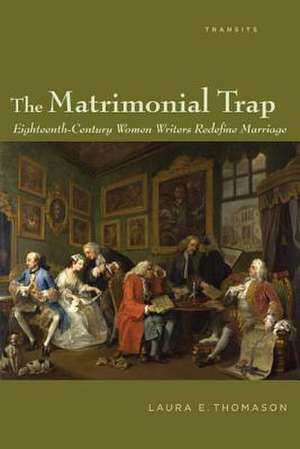
The Matrimonial Trap: Eighteenth-Century Women Writers Redefine Marriage: Transits: Literature, Thought & Culture, 1650–1850
Autor Laura E. Thomasonen Limba Engleză Paperback – 31 aug 2015
Din seria Transits: Literature, Thought & Culture, 1650–1850
- 55%
 Preț: 403.87 lei
 - 34%
 Preț: 541.74 lei
 - 55%
 Preț: 404.56 lei
 - 23%
 Preț: 333.81 lei
 - 23%
 Preț: 333.91 lei
 - 31%
 Preț: 343.05 lei
 - 23%
 Preț: 324.90 lei
 - 34%
 Preț: 498.65 lei
 - 22%
 Preț: 350.78 lei
 - 34%
 Preț: 602.84 lei
 - 23%
 Preț: 326.83 lei
 - 31%
 Preț: 342.52 lei
 - 23%
 Preț: 319.77 lei
 - 31%
 Preț: 343.83 lei
 - 34%
 Preț: 565.36 lei
 - 22%
 Preț: 337.41 lei
 - 22%
 Preț: 334.88 lei
 - 34%
 Preț: 565.20 lei
 - 34%
 Preț: 628.08 lei
 - 22%
 Preț: 351.17 lei
 - 22%
 Preț: 344.31 lei
 - 22%
 Preț: 327.89 lei
 - 23%
 Preț: 305.44 lei
 - 27%
 Preț: 247.91 lei
 - 26%
 Preț: 271.75 lei
 -
 Preț: 244.58 lei
 - 19%
 Preț: 335.45 lei
 - 22%
 Preț: 342.63 lei
 - 22%
 Preț: 328.09 lei
 - 22%
 Preț: 364.62 lei
 - 26%
 Preț: 245.87 lei
 - 23%
 Preț: 305.24 lei
 - 22%
 Preț: 336.92 lei
 - 22%
 Preț: 298.86 lei
 - 22%
 Preț: 321.92 lei
 - 31%
 Preț: 364.26 lei
 - 34%
 Preț: 645.53 lei
Preț: 326.74 lei
Preț vechi: 422.16 lei
-23%
Puncte Express: 490
Preț estimativ în valută:
57.83€ • 67.58$ • 50.20£
57.83€ • 67.58$ • 50.20£
Carte tipărită la comandă
Livrare economică 20 februarie-06 martie
Preluare comenzi: 021 569.72.76
Specificații
ISBN-13: 9781611487053
ISBN-10: 1611487056
Pagini: 216
Dimensiuni: 154 x 235 x 15 mm
Greutate: 0.35 kg
Editura: Bloomsbury Publishing
Colecția Bucknell University Press
Seria Transits: Literature, Thought & Culture, 1650–1850
Locul publicării:New York, United States
ISBN-10: 1611487056
Pagini: 216
Dimensiuni: 154 x 235 x 15 mm
Greutate: 0.35 kg
Editura: Bloomsbury Publishing
Colecția Bucknell University Press
Seria Transits: Literature, Thought & Culture, 1650–1850
Locul publicării:New York, United States
Cuprins
Contents
Acknowledgments vii
Introduction: Eighteenth-Century Marriage in Crisis?
Chapter 1: Intimacy, Identity, and Marital Choice: The Osborne-Temple Correspondence
Chapter 2: Lady Mary Wortley Montagu: The Power of Self-Fashioning
Chapter 3: Hester Chapone as a Living Clarissa in Letters on Filial Obedience and A Matrimonial Creed
Chapter 4: "Perfect Friendship": Mary Delany, Companionacy, and Control
Chapter 5: Duty and Sentiment in Sarah Scott's The Test of Filial Duty
Chapter 6: Eliza Haywood: The Limits of Feminine Agency
Afterword: From Clarissa Harlowe to Elizabeth Bennet
Bibliography
About the Author
Acknowledgments vii
Introduction: Eighteenth-Century Marriage in Crisis?
Chapter 1: Intimacy, Identity, and Marital Choice: The Osborne-Temple Correspondence
Chapter 2: Lady Mary Wortley Montagu: The Power of Self-Fashioning
Chapter 3: Hester Chapone as a Living Clarissa in Letters on Filial Obedience and A Matrimonial Creed
Chapter 4: "Perfect Friendship": Mary Delany, Companionacy, and Control
Chapter 5: Duty and Sentiment in Sarah Scott's The Test of Filial Duty
Chapter 6: Eliza Haywood: The Limits of Feminine Agency
Afterword: From Clarissa Harlowe to Elizabeth Bennet
Bibliography
About the Author
Recenzii
The historian Lawrence Stone argued that the 18th century reconceived marriage as a 'companionate' arrangement founded on mutual affection. Thomason complicates Stone's argument by analyzing the rhetorical self-fashioning of six women writers, nearly all of the social elite. As Thomason demonstrates, women theorized the companionate marriage ideal, rather than taking it as a fait accompli, and shaped their characters to maximize their own freedoms. Thus, Dorothy Osborne and Mary Wortley Montagu both secured their own choice of husband by variously performing the roles of good daughter, virtuous maiden, and canny economist. Similarly, in her correspondence with Samuel Richardson, Hester Chapone cast herself as subject to patriarchal authority in order to undermine the assertion that daughters were obliged to marry as their families desired, while Mary Delany, warning against 'mercenary' marriages, emphasized that marital success was not solely the wife's obligation. Sarah Scott's fiction underlines the emotional toll of arranged marriages, and Eliza Haywood's advice literature tries to codify the attitudes and behaviors that will make companionate marriage a success. Thomason usefully reminds the reader that even conservative rhetorics of gender offered considerable room for rhetorical play and self-determination. Summing Up: Recommended. Upper-division undergraduates through faculty.
Laura E. Thompson's The Matrimonial Trap: Eighteenth Century Women Writers Redefine Marriage offers scholars an engaging insight into the ways that women of the long eighteenth century viewed themselves as active participants in the marriage economy. . . .Thompson's study of marriage provides a thoughtful examination of how women writers consciously and meticulously honed through writing their identities as women and would-be wives. She demonstrates that these women harnessed the power of rhetorical restraint and audience analysis in ways that were sophisticated and used those skills to empower themselves in a system that was purposefully constructed to strip them of such agency. For a well-trod academic topic, Thompson extracts a refreshing analysis of how female writers employed remarkable rhetorical dexterity to spring the matrimonial trap.
Laura E. Thompson's The Matrimonial Trap: Eighteenth Century Women Writers Redefine Marriage offers scholars an engaging insight into the ways that women of the long eighteenth century viewed themselves as active participants in the marriage economy. . . .Thompson's study of marriage provides a thoughtful examination of how women writers consciously and meticulously honed through writing their identities as women and would-be wives. She demonstrates that these women harnessed the power of rhetorical restraint and audience analysis in ways that were sophisticated and used those skills to empower themselves in a system that was purposefully constructed to strip them of such agency. For a well-trod academic topic, Thompson extracts a refreshing analysis of how female writers employed remarkable rhetorical dexterity to spring the matrimonial trap.