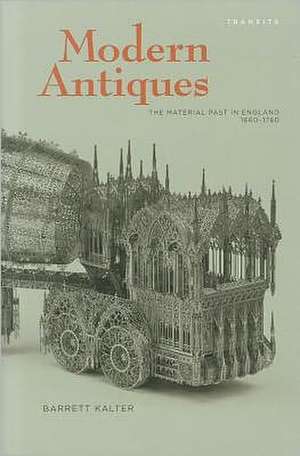
Modern Antiques: The Material Past in England, 1660–1780: Transits: Literature, Thought & Culture, 1650–1850
Autor Barrett Kalteren Limba Engleză Hardback – 23 dec 2011
Inspired by the authentic products as well as the anomalous by-products of contemporary scholarship, writers, craftsmen, and shoppers appropriated the past to create nostalgic and ironic alternatives to their own moment. Barrett Kalter explores the history of these "modern antiques," including Dryden's translation of Virgil, modernizations of The Canterbury Tales, Gray's Gothic wallpaper, and Walpole's Strawberry Hill. Though grounded in the ancient and medieval eras, these works uncannily addressed the controversies about monarchy, nationhood, commerce, and specialized knowledge that defined the present for the English eighteenth century. Bringing together literary criticism, historiography, material culture studies, and book history, Kalter argues that the proliferation of modern antiques in the period reveals modernity's paradoxical emergence out of encounters with the past.
Din seria Transits: Literature, Thought & Culture, 1650–1850
- 33%
 Preț: 714.55 lei
 - 23%
 Preț: 321.15 lei
 - 27%
 Preț: 353.58 lei
 - 47%
 Preț: 455.67 lei
 - 24%
 Preț: 369.27 lei
 - 32%
 Preț: 361.88 lei
 - 23%
 Preț: 337.85 lei
 - 29%
 Preț: 343.17 lei
 - 26%
 Preț: 286.06 lei
 - 24%
 Preț: 353.05 lei
 - 28%
 Preț: 382.95 lei
 - 35%
 Preț: 594.98 lei
 - 27%
 Preț: 351.39 lei
 - 32%
 Preț: 361.23 lei
 - 24%
 Preț: 368.26 lei
 - 25%
 Preț: 361.94 lei
 - 36%
 Preț: 674.42 lei
 - 33%
 Preț: 519.17 lei
 - 33%
 Preț: 643.17 lei
 - 23%
 Preț: 335.82 lei
 -
 Preț: 258.01 lei
 - 34%
 Preț: 599.66 lei
 - 29%
 Preț: 341.81 lei
 - 27%
 Preț: 351.30 lei
 - 27%
 Preț: 351.80 lei
 - 27%
 Preț: 352.54 lei
 - 27%
 Preț: 257.41 lei
 - 29%
 Preț: 344.18 lei
 - 23%
 Preț: 321.15 lei
 - 37%
 Preț: 660.95 lei
 - 23%
 Preț: 314.30 lei
 - 32%
 Preț: 360.78 lei
 - 34%
 Preț: 383.68 lei
 - 28%
 Preț: 349.32 lei
 - 56%
 Preț: 421.30 lei
 - 27%
 Preț: 261.05 lei
 - 26%
 Preț: 359.87 lei
 - 34%
 Preț: 634.63 lei
 - 29%
 Preț: 345.19 lei
Preț: 422.77 lei
Preț vechi: 960.47 lei
-56%
Puncte Express: 634
Carte disponibilă
Livrare economică 13-25 noiembrie
Livrare prin curier în România Termenul estimat este afișat lângă disponibilitate.
Transport gratuit pentru acest produs Plată online sau ramburs, în funcție de opțiunile comenzii.
Retur gratuit în 14 zile Comandă securizată și suport în română.
Specificații
ISBN-13: 9781611483789
ISBN-10: 1611483786
Pagini: 260
Dimensiuni: 154 x 230 x 28 mm
Greutate: 0.52 kg
Ediția:New.
Editura: Bloomsbury Publishing
Colecția Bucknell University Press
Seria Transits: Literature, Thought & Culture, 1650–1850
Locul publicării:New York, United States
ISBN-10: 1611483786
Pagini: 260
Dimensiuni: 154 x 230 x 28 mm
Greutate: 0.52 kg
Ediția:New.
Editura: Bloomsbury Publishing
Colecția Bucknell University Press
Seria Transits: Literature, Thought & Culture, 1650–1850
Locul publicării:New York, United States
Cuprins
Acknowledgments
Introduction: The Time Bound and the Modern Antique
Chapter 1 The "Cobweb-Law" and the Fundamental Law: History, Chronology, and Poetic License
Chapter 2 Chaucer Ancient and Modern: Standardization, Modernization, and the Eighteenth-Century Reception of The Canterbury Tales
Chapter 3 DIY Gothic: Thomas Gray and the Medieval Revival
Chapter 4 Horace Walpole's Fugitive Pieces: Collecting and Ephemerality
Conclusion
Introduction: The Time Bound and the Modern Antique
Chapter 1 The "Cobweb-Law" and the Fundamental Law: History, Chronology, and Poetic License
Chapter 2 Chaucer Ancient and Modern: Standardization, Modernization, and the Eighteenth-Century Reception of The Canterbury Tales
Chapter 3 DIY Gothic: Thomas Gray and the Medieval Revival
Chapter 4 Horace Walpole's Fugitive Pieces: Collecting and Ephemerality
Conclusion
Recenzii
Kalter's consideration of the appreciation of the past in 18th-century England is part of a new series, "Transits," which aims to publish on varied aspects of thought and culture. Kalter (Univ. of Wisconsin, Milwaukee) treats a wide range of material artifacts and asserts that the period's awareness of history was expressed not only in writing but also in tangible collections. In each chapter, he focuses on authors in light of their interest in or practice of historical scholarship. After looking at the influence of chronology on Dryden's approach to contemporary issues, Kalter turns to Chaucer manuscripts and textual scholarship. Later chapters deal with Thomas Gray's preference for the Middle Ages and Horace Walpole's antiquarianism. The author presents a view of a cultural reworking of the past that makes use of "modern antiques" to offer a model for thinking about history in a rapidly changing century. In some way, Kalter sees the antiquarian mode in 18th-century thought as part of the new nationalism and also of the expansion of print culture and a consumer society. Also valuable for those specializing in the philosophy of history. Summing Up: Recommended.
The classical and medieval past acquires a satisfying tangibility in Modern Antiques: the Material Past in England, 1660-1780, in which Barrett Kalter argues that 'the period's consciousness of history was not only expressed in but inextricable from the interdependent spheres of print, consumption, and scholarship'. Kalter in the introduction formulates a historical materialist methodology designed to maintain a double focus-on the intellectual and the material, the present and the past, the scholarly and the literary-and thereby to elucidate the complex interactions between history and imagination in the material and print cultures of the eighteenth century.
The classical and medieval past acquires a satisfying tangibility in Modern Antiques: the Material Past in England, 1660-1780, in which Barrett Kalter argues that 'the period's consciousness of history was not only expressed in but inextricable from the interdependent spheres of print, consumption, and scholarship'. Kalter in the introduction formulates a historical materialist methodology designed to maintain a double focus-on the intellectual and the material, the present and the past, the scholarly and the literary-and thereby to elucidate the complex interactions between history and imagination in the material and print cultures of the eighteenth century.