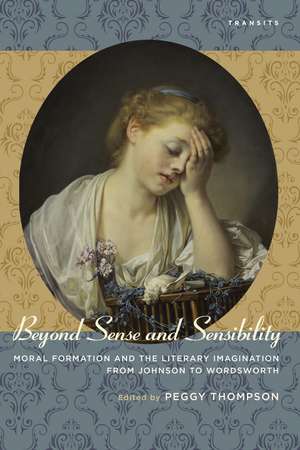
Beyond Sense and Sensibility: Moral Formation and the Literary Imagination from Johnson to Wordsworth: Transits: Literature, Thought & Culture, 1650–1850
Editat de Peggy Thompson Contribuţii de Rhona Brown, Leslie A. Chilton, Timothy Erwin, Evan Gottlieb, Christopher D. Johnson, Heather King, James Noggle, Adam Rounce, Adrianne Wadewitzen Limba Engleză Paperback – 14 oct 2016
Drawing extensively on philosophical thought from the eighteenth century as well as conceptual frameworks developed in the twenty-first century, this volume of essays examines moral formation represented in or implicitly produced by a range of texts, including Boswell's literary criticism, Fergusson's poetry, Burney's novels, Doddridge's biography, Smollett's novels, Charlotte Smith's children's books, Johnson's essays, Gibbon's history, and Wordsworth's poetry. The distinctive conceptual and textual breadth of Beyond Sense and Sensibility yields a rich reassessment and augmentation of the two perspectives summarized by the terms sense and sensibility in later eighteenth-century Britain.
Din seria Transits: Literature, Thought & Culture, 1650–1850
- 33%
 Preț: 684.38 lei
 - 24%
 Preț: 306.36 lei
 - 28%
 Preț: 337.93 lei
 - 48%
 Preț: 438.12 lei
 - 25%
 Preț: 352.23 lei
 - 33%
 Preț: 344.88 lei
 - 24%
 Preț: 322.88 lei
 - 30%
 Preț: 327.72 lei
 - 28%
 Preț: 272.58 lei
 - 25%
 Preț: 336.45 lei
 - 29%
 Preț: 365.72 lei
 - 35%
 Preț: 569.90 lei
 - 28%
 Preț: 334.91 lei
 - 33%
 Preț: 344.09 lei
 - 25%
 Preț: 351.84 lei
 - 27%
 Preț: 345.33 lei
 - 37%
 Preț: 647.47 lei
 - 33%
 Preț: 501.70 lei
 - 34%
 Preț: 615.93 lei
 - 24%
 Preț: 320.72 lei
 -
 Preț: 245.32 lei
 - 35%
 Preț: 574.37 lei
 - 30%
 Preț: 325.87 lei
 - 29%
 Preț: 334.81 lei
 - 28%
 Preț: 338.41 lei
 - 28%
 Preț: 335.89 lei
 - 28%
 Preț: 246.62 lei
 - 30%
 Preț: 327.81 lei
 - 24%
 Preț: 306.16 lei
 - 38%
 Preț: 633.04 lei
 - 33%
 Preț: 343.57 lei
 - 35%
 Preț: 365.37 lei
 - 30%
 Preț: 328.89 lei
 - 56%
 Preț: 406.70 lei
 - 56%
 Preț: 405.79 lei
 - 28%
 Preț: 248.52 lei
 - 27%
 Preț: 343.64 lei
 - 35%
 Preț: 607.87 lei
 - 30%
 Preț: 329.07 lei
Preț: 299.74 lei
Preț vechi: 394.84 lei
-24%
Puncte Express: 450
Carte tipărită la comandă
Livrare economică 06-20 iunie
Specificații
ISBN-13: 9781611486421
ISBN-10: 1611486424
Pagini: 226
Ilustrații: 3 b/w photos
Dimensiuni: 151 x 229 x 17 mm
Greutate: 0.34 kg
Editura: Bloomsbury Publishing
Colecția Bucknell University Press
Seria Transits: Literature, Thought & Culture, 1650–1850
Locul publicării:New York, United States
ISBN-10: 1611486424
Pagini: 226
Ilustrații: 3 b/w photos
Dimensiuni: 151 x 229 x 17 mm
Greutate: 0.34 kg
Editura: Bloomsbury Publishing
Colecția Bucknell University Press
Seria Transits: Literature, Thought & Culture, 1650–1850
Locul publicării:New York, United States
Cuprins
List of Illustrations
Foreword: In Memoriam O M Brack, Jr. (1938-2012)
Timothy Erwin
Acknowledgments
Introduction
Part I Revisiting Sensibility
Chapter One: Boswell and the Limits of Sensibility
Adam Rounce
Chapter Two: "Beshrew the sombre pencil!": Robert Fergusson and Sensibility in Scotland
Rhona Brown
Chapter Three: Pictures of Women in Frances Burney's Cecilia and Camilla: How Cecilia Looks and What Camilla Sees
Heather King
Part II Rethinking Didacticism
Chapter Four: Artful Instruction: Philip Doddridge's Life of Colonel James Gardiner
Christopher D. Johnson
Chapter Five: Two Singularly Moral Works: Fenelon's The Adventure of Telemachus and Smollett's The Expedition of Humphry Clinker
Leslie A. Chilton
Chapter Six: The Politically Engaged Child: Charlotte Smith's Children's Literature and the Discourse of Sensibility
Adrianne Wadewitz
Part III Reframing the Questions
Chapter Seven: Habit and Reason in Samuel Johnson's Rambler
Peggy Thompson
Chapter Eight: Unfelt Affect
James Noggle
Chapter Nine: Seeing into the Life of Things: Re-Viewing Early Wordsworth through Object-Oriented Philosophy
Evan Gottlieb
Works Cited
Index
About the Contributors
Foreword: In Memoriam O M Brack, Jr. (1938-2012)
Timothy Erwin
Acknowledgments
Introduction
Part I Revisiting Sensibility
Chapter One: Boswell and the Limits of Sensibility
Adam Rounce
Chapter Two: "Beshrew the sombre pencil!": Robert Fergusson and Sensibility in Scotland
Rhona Brown
Chapter Three: Pictures of Women in Frances Burney's Cecilia and Camilla: How Cecilia Looks and What Camilla Sees
Heather King
Part II Rethinking Didacticism
Chapter Four: Artful Instruction: Philip Doddridge's Life of Colonel James Gardiner
Christopher D. Johnson
Chapter Five: Two Singularly Moral Works: Fenelon's The Adventure of Telemachus and Smollett's The Expedition of Humphry Clinker
Leslie A. Chilton
Chapter Six: The Politically Engaged Child: Charlotte Smith's Children's Literature and the Discourse of Sensibility
Adrianne Wadewitz
Part III Reframing the Questions
Chapter Seven: Habit and Reason in Samuel Johnson's Rambler
Peggy Thompson
Chapter Eight: Unfelt Affect
James Noggle
Chapter Nine: Seeing into the Life of Things: Re-Viewing Early Wordsworth through Object-Oriented Philosophy
Evan Gottlieb
Works Cited
Index
About the Contributors
Recenzii
The nine essays published here are presented as a Festschrift for the great bibliographer and Smollett scholar O. M. Brack . . . The essays themselves range widely in subject: Adam Rounce explores James Boswell's distancing of himself from the less sentimental Dr. Johnson, who (as Mrs. Thrase said) always 'hated a feeler'; Heather King traces Frances Burney's persistent argument that the same 'sensibility' that makes female suffering morally educative to men takes a terrible toll on women themselves. Perhaps the best essays in the collection come in the last section, 'Reframing the Question': the editor's own discussion of Johnson's fear of nonrational 'habit' and James Noggle on the curious fondness during the 'age of sensibility' for the word insensibly (most of all in Gibbon) . . . Every essay in it [the collection] is clear, thoughtful, interesting, and informative. Summing Up: Recommended. Lower-division undergraduates and above.