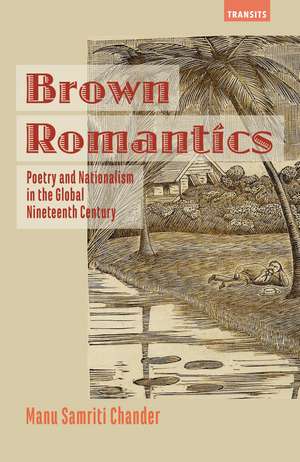
Brown Romantics: Poetry and Nationalism in the Global Nineteenth Century: Transits: Literature, Thought & Culture, 1650–1850
Autor Manu Samriti Chanderen Limba Engleză Paperback – 5 noi 2019
Din seria Transits: Literature, Thought & Culture, 1650–1850
- 33%
 Preț: 714.55 lei
 - 23%
 Preț: 321.15 lei
 - 27%
 Preț: 353.58 lei
 - 47%
 Preț: 455.67 lei
 - 24%
 Preț: 369.27 lei
 - 32%
 Preț: 361.88 lei
 - 23%
 Preț: 337.85 lei
 - 29%
 Preț: 343.17 lei
 - 26%
 Preț: 286.06 lei
 - 24%
 Preț: 353.05 lei
 - 28%
 Preț: 382.95 lei
 - 35%
 Preț: 594.98 lei
 - 27%
 Preț: 351.39 lei
 - 32%
 Preț: 361.23 lei
 - 24%
 Preț: 368.26 lei
 - 25%
 Preț: 361.94 lei
 - 36%
 Preț: 674.42 lei
 - 33%
 Preț: 519.17 lei
 - 33%
 Preț: 643.17 lei
 - 23%
 Preț: 335.82 lei
 -
 Preț: 258.01 lei
 - 34%
 Preț: 599.66 lei
 - 29%
 Preț: 341.81 lei
 - 27%
 Preț: 351.30 lei
 - 27%
 Preț: 351.80 lei
 - 27%
 Preț: 352.54 lei
 - 27%
 Preț: 257.41 lei
 - 29%
 Preț: 344.18 lei
 - 23%
 Preț: 321.15 lei
 - 37%
 Preț: 660.95 lei
 - 23%
 Preț: 314.30 lei
 - 32%
 Preț: 360.78 lei
 - 34%
 Preț: 383.68 lei
 - 28%
 Preț: 349.32 lei
 - 56%
 Preț: 421.30 lei
 - 56%
 Preț: 422.77 lei
 - 26%
 Preț: 359.87 lei
 - 34%
 Preț: 634.63 lei
 - 29%
 Preț: 345.19 lei
Preț: 261.05 lei
Preț vechi: 358.54 lei
-27%
Puncte Express: 392
Carte tipărită la comandă
Livrare economică 03-17 decembrie
Livrare prin curier în România Termenul estimat este afișat lângă disponibilitate.
Transport gratuit de la 400.00 lei Plată online sau ramburs, în funcție de opțiunile comenzii.
Retur gratuit în 14 zile Comandă securizată și suport în română.
Specificații
ISBN-13: 9781611488234
ISBN-10: 1611488230
Pagini: 144
Ilustrații: 4 b/w illustrations;
Dimensiuni: 148 x 226 x 14 mm
Greutate: 0.23 kg
Editura: Bloomsbury Publishing
Colecția Bucknell University Press
Seria Transits: Literature, Thought & Culture, 1650–1850
Locul publicării:New York, United States
ISBN-10: 1611488230
Pagini: 144
Ilustrații: 4 b/w illustrations;
Dimensiuni: 148 x 226 x 14 mm
Greutate: 0.23 kg
Editura: Bloomsbury Publishing
Colecția Bucknell University Press
Seria Transits: Literature, Thought & Culture, 1650–1850
Locul publicării:New York, United States
Cuprins
Introduction: World Literature and World Legislation
Chapter 1: Henry Derozio and the Beginnings of Indian Romanticism
Chapter 2: Christian Romanticism in British Guiana: The Case of Egbert Martin
Chapter 3: Henry Lawson and the Legacy of Romantic Sympathy
Chapter 4: Conclusion: Brown Keats
Afterword
Bibliography
Index
About the Author
Chapter 1: Henry Derozio and the Beginnings of Indian Romanticism
Chapter 2: Christian Romanticism in British Guiana: The Case of Egbert Martin
Chapter 3: Henry Lawson and the Legacy of Romantic Sympathy
Chapter 4: Conclusion: Brown Keats
Afterword
Bibliography
Index
About the Author
Recenzii
"Chander rightly calls for a focus on "how diverse readers read diverse texts" (100) that will reconstitute the ?eld of anglophone Romanticism . This is the sharpest innovation of Brown Romantics and what it requires from the ?eld is more scholarship toward a new literary history of empire. Chander shows that he understands the stakes, when he disarmingly describes his vital book as a "casting call for nineteenth-century poets of color" (107). It is a call that forces the question "what does it really take to count as a Romantic?.... [I]f literature scholars are going to understand empire, we are going to need to identify new reading publics and then reconcile them with the voluminous data provided by historians. Identifying those new literary cultures is the ambition of Manu Samriti Chander's Brown Romantics and Nikki Hessell's Romantic Literature and the Colo-nised World, two of the most important recent books published in Romanticism studies. The authors and publics they introduce and the methods they use to organize them should have profound consequences for how Romanticism de?nes itself as a ?eld.
Manu Samriti Chander's Brown Romantics: Poetry and Nationalism in the Global Nineteenth Century is the kind of book that Romantic literary studies has needed for a very long time. Brown Romantics examines how and why poets from India, Guyana, and Australia placed themselves into conversation with authors now commonly associated with British Romanticism. The book significantly expands our understanding of canonical Romanticism's transnational reach and revises critical commonplaces that have defined Romantic aesthetics since the nineteenth century.
This book has already provided a focal point for a new direction in Romantic studies, as emerging research clusters around its central claims. There's no doubt that it will be looked back upon as a landmark work in Romantic studies.
In calling for more sustained attention to precisely the kinds of "marginal" writers that Brown Romanticstakes the time to read with care and sophistication, Chander points scholars of nineteenth-century literature toward a road less traveled, one that he shows by example-including an unusually personal "Afterword"-is worth traversing even, or perhaps especially, if we don't know in advance where it leads.
In aspiring for "a more global Romanticism . . . that looks beyond the Anglophone world," Brown Romantics challenges readers to rethink the play of race, religion, class, and nation across the nineteenth-century globe.
Brown Romantics, a slim yet impressive volume, offers the capacious claim that we ought to rethink the scope of what we consider to be 'Romantic'. Manu Samriti Chander boldly reaches beyond the terrestrial and temporal limits that have been placed on this designation, recovering the voices of those poet-legislators that have existed beyond the early nineteenth-century British Isles.
Manu Samriti Chander's Brown Romantics: Poetry and Nationalism in the Global Nineteenth Century is the kind of book that Romantic literary studies has needed for a very long time. Brown Romantics examines how and why poets from India, Guyana, and Australia placed themselves into conversation with authors now commonly associated with British Romanticism. The book significantly expands our understanding of canonical Romanticism's transnational reach and revises critical commonplaces that have defined Romantic aesthetics since the nineteenth century.
This book has already provided a focal point for a new direction in Romantic studies, as emerging research clusters around its central claims. There's no doubt that it will be looked back upon as a landmark work in Romantic studies.
In calling for more sustained attention to precisely the kinds of "marginal" writers that Brown Romanticstakes the time to read with care and sophistication, Chander points scholars of nineteenth-century literature toward a road less traveled, one that he shows by example-including an unusually personal "Afterword"-is worth traversing even, or perhaps especially, if we don't know in advance where it leads.
In aspiring for "a more global Romanticism . . . that looks beyond the Anglophone world," Brown Romantics challenges readers to rethink the play of race, religion, class, and nation across the nineteenth-century globe.
Brown Romantics, a slim yet impressive volume, offers the capacious claim that we ought to rethink the scope of what we consider to be 'Romantic'. Manu Samriti Chander boldly reaches beyond the terrestrial and temporal limits that have been placed on this designation, recovering the voices of those poet-legislators that have existed beyond the early nineteenth-century British Isles.