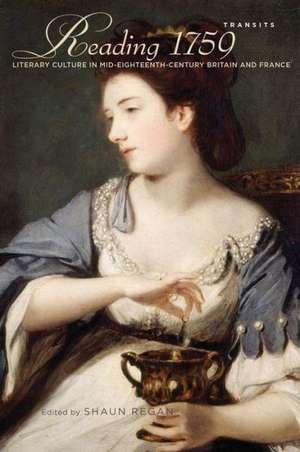
Reading 1759: Literary Culture in Mid-Eighteenth-Century Britain and France: Transits: Literature, Thought & Culture, 1650–1850
Editat de Shaun Reganen Limba Engleză Paperback – 13 iun 2014
Din seria Transits: Literature, Thought & Culture, 1650–1850
- 33%
 Preț: 714.55 lei
 - 23%
 Preț: 321.15 lei
 - 27%
 Preț: 353.58 lei
 - 47%
 Preț: 455.67 lei
 - 24%
 Preț: 369.27 lei
 - 32%
 Preț: 361.88 lei
 - 23%
 Preț: 337.85 lei
 - 29%
 Preț: 343.17 lei
 - 26%
 Preț: 286.06 lei
 - 24%
 Preț: 353.05 lei
 - 28%
 Preț: 382.95 lei
 - 35%
 Preț: 594.98 lei
 - 27%
 Preț: 351.39 lei
 - 32%
 Preț: 361.23 lei
 - 24%
 Preț: 368.26 lei
 - 25%
 Preț: 361.94 lei
 - 36%
 Preț: 674.42 lei
 - 33%
 Preț: 519.17 lei
 - 33%
 Preț: 643.17 lei
 - 23%
 Preț: 335.82 lei
 -
 Preț: 258.01 lei
 - 34%
 Preț: 599.66 lei
 - 29%
 Preț: 341.81 lei
 - 27%
 Preț: 351.30 lei
 - 27%
 Preț: 351.80 lei
 - 27%
 Preț: 257.41 lei
 - 29%
 Preț: 344.18 lei
 - 23%
 Preț: 321.15 lei
 - 37%
 Preț: 660.95 lei
 - 23%
 Preț: 314.30 lei
 - 32%
 Preț: 360.78 lei
 - 34%
 Preț: 383.68 lei
 - 28%
 Preț: 349.32 lei
 - 56%
 Preț: 421.30 lei
 - 56%
 Preț: 422.77 lei
 - 27%
 Preț: 261.05 lei
 - 26%
 Preț: 359.87 lei
 - 34%
 Preț: 634.63 lei
 - 29%
 Preț: 345.19 lei
Preț: 352.54 lei
Preț vechi: 483.79 lei
-27%
Puncte Express: 529
Carte tipărită la comandă
Livrare economică 07-21 decembrie
Livrare prin curier în România Termenul estimat este afișat lângă disponibilitate.
Transport gratuit de la 400.00 lei Plată online sau ramburs, în funcție de opțiunile comenzii.
Retur gratuit în 14 zile Comandă securizată și suport în română.
Specificații
ISBN-13: 9781611485936
ISBN-10: 1611485932
Pagini: 246
Dimensiuni: 152 x 232 x 16 mm
Greutate: 0.41 kg
Ediția:New.
Editura: Bloomsbury Publishing
Colecția Bucknell University Press
Seria Transits: Literature, Thought & Culture, 1650–1850
Locul publicării:New York, United States
ISBN-10: 1611485932
Pagini: 246
Dimensiuni: 152 x 232 x 16 mm
Greutate: 0.41 kg
Ediția:New.
Editura: Bloomsbury Publishing
Colecția Bucknell University Press
Seria Transits: Literature, Thought & Culture, 1650–1850
Locul publicării:New York, United States
Cuprins
Contents
Acknowledgements
Introduction byShaun Regan
I. Writing Empire
1. "What mankind has lost and gained": Johnson, Rasselas, and Colonialism by James Watt
2.. Voltaire's Candide as a Global Text: War, Slavery, and Leadership by Simon Davies
II. Sentimental Ethics, Luxurious Sexualities
3. Adam Smith's The Theory of Moral Sentiments in 1759: Spectatorship, Duty, and Social Improvement by Nigel Wood
4. "On the soft beds of luxury most kingdoms have expired": 1759 and the Lives of Prostitutes by Mary Peace
III. Authorship and Aesthetics
5. Young, Goldsmith, Johnson, and the Idea of the Author in 1759 by Adam Rounce
6. Towards a New Language: Sublime Aesthetics in Smart's Jubilate Agnoby Rosalind Powell
IV. Enlightenment and its Discontents
7. The Encyclopédie in 1759: Crisis and Continuation by Rebecca Ford
8. Lost Cause: Hume, Causation, and Rasselas by James Ward
V. Originality and Appropriation
9. Eccentricity, Originality, and the Novel: Tristram Shandy, volumes 1 and 2 by Moyra Haslett
10. Shakespeare's "Propriety" and the Mid-Eighteenth-Century Novel: Sarah Fielding's The History of the Countess of Dellwynby Kate Rumbold
VI. Conclusion: Reading 1759
11. Writers, Reviewers, and the Culture of Reading by Shaun Regan
Bibliography
About the Contributors
Acknowledgements
Introduction byShaun Regan
I. Writing Empire
1. "What mankind has lost and gained": Johnson, Rasselas, and Colonialism by James Watt
2.. Voltaire's Candide as a Global Text: War, Slavery, and Leadership by Simon Davies
II. Sentimental Ethics, Luxurious Sexualities
3. Adam Smith's The Theory of Moral Sentiments in 1759: Spectatorship, Duty, and Social Improvement by Nigel Wood
4. "On the soft beds of luxury most kingdoms have expired": 1759 and the Lives of Prostitutes by Mary Peace
III. Authorship and Aesthetics
5. Young, Goldsmith, Johnson, and the Idea of the Author in 1759 by Adam Rounce
6. Towards a New Language: Sublime Aesthetics in Smart's Jubilate Agnoby Rosalind Powell
IV. Enlightenment and its Discontents
7. The Encyclopédie in 1759: Crisis and Continuation by Rebecca Ford
8. Lost Cause: Hume, Causation, and Rasselas by James Ward
V. Originality and Appropriation
9. Eccentricity, Originality, and the Novel: Tristram Shandy, volumes 1 and 2 by Moyra Haslett
10. Shakespeare's "Propriety" and the Mid-Eighteenth-Century Novel: Sarah Fielding's The History of the Countess of Dellwynby Kate Rumbold
VI. Conclusion: Reading 1759
11. Writers, Reviewers, and the Culture of Reading by Shaun Regan
Bibliography
About the Contributors
Recenzii
This volume offers fine essays devoted to the pivotal year 1759, a time when Britain emerged as a world power to be reckoned with and when the British literary scene exploded with a collateral force. Regan (Queen's Univ., Belfast) divides the collection into six sections, treating the literature of empire and war, sentimentality, authorship, the Enlightenment, the notion of authorial originality, and the "culture of reading." The volume treats major writers, including Samuel Johnson, Voltaire, Diderot, Adam Smith, Edward Young, Oliver Goldsmith, Christopher Smart, David Hume, Laurence Sterne, and Sarah Fielding. Reading 1759 offers a superb, cogent introduction to mid-18th-century literary culture, covering much important ground and opening up new prospects for future investigation. Summing Up: Recommended. Upper-division undergraduates through faculty.
Reading 1759 nevertheless provides interesting insights into a number of notable works and authors and makes a useful contribution to Bucknell University Press's Transits: Literature, Thought & Culture 1650-1850 transnational eighteenth-century studies series. . . .[S]cholars will find new perspectives on the texts and authors that distinguished 1759's contributions to literary history.
Reading 1759 calls attention to an interesting and pivotal moment in British and French history and reading culture by bringing together eleven essays on different aspects of the literature of that year. As Shaun Regan explains in his introduction to the volume, the year 1759 is particularly suited for this kind of cross-disciplinary study because it was the midpoint of the Seven Years' War and was marked by cultural events such as the public opening of the British Museum, as well as the publication of major literary works by Voltaire, Samuel Johnson, Laurence Sterne, David Hume, Adam Smith, and Edmund Burke (1-2). By encompassing the literature of both Britain and France, Reading 1759 invites a more transnational approach to literature that better approximates what readers at the time could have experienced. Regan explains that 'the purpose of the new essays collected together in Reading 1759 is to investigate the literary culture of Britain and France during this remarkable year' (2). Taken as a whole, the volume does this quite well. . . .Reading 1759 offers an overview of major authors and works from this year of literary, historical, and cultural change.
Reading 1759 nevertheless provides interesting insights into a number of notable works and authors and makes a useful contribution to Bucknell University Press's Transits: Literature, Thought & Culture 1650-1850 transnational eighteenth-century studies series. . . .[S]cholars will find new perspectives on the texts and authors that distinguished 1759's contributions to literary history.
Reading 1759 calls attention to an interesting and pivotal moment in British and French history and reading culture by bringing together eleven essays on different aspects of the literature of that year. As Shaun Regan explains in his introduction to the volume, the year 1759 is particularly suited for this kind of cross-disciplinary study because it was the midpoint of the Seven Years' War and was marked by cultural events such as the public opening of the British Museum, as well as the publication of major literary works by Voltaire, Samuel Johnson, Laurence Sterne, David Hume, Adam Smith, and Edmund Burke (1-2). By encompassing the literature of both Britain and France, Reading 1759 invites a more transnational approach to literature that better approximates what readers at the time could have experienced. Regan explains that 'the purpose of the new essays collected together in Reading 1759 is to investigate the literary culture of Britain and France during this remarkable year' (2). Taken as a whole, the volume does this quite well. . . .Reading 1759 offers an overview of major authors and works from this year of literary, historical, and cultural change.