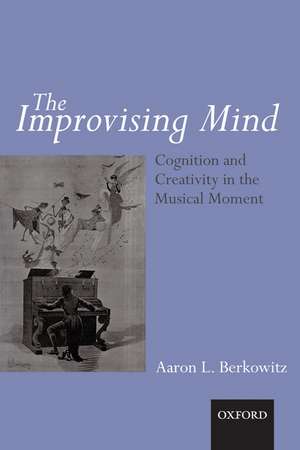
The Improvising Mind: Cognition and Creativity in the Musical Moment
Autor Aaron Berkowitzen Limba Engleză Hardback – 17 iun 2010
Preț: 558.36 lei
Preț vechi: 811.29 lei
-31%
Puncte Express: 838
Carte tipărită la comandă
Livrare economică 27 noiembrie-02 decembrie
Livrare prin curier în România Termenul estimat este afișat lângă disponibilitate.
Transport gratuit pentru acest produs Plată online sau ramburs, în funcție de opțiunile comenzii.
Retur gratuit în 14 zile Comandă securizată și suport în română.
Specificații
ISBN-13: 9780199590957
ISBN-10: 0199590958
Pagini: 240
Ilustrații: numerous black and white photographs
Dimensiuni: 162 x 241 x 22 mm
Greutate: 0.54 kg
Editura: OUP OXFORD
Colecția OUP Oxford
Locul publicării:Oxford, United Kingdom
ISBN-10: 0199590958
Pagini: 240
Ilustrații: numerous black and white photographs
Dimensiuni: 162 x 241 x 22 mm
Greutate: 0.54 kg
Editura: OUP OXFORD
Colecția OUP Oxford
Locul publicării:Oxford, United Kingdom
V-ar putea interesa
-
 One by One by OneAaron BerkowitzPreț: 93.37 lei
 -
 Conscious Mind, Resonant Brain: How Each Brain Makes a MindStephen Grossberg-19%Preț: 252.28 lei311.61 lei
 -
 Chaos and Nonlinear Psychology: Keys to Creativity in Mind and LifeDavid Schuldberg-29%Preț: 498.87 lei706.76 lei
 -
 Science Denial: Why It Happens and What to Do About ItGale M. Sinatra-16%Preț: 214.19 lei253.83 lei
 -
 -31%Preț: 806.95 lei1170.81 lei
 -
 Movies on Our Minds: The Evolution of Cinematic EngagementJames E. Cutting-21%Preț: 311.98 lei395.29 lei
 -
 -29%Preț: 428.88 lei605.94 lei
 -
 CognitionMarvin Chun-27%Preț: 1121.17 lei1535.84 lei
 -
 -9%Preț: 722.09 lei793.51 lei
 -
 Cognitive ScienceJosé Luis BermúdezPreț: 420.56 lei
 -
 Brain Laterality: Up, Right, ForwardKenneth HeilmanPreț: 385.50 lei
 -
 Thinking VisuallyStephen K. ReedPreț: 482.00 lei
 -
 Preț: 410.99 lei
 -
 -22%Preț: 1221.90 lei1566.54 lei
 -
 The ThalamusMichael M Halassa-23%Preț: 1266.74 lei1645.12 lei
 -
 -31%Preț: 331.24 lei479.32 lei
 -
 Preț: 381.55 lei
 -
 Cognitive Psychotherapy Toward a New MillenniumTullio Scrimali-15%Preț: 642.83 lei756.28 lei
 -
 Spatial OrientationHerbert PickPreț: 381.37 lei
 -
 Behavior Modification in Black PopulationsSamuel M. TurnerPreț: 378.64 lei
 -
 Mental Retardation and Developmental DisabilitiesJoseph WortisPreț: 375.99 lei
 -
 Handbook of Mental Illness in the Mentally RetardedF.J. MenolascinoPreț: 389.65 lei
 -
 Human and Machine Problem SolvingK. J. GilhoolyPreț: 381.63 lei
 -
 -15%Preț: 614.60 lei723.05 lei
 -
 -27%Preț: 256.12 lei350.26 lei
 -
 -36%Preț: 525.34 lei816.02 lei
 -
 Thematische Rollen und RelationenMário A. Perini-15%Preț: 699.42 lei822.85 lei
 -
 Cognitive Perspectives on Emotion and MotivationV. Hamilton-18%Preț: 1752.98 lei2137.78 lei
Recenzii
There are many reasons to recommend The Improvising Mind, not least its allure for professional academic audiences, and yet wider appeal; and the potential for its subject matter to provoke cogitation on sociological, psychological and philosophical matters.
Although the primary readership for The Improvising mind: Cognition and Creativity in the Musical Moment is likely to be musicologists, psychologists, musicians and educators, anyone fascinated by the act, process, development, skills and even the miracle of creativity will find much in Aaron Berkowitz's book to intrigue, inform and stimulate them.
This is a short book at under 200 substantive pages. But it's one well deserving of attention ... Although the primary readership for The Improvising mind: Cognition and Creativity in the Musical Moment is likely to be musicologists, psychologists, musicians and educators, anyone fascinated by the act, process, development, skills and even the miracle of creativity will find much in Aaron Berkowitz's book to intrigue, inform and stimulate them.
Although the primary readership for The Improvising mind: Cognition and Creativity in the Musical Moment is likely to be musicologists, psychologists, musicians and educators, anyone fascinated by the act, process, development, skills and even the miracle of creativity will find much in Aaron Berkowitz's book to intrigue, inform and stimulate them.
This is a short book at under 200 substantive pages. But it's one well deserving of attention ... Although the primary readership for The Improvising mind: Cognition and Creativity in the Musical Moment is likely to be musicologists, psychologists, musicians and educators, anyone fascinated by the act, process, development, skills and even the miracle of creativity will find much in Aaron Berkowitz's book to intrigue, inform and stimulate them.
Notă biografică
Aaron Berkowitz received his Bachelor degrees in Music (B.A.) and Biology (B.S.) from George Washington University, his M.D. from Johns Hopkins University, and his Ph.D. in Music from Harvard University, where he received a Presidential Fellowship, a Mind/Brain/Behavior Research Award, and the Oscar S. Schafer Award for Excellence in Teaching. His research has been published in NeuroImage and Twentieth Century Music, he has been an invited speaker at several major US universities and conferences, and he has served as a guest professor in music and psychology at Tufts University. He has performed throughout Europe and the US as a pianist and fortepianist, and his compositions have been performed in Europe and the US, including at Carnegie Hall.
Cuprins
- Dedication
- Acknowledgements
- Prelude
- 1: Introduction
- Part I; Cognition and the Pedagogy and Learning of Improvisation
- 3: The pedagogy of improvisation II: Pedagogical strategies
- 4: Learning to improvise; Learners' perspectives
- 5: Music and language cognition compared I: Acquisition
- Part II: Cognition in Improvised Performance
- 6: Improvised performance: Performers' perspectives
- 7: The neurobiology of improvisation
- 8: Music and language compared II; Production
- 9: Cadenza
- Coda: Constraints and freedom; Improvisation in music, language, and nature
- Bibliography
- Index