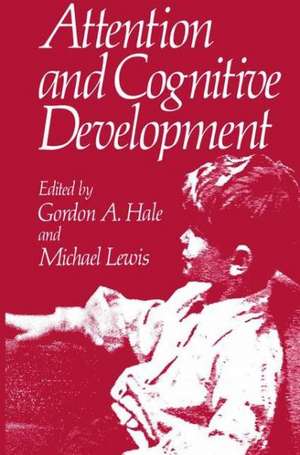
Attention and Cognitive Development
Editat de G. Haleen Limba Engleză Paperback – 5 oct 2011
Preț: 381.55 lei
Puncte Express: 572
Carte tipărită la comandă
Livrare economică 03-17 decembrie
Livrare prin curier în România Termenul estimat este afișat lângă disponibilitate.
Transport gratuit de la 400.00 lei Plată online sau ramburs, în funcție de opțiunile comenzii.
Retur gratuit în 14 zile Comandă securizată și suport în română.
Specificații
ISBN-13: 9781461329879
ISBN-10: 1461329876
Pagini: 384
Ilustrații: XVI, 366 p.
Dimensiuni: 155 x 235 x 21 mm
Greutate: 0.58 kg
Ediția:Softcover reprint of the original 1st ed. 1979
Editura: Springer
Locul publicării:New York, NY, United States
ISBN-10: 1461329876
Pagini: 384
Ilustrații: XVI, 366 p.
Dimensiuni: 155 x 235 x 21 mm
Greutate: 0.58 kg
Ediția:Softcover reprint of the original 1st ed. 1979
Editura: Springer
Locul publicării:New York, NY, United States
V-ar putea interesa
-
 The Making Of MemorySteven RosePreț: 124.38 lei
 -
 Memory: A Very Short IntroductionJonathan K. FosterPreț: 70.32 lei
 -
 Episodic Memory: New Directions in ResearchAlan Baddeley-31%Preț: 506.73 lei733.45 lei
 -
 -28%Preț: 519.97 lei725.50 lei
 -
 Thinking in Sound: The Cognitive Psychology of Human AuditionStephen McAdams-33%Preț: 710.18 lei1053.81 lei
 -
 Implicit CognitionGeoffrey Underwood-28%Preț: 451.64 lei631.15 lei
 -
 Motor Cognition: What actions tell the selfMarc Jeannerod-31%Preț: 567.25 lei824.53 lei
 -
 Ruling Passions: A Theory of Practical ReasoningSimon Blackburn-13%Preț: 304.98 lei348.74 lei
 -
 -27%Preț: 352.74 lei483.96 lei
 -
 Contextuality in Practical ReasonA. W. Price-31%Preț: 627.89 lei910.17 lei
 -
 The Sapient Mind: Archaeology meets neuroscienceColin Renfrew-31%Preț: 607.53 lei881.53 lei
 -
 In Your Face: The new science of human attractionDavid PerrettPreț: 227.85 lei
 -
 Sensation, Perception and Action: An Evolutionary PerspectiveJohannes ZankerPreț: 338.83 lei
 -
 Social IntelligenceKarl AlbrechtPreț: 119.31 lei
 -
 Chaos, Creativity, and Cosmic ConsciousnessRupert Sheldrake-24%Preț: 88.70 lei116.18 lei
Public țintă
ResearchCuprins
1 Attention: The Perceiver as Performer.- Some Examples of Attending.- What Is Attention?.- What Attention Is Not.- Restatement of the Theme.- Classic Variables of Attention.- Expectation.- How Does Attention Develop?.- Conclusion.- References.- 2 The Concept of Identity and Children’s Selective Attention.- Extent of Visual Scanning.- Relevance of Perceived Differences to Judgments of Identity.- Criteria of Identity Judgments and Scanning Strategies.- Conclusion.- References.- 3 Development of Children’s Attention to Stimulus Components.- The Component Selection Task.- Development of Children’s Disposition toward Selectivity.- Development of Flexibility in Attention to Components.- A Further Issue in Measuring Attention to Components: Dimension Preferences.- Concluding Remarks.- References.- 4 A Constructivist Account of the Development of Perception, Attention, and Memory.- The Thesis.- Empirical and Theoretical Underpinnings.- A General, Unified Cognitive System?.- Concluding Remarks.- References.- 5 Stimulus Dimensions, Problem Solving, and Piaget.- Developmental Relationships between Conservation and Attention to Dimensions.- How Attention to Dimensions Affects Conservation Performance.- Implications for an Understanding of the Development of Dimensionalization.- Summary.- References.- 6 Developmental Aspects of Selective Orientation.- From Selective Orienting to Mental Representation.- Orienting Asymmetry and the Development of Handedness.- Effect of Rightward Response Bias on Lateral Attending.- Task-Related Attentional Biases.- References.- 7 Attentional Processes and Individual Differences.- A Review of Models of Attention and Memory.- Individual Differences in Information Processing.- Conclusion.- References.- 8 Toward a Clearer Definition of theAttentional Deficit of Hyperactive Children.- Confusion Caused by Current Diagnostic Labels.- Confusion Caused by Definitions of Attention.- Selective Attention as Defined in Studies of Stimulus Reduction, Distraction, and Incidental Learning.- Sustained Attention as Defined in Vigilance Studies.- Sustained Attention as Defined in Studies of More Complex Perceptual and Conceptual Processes: A Brief Review.- References.- 9 The Cognitive Effects of Stimulant Drugs on Hyperactive Children.- Definition of the Disorder.- Background Information on Drug Treatment.- Evaluation of Diagnostic Drug Trials.- Experiments Using Paired-Associate Learning.- Other Laboratory Tests.- Problems with Drug Treatment.- Directions for Future Research.- References.- 10 Attention and Cognitive Style in Children.- The Confounding of Cognitive Style and Development.- Attention and Cognitive Style: A Developmental Lag Approach.- Style: Individual Differences in Attention Deployment.- Attention and Cognitive Style: The Developmental Lag Interpretation Reevaluated.- Cognitive Styles: Separate but Unequal?.- A Word of Caution.- References.- 11 Attention in the Classroom.- Alertness.- Selectivity.- Central Processing.- Monitoring and Fostering Attention in the Classroom.- Special Problems of Attention.- Summary.- References.- 12 Watching Children Watch Television.- When Children Begin to Watch Television.- Amount of Television Viewing.- Factors Related to Amount of Home Viewing.- Visual Attention to Television.- Attributes of Television Programs That Influence Visual Attention.- Discussion of the Attribute Effects.- Auditory Attention to Television.- A Possible Theoretical Direction for Future Research on Attention to Television.- Final Comments.- References.