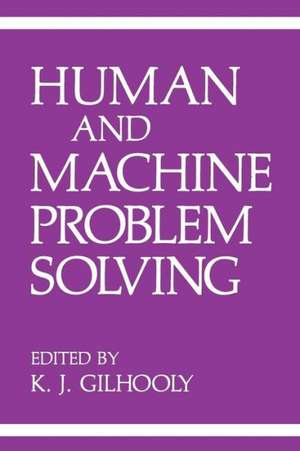
Human and Machine Problem Solving
Editat de K. J. Gilhoolyen Limba Engleză Paperback – 24 apr 2012
Preț: 381.63 lei
Puncte Express: 572
Carte tipărită la comandă
Livrare economică 02-16 decembrie
Livrare prin curier în România Termenul estimat este afișat lângă disponibilitate.
Transport gratuit de la 400.00 lei Plată online sau ramburs, în funcție de opțiunile comenzii.
Retur gratuit în 14 zile Comandă securizată și suport în română.
Specificații
ISBN-13: 9781468480177
ISBN-10: 1468480170
Pagini: 404
Ilustrații: 400 p.
Dimensiuni: 152 x 229 x 22 mm
Greutate: 0.58 kg
Ediția:Softcover reprint of the original 1st ed. 1989
Editura: Springer
Locul publicării:New York, NY, United States
ISBN-10: 1468480170
Pagini: 404
Ilustrații: 400 p.
Dimensiuni: 152 x 229 x 22 mm
Greutate: 0.58 kg
Ediția:Softcover reprint of the original 1st ed. 1989
Editura: Springer
Locul publicării:New York, NY, United States
V-ar putea interesa
-
 Happiness by DesignPaul Dolan-31%Preț: 63.80 lei92.70 lei
 -
 Cognitive Neuroscience: A Very Short IntroductionRichard Passingham-20%Preț: 57.15 lei71.12 lei
 -
 Preț: 355.76 lei
 -
 Face Value: The Irresistible Influence of First ImpressionsAlexander TodorovPreț: 304.08 lei
 -
 Body LanguageElizabeth KuhnkePreț: 93.73 lei
 -
 Judgment Decision MakingDavid HardmanPreț: 389.57 lei
 -
 The Learning BrainSarah-Jayne BlakemorePreț: 270.32 lei
 -
 Build Your Brain Power: The Art of Smart ThinkingSimon Wootton-26%Preț: 68.38 lei92.77 lei
 -
 The Little Mindfulness WorkbookGary Hennessey-28%Preț: 50.64 lei70.22 lei
 -
 New Developments in Expressive Arts Therapy: The Play of PoiesisStephen K. Levine-28%Preț: 233.20 lei324.84 lei
 -
 -25%Preț: 222.81 lei295.28 lei
Public țintă
ResearchCuprins
1 Human and Machine Problem Solving: Toward a Comparative Cognitive Science.- 1. Introduction.- 2. Problem Solving.- 3. Perspectives.- 4. Some Issues.- 5. References.- 2 Nonadversary Problem Solving by Machine.- 1. Introduction.- 2. State Space Representation.- 3. Problem Reduction Representation: And/or Graphs.- 4. Planning.- 5. Conclusions.- 6. References.- 3 Human Nonadversary Problem Solving.- 1. Introduction.- 2. Constraints on a Model of Human Nonadversary Problem Solving.- 3. Conclusion.- 4. References.- 4 Adversary Problem Solving by Machine.- 1. Introduction.- 2. Search Techniques for Two-Person Games.- 3. Minimaxing with an Evaluation Function.- 4. The Alpha-Beta Algorithm.- 5. Refinements of the Basic Alpha-Beta Rule.- 6. Theoretical Analyses of Alpha-Beta and Its Variants.- 7. Other Problem-Independent Adversary Search Methods.- 8. Selective Search, Evaluation Functions, and Quiescence.- 9. A Short History of Game-Playing Programs.- 10. Example of Implementation Method for Chess.- 11. Knowledge-Based Selective Search.- 12. Exact Play in Chess Endgames.- 13. Other Nonprobabilistic Games.- 14. Games of Imperfect Information, Game Theory.- 15. Conclusion—Likely Future Trends.- 16. References.- 17. Further Reading.- 5 Adversary Problem Solving by Humans.- 1. Adversary Games.- 2. Dealing with the Adversary.- 3. Characteristics of the Search Process.- 4. Plans and Knowledge.- 5. Evaluation Functions.- 6. Projecting Ahead.- 7. Humans versus Computers.- 8. Overview.- 9. References.- 6 Machine Expertise.- 1. The Automation of Problem Solving—Continuing a Tradition.- 2. Problem-Solving Knowledge Representation.- 3. The Nature of Expert Knowledge.- 4. Knowledge Representation.- 5. Problems with the Traditional Approach.- 6. Architectures for Representing MachineExpertise.- 7. The Rule-Based Approach—mycin, prospector, and xcon.- 8. The Blackboard Approach (hearsay).- 9. The Set-Covering Approach (Frame Abduction).- 10. Multiple Paradigm Approaches.- 11. Expert System Shells.- 12. Recent Developments.- 13. Conclusions.- 14. References.- 7 Human Expertise.- 1. Introduction.- 2. The Theoretical Framework: Information-Processing Theory of Problem Solving.- 3. The Construction of a Problem Representation.- 4. The Role of Schemata in Problem Solving.- 5. Problem-Solving Strategies.- 6. The Development of Expertise.- 7. Conclusion.- 8. References.- 8 Machine Inference.- 1. Input of Knowledge.- 2. Machine Inference Based on Logic.- 3. The Production-Rule-Based Approach to Inference.- 4. The Frame-Based Approach to Inference.- 5. The Current Status of Machine Inference.- 6. References.- 9 Human Inference.- 1. Introduction.- 2. The Mental Logic Approach.- 3. The Mental Models Approach.- 4. The Nature of Inference.- 5. References.- 10 Machine Learning.- 1. Introduction.- 2. Learning Concepts from Examples: Problem Statement.- 3. Learning Concepts by Induction: A Detailed Example.- 4. Learning Decision Trees and Coping with Noise.- 5. Other Approaches to Learning and Bibliographical Remarks.- 6. References.- 11 Human Learning.- 1. Introduction.- 2. Schemata, Scripts, and Frames.- 3. Amnesia.- 4. Retrieval from Long-Term Memory.- 5. Concept Learning.- 6. Conclusions.- 7. References.- 12 Problem Solving by Human-Machine Interaction.- 1. Problem Solving for the Real World.- 2. Problem Solving Reconsidered from a Human Factors Perspective.- 3. Stages of the Problem-Solving Process.- 4. Human-Computer Problem Solving: Cases.- 5. A Retrospective Example.- 6. Summary and Conclusions.- 7. References.- 8. Further Reading.- 13 Human and MachineProblem Solving: A Comparative Overview.- 1. Introduction.- 2. Nonadversary Problems.- 3. Adversary Problems.- 4. Expertise.- 5. Inference.- 6. Learning.- 7. Solving Problems by Human-Computer Interaction.- 8. Concluding Comments.- 9. References.- Author Index.