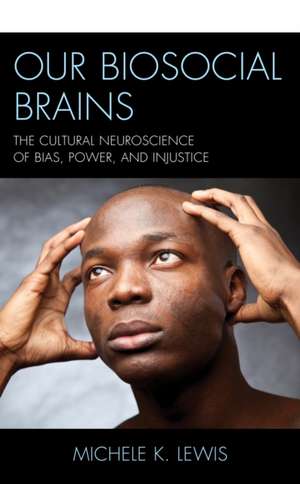
Our Biosocial Brains: The Cultural Neuroscience of Bias, Power, and Injustice
Autor Michele K. Lewisen Limba Engleză Paperback – 21 dec 2021
Preț: 245.42 lei
Preț vechi: 339.67 lei
-28%
Puncte Express: 368
Carte tipărită la comandă
Livrare economică 08-22 iunie
Specificații
ISBN-13: 9781498583558
ISBN-10: 1498583555
Pagini: 218
Dimensiuni: 153 x 231 x 16 mm
Greutate: 0.34 kg
Editura: Bloomsbury Publishing
Colecția Lexington Books
Locul publicării:New York, United States
ISBN-10: 1498583555
Pagini: 218
Dimensiuni: 153 x 231 x 16 mm
Greutate: 0.34 kg
Editura: Bloomsbury Publishing
Colecția Lexington Books
Locul publicării:New York, United States
Cuprins
Chapter 1 Still Wretched
Chapter 2 Subhuman to Superhuman: Cultural Neuroscience of Illusory Blackness
Chapter 3 Cultural Neuroscience and Poverty: Emotional Emancipation Circle for Black Women
Chapter 4 The Black Women in Poverty Study: Cultural Neuroscience of Social-Injustice
Chapter 5 That Female is Ratchet: Mixed-Slurs
Chapter 6 Negative Emotionality and Disgust Activations Towards LGBT Humans
Chapter 7 Collectivists and Individualists Brains
Chapter 8 Minding Perceptions of Native Peoples
Chapter 9 Killing Loneliness, Saving Humanity
Chapter 10 Environmental Injustices
Chapter 11 Forever Fanon
Chapter 12 Future Directions
Chapter 2 Subhuman to Superhuman: Cultural Neuroscience of Illusory Blackness
Chapter 3 Cultural Neuroscience and Poverty: Emotional Emancipation Circle for Black Women
Chapter 4 The Black Women in Poverty Study: Cultural Neuroscience of Social-Injustice
Chapter 5 That Female is Ratchet: Mixed-Slurs
Chapter 6 Negative Emotionality and Disgust Activations Towards LGBT Humans
Chapter 7 Collectivists and Individualists Brains
Chapter 8 Minding Perceptions of Native Peoples
Chapter 9 Killing Loneliness, Saving Humanity
Chapter 10 Environmental Injustices
Chapter 11 Forever Fanon
Chapter 12 Future Directions
Recenzii
Encouraging readers to explore the brain as a biosocial organ, Lewis weaves together research in neuroscience and African-Centered/Black psychology with contemporary illustrations of oppression and their historic backdrops to make evident the need for an inclusive and deepened cultural neuroscience. Stressing the ways in which the brain is shaped by sociocultural impact, her treatment of cultural neuroscience makes clear the necessity of a shift toward the worldview of optimal psychology found capable of more effectively addressing human needs and providing solutions to global problems.