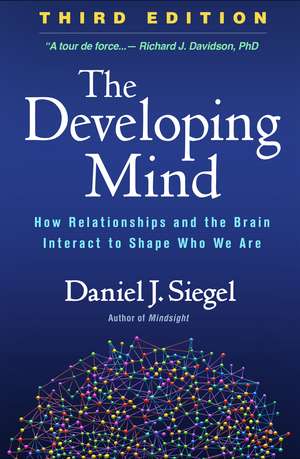
The Developing Mind: The Developing Mind
Autor Daniel J. Siegelen Limba Engleză Hardback – 24 iun 2020
*Incorporates findings from a huge body of recent research; over 1,000 citations added.
*Revisits and refines the core hypotheses of interpersonal neurobiology.
*Chapter on the experience of belonging and the development of identity.
*New or expanded discussions of behavioral epigenetics, the default mode network of the brain, social neuroscience, cultural and gender issues, theory of mind, the Wheel of Awareness contemplative practice, the science of consciousness, and more.
Preț: 530.14 lei
Preț vechi: 558.04 lei
-5%
Carte disponibilă
Livrare economică 06-20 noiembrie
Livrare express 22-28 octombrie pentru 59.50 lei
Specificații
ISBN-10: 1462542751
Pagini: 674
Dimensiuni: 156 x 234 x 40 mm
Greutate: 1.07 kg
Ediția:3 ed
Editura: Guilford Publications
Colecția Guilford Press
V-ar putea interesa
-
 Your Brain at WorkDavid RockPreț: 144.67 lei
 -
 Prosocial Development: A Multidimensional ApproachLaura M. Padilla-WalkerPreț: 261.24 lei
 -
 Parents' Beliefs About ChildrenScott A. Miller-28%Preț: 497.96 lei693.42 lei
 -
 Social: Why our brains are wired to connectMatthew D. Lieberman-20%Preț: 90.69 lei113.09 lei
 -
 -16%Preț: 124.00 lei147.72 lei
 -
 Preț: 108.92 lei
 -
 -15%Preț: 422.82 lei497.44 lei
 -
 Interpersonal Neurobiology and Clinical PracticeAllan SchorePreț: 241.60 lei
 -
 Theories Infant DevelopmentBremmerPreț: 459.21 lei
 -
 The Social Psychology of Prosocial BehaviorJohn F. Dovidio-15%Preț: 485.68 lei571.39 lei
 -
 The Cambridge Handbook of Infant DevelopmentJeffrey J. Lockman-11%Preț: 474.94 lei533.63 lei
 -
 -34%Preț: 52.78 lei80.10 lei
 -
 Child Development, Fourth Edition: A Practitioner's GuideDouglas Davies-15%Preț: 517.05 lei608.29 lei
 -
 Promoting Executive Function in the ClassroomLynn MeltzerPreț: 357.50 lei
 -
 The Wonder WeeksXaviera PlooijPreț: 127.73 lei
 -
 Man's Search For MeaningViktor E. Frankl-27%Preț: 62.25 lei84.79 lei
 -
 Preț: 63.54 lei
 -
 -28%Preț: 141.11 lei197.20 lei
 -
 Preț: 49.00 lei
 -
 Drive: Ce anume ne motivează cu adevăratDaniel PinkPreț: 47.00 lei
Cuprins
1. The Embodied Brain, Awareness, and the Nature of Energy
2. States of Mind: Cohesion, Subjective Experience, and Complex Systems
3. Memory and Narrative
4. Attachment and a Sense of Self
5. Emotion as Shifts in Integration
6. Representations and Mental Reality: Modes of Processing and the Construction of Experience
7. Regulation and Coherence
8. Interpersonal Connection and the Relational Mind
9. Integration Within and Between
10. Belonging, “Self,” and an Integrated Identity as Me plus We = MWe: A Framework for Cultivating Integration
Glossary
Notes
References
Index
Notă biografică
Recenzii
"I can only describe this as a unique and astounding book about child development that every therapist must have in his or her library. Siegel is thorough and incredibly informative as he explains the child's developing social mind and brain. The book is also very readable."--John M. Gottman, PhD, The Gottman Institute, Seattle, Washington
"Siegel presents an up-to-the-minute third edition of a book that is already in wide use. He elucidates the neurological underpinnings and social processes that have made humans--with our peculiar questing for intersubjective engagement--so different emotionally from other apes. No book I know of more clearly lays out, step by step, how people develop in response to those around them, and how variable those outcomes can be."--Sarah Blaffer Hrdy, PhD, Professor Emerita of Anthropology, University of California, Davis
"This comprehensive book reviews three decades of neuroscience related to learning with others in the early months, and reveals new ideas about how the mind grows when a child is thriving. Siegel, a leader in child and family mental health, generously shares his expertise. He traces how the infant is committed from birth to play a part in the life of a community of personalities, and how our emotions, bodies, and brains move together in search of kindness and connection."--Colwyn Trevarthen, PhD, FRSE, Professor Emeritus of Child Psychology and Psychobiology, University of Edinburgh, United Kingdom
"The importance of Siegel’s work has been reflected in the interest, enthusiasm, and joy that his interpersonal neurobiology has brought to people around the world for more than two decades. The third edition of The Developing Mind presents the ongoing neuroscientific research that supports the book's initial hypotheses and expands their applications in psychotherapy, education, and mindfulness. It offers a window into Siegel's evolving synthesis of his theories of mind into the core of interpersonal neurobiology. Readers will find themselves on a wonderful intellectual and personal journey."--Louis Cozolino, PhD, Graduate School of Education and Psychology, Pepperdine University
“An astonishing accomplishment. Somehow, Siegel explains the amazingly complex human mind to clinicians and researchers alike. As a child psychologist, I find much of The Developing Mind of great interest and relevance to my practice, including excellent material on early attachment and trauma. The third edition has been completely updated with the most recent research and writings across multiple disciplines. Students and professionals in diverse fields will find interesting and useful material in this impressive work."--Deborah Roth Ledley, PhD, private practice, Plymouth Meeting and Narberth, Pennsylvania
"I used the second edition in our required social work practice course for graduate students. My students gained an understanding of the meaning of 'mind,' how the mind emerges from the brain, and the way the mind is shaped by interpersonal relationships. I used the text to demonstrate how an interpersonal neurobiology framework can be utilized in assessment, diagnosis, and treatment of infants, children, and adolescents. Readings and discussions also helped students explore aspects of their own identity and subjective mental processes. Two things that immediately caught my attention in the third edition are the expanded glossary and the new chapter on identity development and belonging. I look forward to adopting the third edition for my class!"--Marian S. Harris, PhD, School of Social Work and Criminal Justice, University of Washington Tacoma-
Descriere
This highly influential work--now in a revised and expanded third edition incorporating major advances in the field--gives clinicians, educators, and students a new understanding of what the mind is, how it grows, and how to promote healthy development and resilience. Daniel J. Siegel synthesizes cutting-edge research from multiple disciplines, revealing the ways in which neural processes are fundamentally shaped by interpersonal relationships throughout life. And even when early experiences are not optimal, building deeper connections to other people and to one's own internal experience remains a powerful resource for growth. Professors praise the book's utility in courses from developmental psychology and child development to neuroscience and counseling.
New to This Edition
*Incorporates findings from a huge body of recent research; over 1,000 citations added.
*Revisits and refines the core hypotheses of interpersonal neurobiology.
*Chapter on the experience of belonging and the development of identity.
*New or expanded discussions of behavioral epigenetics, the default mode network of the brain, social neuroscience, cultural and gender issues, theory of mind, the Wheel of Awareness contemplative practice, the science of consciousness, and more.