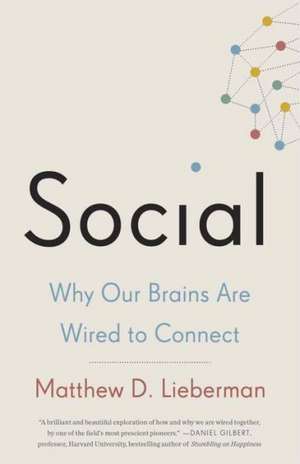
Social
en Limba Engleză Paperback – 1900
Apreciem că Social reprezintă o resursă academică esențială pentru studenții și profesioniștii din psihologie, neuroștiințe și sociologie, fiind o lucrare de referință care fundamentează biologic comportamentul uman colectiv. Matthew D. Lieberman utilizează date din scanări fMRI pentru a demonstra o teză provocatoare: creierul nostru nu este un organ izolat, ci unul programat structural pentru interacțiune. Suntem de părere că relevanța acestui titlu depășește sfera teoretică, oferind argumente solide pentru reevaluarea politicilor de management și a metodelor pedagogice, care adesea ignoră natura socială a procesului de învățare. Spre deosebire de abordările pur clinice, Social analizează mecanismele prin care interpretăm intențiile celorlalți și modul în care identitatea noastră este indisolubil legată de grupurile de apartenență. Comparabil cu Introduction to Social Neuroscience de Stephanie Cacioppo în rigurozitatea științifică, volumul de față este actualizat cu date recente despre „rețeaua implicită” a creierului, care devine activă exact în momentele de repaus, pregătindu-ne constant pentru următoarea interacțiune. De asemenea, dacă Social Intelligence de Daniel Goleman se concentrează pe manifestările comportamentale ale inteligenței emoționale, Lieberman coboară la nivelul circuitelor neuronale pentru a explica de ce excluderea socială provoacă o suferință neurologică identică cu cea fizică. Stilul este analitic și structurat, transformând date complexe de laborator într-un argument coerent despre succesul nostru ca specie prin cooperare și altruism.
Preț: 102.46 lei
Carte disponibilă
Livrare economică 13-27 noiembrie
Livrare express 30 octombrie-05 noiembrie pentru 38.73 lei
Specificații
ISBN-10: 0307889106
Pagini: 386
Dimensiuni: 131 x 203 x 25 mm
Greutate: 0.43 kg
Editura: Not Stated
V-ar putea interesa
-
 Social IntelligenceDaniel Goleman-18%Preț: 76.90 lei93.99 lei
 -
 EmotionalLeonard Mlodinow-19%Preț: 63.69 lei78.82 lei
 -
 Positive NeuroscienceJoshua D. Greene-33%Preț: 662.18 lei982.44 lei
 -
 The Student's Guide to Social NeuroscienceJamie Ward-8%Preț: 458.80 lei498.69 lei
 -
 A General Theory of LoveThomas LewisPreț: 101.39 lei
 -
 The Social Neuroscience of EducationLouis CozolinoPreț: 263.10 lei
 -
 The Neuroscience of Human RelationshipsLouis Cozolino-5%Preț: 375.14 lei394.88 lei
 -
 Introduction to Social NeuroscienceStephanie Cacioppo-16%Preț: 660.13 lei785.87 lei
 -
 The Social AnimalDavid BrooksPreț: 114.43 lei
 -
 Finding Focus: Own Your Attention in an Age of DistractionDr Zelana Montminy-26%Preț: 90.95 lei122.94 lei
 -
 Why We ClickKate MurphyPreț: 178.42 lei
 -
 The Neuroscience of PsychotherapyLouis CozolinoPreț: 401.69 lei
 -
 -19%Preț: 63.88 lei78.85 lei
 -
 Two HeadsUta Frith-22%Preț: 113.12 lei144.26 lei
 -
 Preț: 122.07 lei
 -
 The Laws of ConnectionDavid RobsonPreț: 79.55 lei
 -
 The Social BrainTracey Camilleri-26%Preț: 63.80 lei85.75 lei
 -
 -18%Preț: 87.89 lei107.34 lei
 -
 The Other Side of ChangeMaya ShankarPreț: 122.07 lei
De ce să citești această carte
Recomandăm această carte oricărui specialist care dorește să înțeleagă fundamentul biologic al empatiei și colaborării. Veți descoperi de ce izolarea afectează performanța cognitivă și cum puteți optimiza mediile profesionale prin recunoașterea nevoilor sociale primare. Este o lectură care transformă intuiția despre relații umane într-o certitudine bazată pe date neuroștiințifice, oferind un avantaj competitiv în înțelegerea dinamicii de grup.
Despre autor
Matthew D. Lieberman este un cercetător de renume și profesor în cadrul departamentelor de Psihologie, Psihiatrie și Științe Comportamentale de la University of California, Los Angeles (UCLA). Este considerat unul dintre fondatorii disciplinei de neuroștiințe cognitive sociale. Activitatea sa academică se concentrează pe utilizarea neuroimagisticii pentru a elucida bazele neuronale ale interacțiunii umane, controlului de sine și intuiției sociale. Prin laboratorul său de la UCLA, a coordonat numeroase studii de pionierat care au schimbat înțelegerea modului în care creierul procesează experiențele subiective în context colectiv.
Descriere scurtă
In "Social," renowned psychologist Matthew Lieberman explores groundbreaking research in social neuroscience revealing that our need to connect with other people is even more fundamental, more basic, than our need for food or shelter. Because of this, our brain uses its spare time to learn about the social world other people and our relation to them. It is believed that we must commit 10,000 hours to master a skill. According to Lieberman, each of us has spent 10,000 hours learning to make sense of people and groups "by the time we are ten."
"Social" argues that our need to reach out to and connect with others is a primary driver behind our behavior. We believe that pain and pleasure alone guide our actions. Yet, new research using fMRI including a great deal of original research conducted by Lieberman and his UCLA lab -- shows that our brains react to social pain and pleasure in much the same way as they do to physical pain and pleasure. Fortunately, the brain has evolved sophisticated mechanisms for securing our place in the social world. We have a unique ability to read other people s minds, to figure out their hopes, fears, and motivations, allowing us to effectively coordinate our lives with one another. And our most private sense of who we are is intimately linked to the important people and groups in our lives. This wiring often leads us to restrain our selfish impulses for the greater good. These mechanisms lead to behavior that might seem irrational, but is really just the result of our deep social wiring and necessary for our success as a species.
Based on the latest cutting edge research, the findings in "Social" have important real-world implications. Our schools and businesses, for example, attempt to minimalize social distractions. But this is exactly the wrong thing to do to encourage engagement and learning, and literally shuts down the social brain, leaving powerful neuro-cognitive resources untapped. The insights revealed in this pioneering book suggest ways to improve learning in schools, make the workplace more productive, and improve our overall well-being."