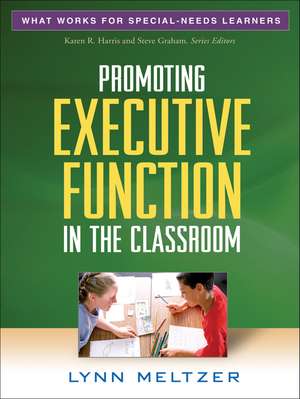
Promoting Executive Function in the Classroom: What Works for Special-Needs Learners
Autor Lynn Meltzeren Limba Engleză Paperback – 13 aug 2010
This book will be invaluable to classroom teachers and special educators in grades K-12, teacher educators, school psychologists, and neuropsychologists.
Din seria What Works for Special-Needs Learners
-
 Preț: 342.73 lei
 -
 Preț: 381.50 lei
 -
 Preț: 346.32 lei
 -
 Preț: 354.63 lei
 -
 Preț: 278.45 lei
 -
 Preț: 270.03 lei
 -
 Preț: 277.30 lei
 -
 Preț: 211.27 lei
 -
 Preț: 328.82 lei
 - 15%
 Preț: 271.68 lei
 - 8%
 Preț: 473.42 lei
 - 17%
 Preț: 300.98 lei
 - 18%
 Preț: 297.10 lei
 - 17%
 Preț: 231.96 lei
 - 17%
 Preț: 230.20 lei
 - 19%
 Preț: 210.47 lei
 - 18%
 Preț: 224.84 lei
Preț: 357.50 lei
Carte disponibilă
Livrare economică 16-30 noiembrie
Livrare express 30 octombrie-05 noiembrie pentru 40.57 lei
Specificații
ISBN-10: 1606236164
Pagini: 252
Ilustrații: Illustrations
Dimensiuni: 203 x 267 x 18 mm
Greutate: 0.58 kg
Ediția:1
Editura: Guilford Publications
Colecția Guilford Press
Seria What Works for Special-Needs Learners
V-ar putea interesa
-
 Prosocial Development: A Multidimensional ApproachLaura M. Padilla-WalkerPreț: 270.10 lei
 -
 Parents' Beliefs About ChildrenScott A. Miller-27%Preț: 514.71 lei703.06 lei
 -
 Preț: 435.30 lei
 -
 -15%Preț: 422.82 lei497.44 lei
 -
 Theories Infant DevelopmentJ Gavin BremnerPreț: 459.21 lei
 -
 The Social Psychology of Prosocial BehaviorJohn F. Dovidio-15%Preț: 485.68 lei571.39 lei
 -
 Supporting Children with Multiple DisabilitiesMichael Mednick-41%Preț: 197.08 lei331.71 lei
 -
 The Cambridge Handbook of Infant DevelopmentJeffrey J. Lockman-11%Preț: 474.94 lei533.63 lei
 -
 Preț: 354.63 lei
 -
 The Developing Mind: The Developing MindDaniel J. Siegel-5%Preț: 530.14 lei558.04 lei
 -
 Child Development, Fourth Edition: A Practitioner's GuideDouglas Davies-15%Preț: 517.05 lei608.29 lei
 -
 Preț: 103.52 lei
 -
 The Wonder WeeksXaviera PlooijPreț: 125.97 lei
 -
 -28%Preț: 141.11 lei197.20 lei
 -
 How to Survive and Succeed as a SENCo in the Primary SchoolMarjorie LautmanPreț: 105.68 lei
Public țintă
Professional Practice & DevelopmentRecenzii
"This book succeeds very well in its goal of providing usable information for teachers and other school professionals. The chapters are well written, informative, clear, and practical. The case studies and numerous case examples are excellent. These human touches help to illustrate the many areas of executive functioning that can be supported and enhanced for children with disabilities as well as typically developing children." - Margaret Semrud-Clikeman, Departments of Psychology and Psychiatry, Michigan State University, USA
"This very readable book enables teachers to explicitly teach implicit learning skills. It balances research and practice in reminding educators that students can't master the material they need to know if we don't teach them how to do it. Meltzer shares tested strategies and abundant classroom examples. She provides necessary tools for supporting academic growth in a wide range of students, and for helping students experience the critical truth that informed effort is the key to success. This book really gets the job done!" - Carol Ann Tomlinson, William Clay Parrish, Jr. Professor and Chair, Department of Educational Leadership, Foundations, and Policy, University of Virginia, USA
"Teachers will find this book enormously useful, easy to understand, and easy to implement. Each chapter includes a remarkable array of rubrics, templates, checklists, and examples. The book looks strategically at the role of executive function (EF) in teaching and learning, showing how EF deficits can be impediments to academic, personal, and social success. By creating a culture of EF, teachers and administrators can support the growth of self-aware, resilient, problem-solving students who are ready to take on the challenges of learning, in school and beyond." - Lou Salza, Headmaster, Lawrence School, Broadview Heights, Ohio, USA
"This is an excellent book. It will be very useful for practitioners across the grade levels, as well as for teacher educators. It is the clearest and most informative description of how to foster students' executive functioning that I have seen. The quotes, vignettes, and many examples all bring the book to life. I highly recommend it!" - Janette Klingner, School of Education, University of Colorado at Boulder, USA
Cuprins
Part 1. Understanding Executive Function: The Challenge for 21st-Century Teachers. L. Meltzer, Understanding, Assessing and Teaching Executive Function Processes: The Why, What, and How. L. Meltzer, S. Basho, Creating a Classroomwide Executive Function Culture That Fosters Strategy Use, Motivation, and Resilience. Part 2. Scaffolding Executive Function Processes into the Curriculum Content. K. Krishnan, M. J. Feller, M. Orkin, Goal Setting, Planning, and Prioritizing: The Foundations of Effective Learning. K. Krishnan, M. J. Feller, Organizing: The Heart of Efficient and Successful Learning. D. M. Kincaid, N. Trautman, Remembering: Teaching Students How to Retain and Mentally Manipulate Information. L. Meltzer, J. S. Bagnato, Shifting and Flexible Problem Solving: The Anchors for Academic and Life Success. J. S. Bagnato, L. Meltzer, Self-Monitoring and Self-Checking: The Cornerstones of Independent Learning. J. A. Stein, Emotional Self-Regulation: A Critical Component of Executive Function. Part 3. Case Studies: Addressing Executive Function Weaknesses Across the Grades, Lena Hannus-Suksi, Laura Sales Pollica, Wendy Stacey, Melissa J. Feller, and Jason Bendezu. Appendix: Reproducibles for the Classroom.
Notă biografică
Edited by Lynn Meltzer, PhD, Research Institute for Learning and Development, Lexington, MA; Harvard Graduate School of Education; and Department of Child Development, Tufts University, USA
Descriere
Accessible and practical, this book helps teachers incorporate executive function processes ߝ such as planning, organizing, prioritizing, and self-checking ߝ into the classroom curriculum. Chapters provide effective strategies for optimizing what K-12 students learn by improving how they learn. Noted authority Lynn Meltzer and her research associates present a wealth of easy-to-implement assessment tools, teaching techniques and activities, and planning aids. Featuring numerous whole-class ideas and suggestions, the book also covers the nuts and bolts of differentiating instruction for students with learning or attention difficulties. Case examples illustrate individualized teaching strategies and classroom accommodations. Fifteen reproducibles are included; the large-size format facilitates photocopying and day-to-day reference.
This book will be invaluable to classroom teachers and special educators in grades K-12, teacher educators, school psychologists, and neuropsychologists.