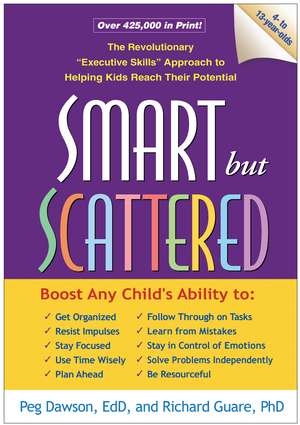
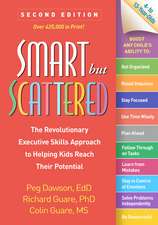
Smart but Scattered, First Edition: The Revolutionary "Executive Skills" Approach to Helping Kids Reach Their Potential
Autor Peg Dawson, Richard Guareen Limba Engleză Paperback – 26 noi 2008
În peisajul educației speciale și al psihologiei dezvoltării, Smart but Scattered, First Edition ocupă un loc central, fiind fundamentul unei metodologii care a transformat modul în care înțelegem dificultățile de organizare la copii. Considerăm că această lucrare se încadrează în programul de studiu al psihopedagogiei și al dezvoltării profesionale pentru cadrele didactice, oferind un cadru teoretic solid pentru gestionarea deficitelor funcțiilor executive. Găsim în acest volum o analiză detaliată a modului în care procesele neurologice influențează capacitatea de concentrare și planificare a elevilor care, deși inteligenți, par adesea pierduți în sarcini cotidiene.
Abordarea autorilor Peg Dawson și Richard Guare se distinge prin pragmatism, structurând volumul în trei părți esențiale: fundamentul teoretic, principiile de îmbunătățire a abilităților și implementarea planurilor de acțiune. Reținem importanța capitolului despre potrivirea copilului cu sarcina, o perspectivă care echilibrează așteptările părinților cu resursele cognitive reale ale copilului. Această ediție acoperă aceeași arie tematică precum The Impulsive, Disorganized Child, dar cu o abordare mult mai structurată pe intervenții specifice pentru zece abilități executive distincte, de la memoria de lucru la flexibilitate.
În contextul operei autorilor, lucrarea reprezintă punctul de plecare pentru o serie extinsă care include Smart but Scattered Teens și Executive Skills in Children and Adolescents, Third Edition. Dacă lucrările ulterioare s-au specializat pe segmente de vârstă sau pe mediul școlar, acest volum rămâne resursa de bază care definește terminologia și instrumentele de evaluare. Tonul este unul clinic, dar accesibil, axat pe soluții comportamentale derivate din analiza antecedentelor și consecințelor, oferind un ritm de lectură aplicat, susținut de numeroase studii de caz și grile de evaluare.
Preț: 103.52 lei
Carte disponibilă
Livrare economică 18 mai-01 iunie
Specificații
ISBN-10: 1593854455
Pagini: 314
Dimensiuni: 178 x 254 x 23 mm
Greutate: 0.5 kg
Ediția:1
Editura: Guilford Publications
Colecția Guilford Press
V-ar putea interesa
-
 A Kids Book About Executive FunctioningIris Wong-18%Preț: 74.38 lei91.06 lei
 -
 Preț: 69.41 lei
 -
 The Everything Parent's Guide to Children with Executive Functioning DisorderRebecca BranstetterPreț: 98.49 lei
 -
 Preț: 81.68 lei
 -
 Preț: 110.92 lei
 -
 Preț: 110.17 lei
 -
 Preț: 110.60 lei
 -
 Preț: 139.64 lei
 -
 Preț: 362.40 lei
 -
 Preț: 112.13 lei
 -
 -28%Preț: 92.70 lei128.21 lei
 -
 Preț: 112.74 lei
 -
 Raising an Organized ChildDamon KorbPreț: 90.18 lei
 -
 Preț: 73.14 lei
 -
 Scattered to FocusedZac GrishamPreț: 85.18 lei
 -
 -26%Preț: 71.27 lei96.25 lei
 -
 -21%Preț: 112.29 lei141.39 lei
 -
 -22%Preț: 115.97 lei148.22 lei
 -
 -21%Preț: 144.43 lei183.80 lei
 -
 Train Your Brain for SuccessRandy KulmanPreț: 89.36 lei
Public țintă
Professional Practice & DevelopmentDe ce să citești această carte
Această carte este esențială pentru părinții și profesioniștii care lucrează cu copii ce prezintă dificultăți de organizare sau ADHD. Cititorul câștigă o înțelegere clară a mecanismelor cerebrale din spatele „dezordinii” și, mai important, primește instrumente practice pentru a construi rutine funcționale. Este o resursă care transformă frustrarea zilnică în strategii de învățare, oferind un parcurs concret spre autonomie.
Despre autor
Peg Dawson, Ed.D., este psiholog în cadrul Centrului pentru Tulburări de Învățare și Atenție din Portsmouth, New Hampshire. Cu o experiență vastă în psihologie școlară, ea a dezvoltat, împreună cu Richard Guare, Ph.D., un cadru de intervenție recunoscut la nivel internațional pentru antrenarea abilităților executive. Expertiza sa se reflectă în numeroasele publicații de specialitate, precum The Work-Smart Academic Planner, Revised Edition, (Wire-Bound Paperback), fiind o autoritate în adaptarea strategiilor cognitive pentru mediul educațional și familial.
Cuprins
I. What Makes Your Child Smart But Scattered
1. How Did Such a Smart Kid End Up So Scattered?
2. Identifying Your Child's Strengths and Weaknesses
3. How Your Own Executive Strengths and Weaknesses Matter
4. Matching the Child to the Task
II. Laying a Foundation That Can Help
5. Ten Principles for Improving Your Child's Executive Skills
6. Modifying the Environment: A Is for Antecedent
7. Teaching Executive Skills Directly: B Is for Behavior
8. Motivating Your Child to Learn and Use Executive Skills: C Is for Consequence
III. Putting It All Together
9. Advance Organizer
10. Ready-Made Plans for Teaching Your Child to Complete Daily Routines
11. Building Response Inhibition
12. Enhancing Working Memory
13. Improving Emotional Control
14. Strengthening Sustained Attention
15. Teaching Task Initiation
16. Promoting Planning and Prioritizing
17. Fostering Organization
18. Instilling Time Management
19. Encouraging Flexibility
20. Increasing Goal-Directed Persistence
21. Cultivating Metacognition
22. When What You Do Is Not Enough
23. Working with the School
24. What's Ahead?