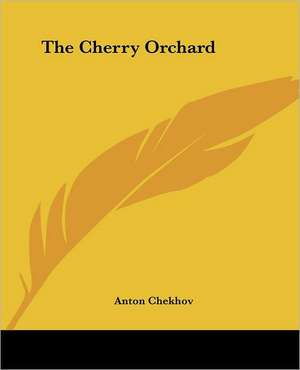
The Cherry Orchard
Autor Anton Chekhoven Limba Engleză Paperback – 17 iun 2004
Preț: 84.52 lei
Puncte Express: 127
Carte tipărită la comandă
Livrare economică 27 noiembrie-08 decembrie
Livrare prin curier în România Termenul estimat este afișat lângă disponibilitate.
Transport gratuit de la 400.00 lei Plată online sau ramburs, în funcție de opțiunile comenzii.
Retur gratuit în 14 zile Comandă securizată și suport în română.
Specificații
ISBN-13: 9781419156519
ISBN-10: 1419156519
Pagini: 72
Dimensiuni: 191 x 235 x 5 mm
Greutate: 0.15 kg
Editura: Kessinger Publishing
Locul publicării:United States
ISBN-10: 1419156519
Pagini: 72
Dimensiuni: 191 x 235 x 5 mm
Greutate: 0.15 kg
Editura: Kessinger Publishing
Locul publicării:United States
V-ar putea interesa
-
 Wuthering HeightsEmily BrontëPreț: 28.01 lei
 -
 The Plays of Anton ChekhovAnton ChekhovPreț: 108.42 lei
 -
 PlaysAnton Chekhov-24%Preț: 60.42 lei79.99 lei
 -
 Death of a SalesmanArthur Miller-28%Preț: 50.97 lei70.66 lei
 -
 Preț: 56.81 lei
 -
 Preț: 176.89 lei
 -
 Preț: 214.17 lei
 -
 Anton Chekhov: Selected StoriesAnton Chekhov-29%Preț: 35.82 lei50.11 lei
 -
 The Singular Life of Albert NobbsSimone Benmussa-13%Preț: 67.92 lei77.86 lei
 -
 Four Plays and Three JokesAnton Chekhov-16%Preț: 97.31 lei115.86 lei
 -
 Crooked DancesMr Robin French-24%Preț: 85.78 lei112.76 lei
 -
 Cash CowOli ForsythPreț: 14.89 lei
 -
 RadioAl Smith-26%Preț: 85.60 lei115.65 lei
 -
 On the Other Hand, We're HappyDaf James-24%Preț: 85.60 lei112.67 lei
 -
 Adapting Chekhov in the 21st Century: Seven Contemporary PlaysFrances Babbage-20%Preț: 189.58 lei237.90 lei
 -
 The Changeling: Revised EditionThomas Middleton-18%Preț: 72.72 lei89.10 lei
 -
 Uncle VanyaAnton Pavlovich ChekhovPreț: 42.62 lei
 -
 The SeagullAnton ChekhovPreț: 27.96 lei
 -
 IvanovAnton ChekhovPreț: 31.07 lei
 -
 Uncle VanyaAnton ChekhovPreț: 31.69 lei
 -
 Three SistersAnton ChekhovPreț: 31.11 lei
 -
 The Three Theban PlaysSophoclesPreț: 45.74 lei
 -
 Chekhov Selected StoriesAnton ChekhovPreț: 56.62 lei
 -
 Women Centre StageSue ParrishPreț: 99.30 lei
 -
 CaterpillarAlison CarrPreț: 72.87 lei
 -
 An Inspector Calls: Annotation-Friendly EditionJ. B. PriestleyPreț: 86.45 lei
 -
 CuttingsOllie George Clarke-11%Preț: 67.49 lei75.99 lei
 -
 Preț: 34.20 lei
 -
 Long Day's Journey into NightEugene O'NeillPreț: 56.14 lei
Notă biografică
Anton Pavlovich Chekhov (1860 - 1904) was a Russian playwright and short story writer, who is considered to be among the greatest writers of short fiction in history. His career as a playwright produced four classics and his best short stories are held in high esteem by writers and critics. Along with Henrik Ibsen and August Strindberg, Chekhov is often referred to as one of the three seminal figures in the birth of early modernism in the theater. Chekhov practiced as a medical doctor throughout most of his literary career: "Medicine is my lawful wife", he once said, "and literature is my mistress."
Descriere
Descriere de la o altă ediție sau format:
The orchard's white, all white. You haven't forgotten, have you, Lyuba? The avenue lined with trees, unfurling like a slender ribbon. And on moonlit nights, it shimmers. You remember, don't you? You haven't forgotten?
Can anyone persuade Ranevskaya and her aristocratic household that the world is changing, and they must too?
Following internationally acclaimed productions of The Seagull (Belvoir St Theatre, Sydney) and Three Sisters (Young Vic, London), director Benedict Andrews has a reputation as one of the world's leading interpreters of Chekhov.
For the Donmar Warehouse he stages the great writer's final play. It's a work that predicted and captured the end of an era, but is timeless in its humanity, prescience, humour and pathos. The Cherry Orchard is Chekhov's masterpiece.
This edition was published to coincide with its world premiere at London's Donmar Warehouse in April 2024.
The orchard's white, all white. You haven't forgotten, have you, Lyuba? The avenue lined with trees, unfurling like a slender ribbon. And on moonlit nights, it shimmers. You remember, don't you? You haven't forgotten?
Can anyone persuade Ranevskaya and her aristocratic household that the world is changing, and they must too?
Following internationally acclaimed productions of The Seagull (Belvoir St Theatre, Sydney) and Three Sisters (Young Vic, London), director Benedict Andrews has a reputation as one of the world's leading interpreters of Chekhov.
For the Donmar Warehouse he stages the great writer's final play. It's a work that predicted and captured the end of an era, but is timeless in its humanity, prescience, humour and pathos. The Cherry Orchard is Chekhov's masterpiece.
This edition was published to coincide with its world premiere at London's Donmar Warehouse in April 2024.
Recenzii
Now Chekhov's final and finest play, from 1903, is the latest twentieth-century masterpiece to get a good going-over. Actually, make that an excellent going-over . . . It's been pruned, yes, but this grimly witty tragicomedy is unmistakably Chekhov . . . and it teems with life.
Stephens [has] refocussed Chekhov's play into a potent study in feminine - rather than societal - collapse.
Chekhov was superb on the destructive impact of people who take no heed: who turn other people's lives upside down (Uncle Vanya) or blithely ignore warnings (Cherry Orchard). He was superb too on those who can see the dangers, but are powerless to do anything. Little wonder then, that these great plays feel so painfully pertinent now to audiences keenly aware of intractable global problems. Little wonder either that contemporary theatre-makers seek to meet his works in the spirit of innovation.
If Chekhov were planning a revenant visit to see how his work fares in England in the 21 century, this would be an opportune moment to come.
Revivals of classic plays are the lifeblood of theatre. They are the way in which the art form tests the reputation, relevance and validity of the masterpieces of the past.
Stephens [has] refocussed Chekhov's play into a potent study in feminine - rather than societal - collapse.
Chekhov was superb on the destructive impact of people who take no heed: who turn other people's lives upside down (Uncle Vanya) or blithely ignore warnings (Cherry Orchard). He was superb too on those who can see the dangers, but are powerless to do anything. Little wonder then, that these great plays feel so painfully pertinent now to audiences keenly aware of intractable global problems. Little wonder either that contemporary theatre-makers seek to meet his works in the spirit of innovation.
If Chekhov were planning a revenant visit to see how his work fares in England in the 21 century, this would be an opportune moment to come.
Revivals of classic plays are the lifeblood of theatre. They are the way in which the art form tests the reputation, relevance and validity of the masterpieces of the past.