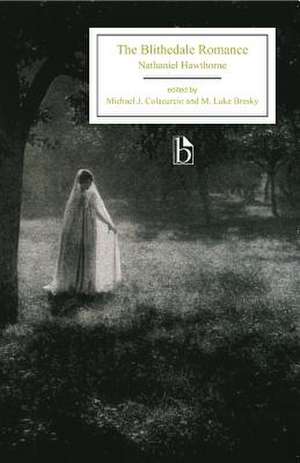
The Blithedale Romance
Autor Nathaniel Hawthorne Editat de Michael J. Colacurcio, Luke Breskyen Limba Engleză Paperback – 24 iul 2015
The editors’ new introduction helps the reader to negotiate Blithedale’s literary difficulties by offering a detailed reflection on the main problems confronted by past and present interpreters of the novel. Appendices expand on the central historical theme of reform, highlighting the novel’s references to women’s emancipation, antislavery, and Utopian socialism.
Preț: 188.03 lei
Puncte Express: 282
Carte disponibilă
Livrare economică 14-28 noiembrie
Livrare express 03-07 noiembrie pentru 32.65 lei
Livrare prin curier în România Termenul estimat este afișat lângă disponibilitate.
Transport gratuit de la 400.00 lei Plată online sau ramburs, în funcție de opțiunile comenzii.
Retur gratuit în 14 zile Comandă securizată și suport în română.
Specificații
ISBN-13: 9781554811236
ISBN-10: 1554811236
Pagini: 376
Dimensiuni: 140 x 216 x 19 mm
Greutate: 0.49 kg
Editura: BROADVIEW PR
Colecția Broadview Press
Locul publicării:Peterborough, Canada
ISBN-10: 1554811236
Pagini: 376
Dimensiuni: 140 x 216 x 19 mm
Greutate: 0.49 kg
Editura: BROADVIEW PR
Colecția Broadview Press
Locul publicării:Peterborough, Canada
V-ar putea interesa
-
 The Scarlet LetterNathaniel HawthornePreț: 64.31 lei
 -
 Jonathan Swift: The Critical HeritageKathleen WilliamsPreț: 501.26 lei
 -
 Marcel ProustLeighton HodsonPreț: 481.28 lei
 -
 Virginia WoolfRobin MajumdarPreț: 496.61 lei
 -
 Anton ChekhovVictor EmeljanowPreț: 377.59 lei
 -
 -18%Preț: 1254.12 lei1529.41 lei
 -
 The House of the Seven GablesNathaniel HawthornePreț: 36.76 lei
 -
 Self-Reliance, and Other EssaysRalph Waldo Emerson-34%Preț: 23.65 lei35.82 lei
 -
 Walden, Or, Life in the WoodsHenry David Thoreau-17%Preț: 39.06 lei47.32 lei
 -
 -18%Preț: 1256.55 lei1532.39 lei
 -
 Hawthorne in ConcordPhilip McFarlandPreț: 100.85 lei
 -
 Writing Indian, Native ConversationsJohn Lloyd PurdyPreț: 394.02 lei
 -
 Everybody’s Family Romance: Reading Incest in Neoliberal AmericaGillian HarkinsPreț: 221.02 lei
 -
 Joyce: A Guide for the PerplexedDr Peter Mahon-17%Preț: 205.43 lei247.79 lei
 -
 Science Fiction & Fantasy Book ReviewR. ReginaldPreț: 199.19 lei
 -
 The Transcendentalists and Their WorldRobert A GrossPreț: 232.17 lei
 -
 Preț: 73.16 leiRecomandat
 -
 Little DaffydowndillyNathaniel HawthornePreț: 59.27 lei
 -
 The Old ManseNathaniel HawthornePreț: 60.69 lei
 -
 The ProphetKahlil GibranPreț: 27.21 lei
 -
 The Marble FaunNathaniel HawthornePreț: 55.71 lei
 -
 -24%Preț: 84.02 lei109.99 lei
 -
 The Country of the Pointed FirsSarah Orne JewettPreț: 36.09 lei
 -
 Oliver TwistCharles DickensPreț: 38.00 lei
 -
 The Scarlet LetterNathaniel HawthornePreț: 40.86 lei
 -
 FeathertopNathaniel HawthornePreț: 47.70 lei
 -
 UtopiaThomas MorePreț: 33.19 lei
 -
 Walden - ClassicsHenry David ThoreauPreț: 41.88 lei
Recenzii
Inspired by Nathaniel Hawthorne’s own experience as a member of the famous Brook Farm Community, which the author describes in his preface as the “most romantic episode” in his life, The Blithedale Romance is one of the most engaging and complex of Hawthorne’s novels. Recounting the hopeful formation and slow fragmentation of a reform-minded socialist community in antebellum Massachusetts, the novel has increasingly preoccupied commentators on American literature and culture over the last few decades.
The editors’ new introduction helps the reader to negotiate Blithedale’s literary difficulties by offering a detailed reflection on the main problems confronted by past and present interpreters of the novel. Appendices expand on the central historical theme of reform, highlighting the novel’s references to women’s emancipation, antislavery, and Utopian socialism.
“The Broadview edition of The Blithedale Romance is an exceptional scholarly achievement. The excellent critical introduction, along with the wealth of biographical and historical materials, at last make it possible to see Hawthorne’s novel in all its complexity and brilliance.” — Eric J. Sundquist, Andrew W. Mellon Professor of the Humanities, Johns Hopkins University
“The introduction, by Michael J. Colacurcio (a scholar unrivaled in Hawthorne criticism over the past three decades) and Luke Bresky, is a major piece of literary analysis. An authoritative text of the novel, judicious annotations to help readers with historical persons and events, and extensive appendices contextualizing more fully than heretofore the religious, feminist, reformist, and slavery contexts in which the book should be read—all these make this edition of The Blithedale Romance unsurpassed.” — Frederick Newberry, Professor Emeritus, Duquesne University, former editor of The Nathaniel Hawthorne Review
“The Blithedale Romance is a brilliant novel, one that compresses into its reveries and observations some of the most urgent issues troubling antebellum America. With this sparkling new edition, Colacurcio and Bresky not only recognize Hawthorne’s political thoughtfulness, but also include a rich framework of primary sources through which to approach the allusive energy of Hawthorne’s prose. I am looking forward to using this edition in my American Literature courses.” — Dana Medoro, University of Manitoba
The editors’ new introduction helps the reader to negotiate Blithedale’s literary difficulties by offering a detailed reflection on the main problems confronted by past and present interpreters of the novel. Appendices expand on the central historical theme of reform, highlighting the novel’s references to women’s emancipation, antislavery, and Utopian socialism.
“The Broadview edition of The Blithedale Romance is an exceptional scholarly achievement. The excellent critical introduction, along with the wealth of biographical and historical materials, at last make it possible to see Hawthorne’s novel in all its complexity and brilliance.” — Eric J. Sundquist, Andrew W. Mellon Professor of the Humanities, Johns Hopkins University
“The introduction, by Michael J. Colacurcio (a scholar unrivaled in Hawthorne criticism over the past three decades) and Luke Bresky, is a major piece of literary analysis. An authoritative text of the novel, judicious annotations to help readers with historical persons and events, and extensive appendices contextualizing more fully than heretofore the religious, feminist, reformist, and slavery contexts in which the book should be read—all these make this edition of The Blithedale Romance unsurpassed.” — Frederick Newberry, Professor Emeritus, Duquesne University, former editor of The Nathaniel Hawthorne Review
“The Blithedale Romance is a brilliant novel, one that compresses into its reveries and observations some of the most urgent issues troubling antebellum America. With this sparkling new edition, Colacurcio and Bresky not only recognize Hawthorne’s political thoughtfulness, but also include a rich framework of primary sources through which to approach the allusive energy of Hawthorne’s prose. I am looking forward to using this edition in my American Literature courses.” — Dana Medoro, University of Manitoba
Cuprins
Acknowledgements
Introduction
Nathaniel Hawthorne: A Brief Chronology
A Note on the Text
The Blithedale Romance
Appendix A: Hawthorne on Brook Farm, Reform, and Social Change
Appendix F: Contemporary Reviews of The Blithedale Romance
Introduction
Nathaniel Hawthorne: A Brief Chronology
A Note on the Text
The Blithedale Romance
Appendix A: Hawthorne on Brook Farm, Reform, and Social Change
- Nathaniel Hawthorne, Selected Letters to Sophia Peabody (April 1841 to June 1842)
- From “The Hall of Fantasy” (1843, 1846)
- From “Earth’s Holocaust” (1844, 1846)
- From “The Old Manse” (1846)
- From The Scarlet Letter (1850)
- From George Ripley, Letter to the Church in Purchase Street (1 October 1840)
- From “‘The Memory and Example of the Just,’ A Sermon, Preached on All Saints’ Day, to the First Church, by Its Minister, N.L. Frothingham. Boston, 1840.” Christian Examiner (January 1841)
- From Ralph Waldo Emerson, “Chardon Street and Bible Conventions,” The Dial (July 1842)
- From Ralph Waldo Emerson, “Lectures on the Times,” The Dial (July 1842)
- From Ralph Waldo Emerson, “New England Reformers” (1844)
- From Albert Brisbane, “Association and Social Reform,” The Boston Quarterly Review (April 1842)
- From Charles Lane, “Brook Farm,” The Dial (January 1844)
- From Andrew Jackson Davis, The Principles of Nature, Her Divine Revelations, and a Voice to Mankind (1847)
- Pastoral Letter of the General Association of Massachusetts (28 June 1837)
- From Sarah Grimké, Letters on the Equality of the Sexes, Addressed to Mary S. Parker, President of the Boston Female Anti-Slavery Society (1838)
- From Letter III: The Pastoral Letter of the General Association of Congregational Ministers of Massachusetts
- From Letter XII: Legal Disabilities of Women
- From Catharine E. Beecher, An Essay on Slavery and Abolitionism, with Reference to the Duty of American Females (1837)
- From William Lloyd Garrison, “Letter to the Boston Female Anti-Slavery Society,” The Liberator (16 October 1840)
- Margaret Fuller, Selected Comments on Woman
- From “Leila,” The Dial (April 1841)
- From Woman in the Nineteenth Century (1845)
- Sophia Ripley, “Woman,” The Dial (January 1841)
- From Orestes Brownson, “Miss Fuller and Reformers,” Brownson’s Quarterly Review (April 1845)
- From Oneida Community [John Humphrey Noyes], “Bible Argument; Defining the Relations of the Sexes in the Kingdom of Heaven” (1849)
- From Theodore Parker, “Sermon of the Public Function of Woman” (1853)
- From the US Constitution, Fugitive Slave Act (1850)
- From Horace Mann, “Speech to the Massachusetts Convention in Opposition to the Fugitive Slave Law” (1851)
- Caroline W. Healey Dall, “Amy. A Tale,” Liberty Bell (1849)
- Antislavery Emblems: “Am I Not a Woman and a Sister?”
- Josiah Wedgwood Antislavery Medallion (1787)
- Typefounder’s Cut from The Liberator (1832)
- Kneeling Slave with Dame Justice, from the Cover Page of Authentic Anecdotes of American Slavery (1838) by Lydia Maria Child
- Needlecase Stamped with Antislavery Emblem
Appendix F: Contemporary Reviews of The Blithedale Romance
- From “Contemporary Literature of America: ‘The Blithedale Romance,’” The Westminster Review (October 1852)
- Edwin Percy Whipple, Graham’s Magazine (September 1852)
Notă biografică
Nathaniel Hawthorne (1804 - 1864) was an American novelist, dark romantic and short story writer. He was born in 1804 in Salem, Massachusetts to Nathaniel Hathorne and the former Elizabeth Clarke Manning. His ancestors include John Hathorne, the only judge involved in the Salem witch trials who never repented of his actions. He entered Bowdoin College in 1821, was elected to Phi Beta Kappa in 1824 and graduated in 1825. He published his first work in 1828, the novel Fanshawe; he later tried to suppress it, feeling that it was not equal to the standard of his later work. He published several short stories in periodicals, which he collected in 1837 as Twice-Told Tales. The next year, he became engaged to Sophia Peabody. He worked at the Boston Custom House and joined Brook Farm, a transcendentalist community, before marrying Peabody in 1842. The Scarlet Letter was published in 1850, followed by a succession of other novels. A political appointment as consul took Hawthorne and family to Europe before their return to Concord in 1860. Hawthorne died on May 19, 1864, and was survived by his wife and their three children. Much of Hawthorne's writing centers on New England, many works featuring moral metaphors with an anti-Puritan inspiration. His fiction works are considered part of the Romantic movement and, more specifically, dark romanticism. His themes often center on the inherent evil and sin of humanity and his works often have moral messages and deep psychological complexity. His published works include novels, short stories and a biography of his college friend Franklin Pierce, the 14th President of the United States.