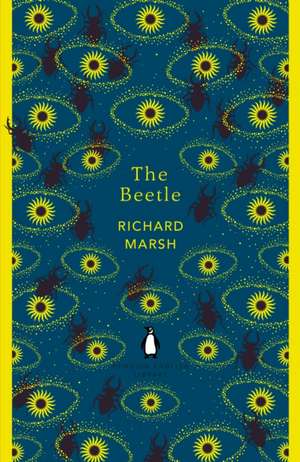
The Beetle: The Penguin English Library
Autor Richard Marshen Limba Engleză Paperback – 7 iun 2018
Eminent politician Paul Lessingham is the toast of Westminster, but when 'the Beetle' arrives from Egypt to hunt him down, the dark and gruesome secret that haunts him is dragged into the light. Bent on revenge for a crime committed against the disciples of an Egyptian goddess, the Beetle terrorizes its victims and will stop at nothing until it has satisfaction.
The Penguin English Library - collectable general readers' editions of the best fiction in English, from the eighteenth century to the end of the Second World War.
Din seria The Penguin English Library
-
 Preț: 45.62 lei
 - 27%
 Preț: 47.00 lei
 - 32%
 Preț: 49.31 lei
 -
 Preț: 58.79 lei
 -
 Preț: 63.63 lei
 - 27%
 Preț: 46.79 lei
 - 27%
 Preț: 47.46 lei
 -
 Preț: 64.27 lei
 - 27%
 Preț: 47.34 lei
 - 29%
 Preț: 45.32 lei
 - 24%
 Preț: 51.20 lei
 - 28%
 Preț: 59.85 lei
 - 24%
 Preț: 50.51 lei
 - 25%
 Preț: 49.53 lei
 - 27%
 Preț: 46.84 lei
 - 32%
 Preț: 49.73 lei
 - 29%
 Preț: 45.57 lei
 - 28%
 Preț: 45.94 lei
 - 31%
 Preț: 50.86 lei
 -
 Preț: 71.60 lei
 - 19%
 Preț: 68.34 lei
 - 27%
 Preț: 47.22 lei
 - 28%
 Preț: 59.35 lei
 - 27%
 Preț: 47.77 lei
 - 22%
 Preț: 63.58 lei
 - 31%
 Preț: 50.73 lei
 - 27%
 Preț: 47.47 lei
 - 18%
 Preț: 53.96 lei
 - 27%
 Preț: 47.21 lei
 - 23%
 Preț: 57.02 lei
 - 28%
 Preț: 46.26 lei
 - 33%
 Preț: 49.00 lei
 - 26%
 Preț: 48.91 lei
 - 26%
 Preț: 48.65 lei
 - 22%
 Preț: 64.71 lei
 - 25%
 Preț: 49.62 lei
 - 28%
 Preț: 46.66 lei
 - 24%
 Preț: 56.57 lei
 - 28%
 Preț: 45.89 lei
 - 26%
 Preț: 48.86 lei
 - 27%
 Preț: 47.08 lei
 - 26%
 Preț: 48.77 lei
 - 25%
 Preț: 49.28 lei
 - 28%
 Preț: 46.66 lei
 - 22%
 Preț: 63.85 lei
 - 29%
 Preț: 45.57 lei
 - 32%
 Preț: 49.40 lei
 - 27%
 Preț: 47.82 lei
 - 26%
 Preț: 48.56 lei
 - 23%
 Preț: 57.17 lei
Preț: 49.49 lei
Preț vechi: 72.99 lei
-32%
Puncte Express: 74
Carte disponibilă
Livrare economică 12-18 noiembrie
Livrare express 23-29 octombrie pentru 46.75 lei
Livrare prin curier în România Termenul estimat este afișat lângă disponibilitate.
Transport gratuit de la 400.00 lei Plată online sau ramburs, în funcție de opțiunile comenzii.
Retur gratuit în 14 zile Comandă securizată și suport în română.
Specificații
ISBN-13: 9780241341353
ISBN-10: 0241341353
Pagini: 384
Dimensiuni: 131 x 198 x 27 mm
Greutate: 0.28 kg
Editura: Penguin Books
Colecția Penguin Classics
Seria The Penguin English Library
Locul publicării:London, United Kingdom
ISBN-10: 0241341353
Pagini: 384
Dimensiuni: 131 x 198 x 27 mm
Greutate: 0.28 kg
Editura: Penguin Books
Colecția Penguin Classics
Seria The Penguin English Library
Locul publicării:London, United Kingdom
V-ar putea interesa
-
 House of the BeastMichelle WongPreț: 124.99 leiRecomandat
 -
 Victorian PsychoVirginia FeitoPreț: 107.29 lei
 -
 Three Gothic NovelsHorace Walpole-18%Preț: 78.04 lei94.71 lei
 -
 Christmas with the SavagesMary Clive-20%Preț: 45.53 lei56.68 lei
 -
 Strange Case of Dr Jekyll and Mr Hyde and Other TalesRobert Louis StevensonPreț: 47.27 lei
 -
 Boxer, BeetleNed Beauman-26%Preț: 58.41 lei79.13 lei
 -
 Preț: 146.26 lei
 -
 Preț: 87.41 lei
 -
 The Wayfearers WeirdWeird WalkPreț: 76.93 leiNou
 -
 Out of the PastAaron Worth-5%Preț: 66.99 lei70.52 lei
 -
 Preț: 192.24 lei
 -
 -25%Preț: 59.46 lei79.76 lei
 -
 Preț: 133.93 lei
 -
 The King in Yellow & Other Tales of the SupernaturalRobert Chambers W.-28%Preț: 91.02 lei126.96 lei
 -
 -31%Preț: 130.38 lei188.89 lei
 -
 -26%Preț: 52.44 lei71.04 lei
 -
 Sweetness And Lightning 1Gido AmagakurePreț: 93.36 lei
 -
 Witch Hat Atelier 2Kamome ShirahamaPreț: 74.61 lei
 -
 -18%Preț: 168.62 lei205.95 leiRecomandat
 -
 Sherlock Holmes and the Highgate HorrorsJames Lovegrove-16%Preț: 62.36 lei74.19 lei
 -
 The Butcher's DaughterCorinne Leigh Clark-18%Preț: 112.41 lei137.73 lei
 -
 Preț: 159.23 lei
 -
 Preț: 142.70 lei
 -
 Preț: 51.60 lei
 -
 The Eerie BookMaragret ArmourPreț: 133.72 lei
 -
 A Scarab Where the Heart Should BeMarieke Bigg-19%Preț: 62.72 lei77.68 lei
 -
 Preț: 98.09 lei
 -
 The Time MachineH. G. WellsPreț: 33.23 lei
Notă biografică
Richard Marsh (1857-1915) was the pseudonym of the British author born Richard Bernard Heldman. He is best known for his supernatural thriller The Beetle: A Mystery, published in the same year as Bram Stoker's Dracula and initially even more popular. Heldman was educated at Eton and Oxford University. Several of the prolific Marsh's novels were published posthumously.
Recenzii
The Beetle (1897) tells the story of a fantastical creature, “born of neither god nor man,” with supernatural and hypnotic powers, who stalks British politician Paul Lessingham through fin de siècle London in search of vengeance for the defilement of a sacred tomb in Egypt. In imitation of various popular fiction genres of the late nineteenth century, Marsh unfolds a tale of terror, late imperial fears, and the “return of the repressed,” through which the crisis of late imperial Englishness is revealed.
This Broadview edition includes a critical introduction and a rich selection of historical documents that situate the novel within the contexts of fin de siècle London, England’s interest and involvement in Egypt, the emergence of the New Woman, and contemporary theories of mesmerism and animal magnetism.
“The Beetle has it all: it’s at once a ripping gothic yarn, a fin de siècle melodrama, and a document of the fears and obsessions of late imperial culture. Julian Wolfreys’ introduction is excellent, bringing lots of fascinating material to bear on the novel and doing so clearly and persuasively. He makes you want to read it.” — Jonathan Dollimore, author of Sexual Dissidence and Death, Desire and Loss in Western Culture
“The Beetle is a great read. As Julian Wolfreys’ admirably learned, perceptive, and comprehensive introduction, appendices, and notes show, it is also a wonderful assemblage of many motifs from popular culture at the fin de siècle. I enthusiastically recommend this book.” — J. Hillis Miller, University of California, Irvine
“For far too long we have had to do without an edition of one of the key best-selling novels of the fin de siècle, Richard Marsh’s The Beetle. Broadview has once again come to the rescue with a new edition of this lurid classic that at one time outsold Dracula. Featuring useful appendices and with an extensive introduction by Julian Wolfreys, this edition will be coveted by everyone interested in late Victorian fiction.” — Nicholas Daly, Trinity College, Dublin
This Broadview edition includes a critical introduction and a rich selection of historical documents that situate the novel within the contexts of fin de siècle London, England’s interest and involvement in Egypt, the emergence of the New Woman, and contemporary theories of mesmerism and animal magnetism.
“The Beetle has it all: it’s at once a ripping gothic yarn, a fin de siècle melodrama, and a document of the fears and obsessions of late imperial culture. Julian Wolfreys’ introduction is excellent, bringing lots of fascinating material to bear on the novel and doing so clearly and persuasively. He makes you want to read it.” — Jonathan Dollimore, author of Sexual Dissidence and Death, Desire and Loss in Western Culture
“The Beetle is a great read. As Julian Wolfreys’ admirably learned, perceptive, and comprehensive introduction, appendices, and notes show, it is also a wonderful assemblage of many motifs from popular culture at the fin de siècle. I enthusiastically recommend this book.” — J. Hillis Miller, University of California, Irvine
“For far too long we have had to do without an edition of one of the key best-selling novels of the fin de siècle, Richard Marsh’s The Beetle. Broadview has once again come to the rescue with a new edition of this lurid classic that at one time outsold Dracula. Featuring useful appendices and with an extensive introduction by Julian Wolfreys, this edition will be coveted by everyone interested in late Victorian fiction.” — Nicholas Daly, Trinity College, Dublin
Descriere
Descriere de la o altă ediție sau format:
The Beetle (1897) tells the story of a fantastical creature, “born of neither god nor man,” with supernatural and hypnotic powers, who stalks British politician Paul Lessingham through fin de siècle London in search of vengeance for the defilement of a sacred tomb in Egypt. In imitation of various popular fiction genres of the late nineteenth century, Marsh unfolds a tale of terror, late imperial fears, and the “return of the repressed,” through which the crisis of late imperial Englishness is revealed.
This Broadview edition includes a critical introduction and a rich selection of historical documents that situate the novel within the contexts of fin de siècle London, England’s interest and involvement in Egypt, the emergence of the New Woman, and contemporary theories of mesmerism and animal magnetism.
The Beetle (1897) tells the story of a fantastical creature, “born of neither god nor man,” with supernatural and hypnotic powers, who stalks British politician Paul Lessingham through fin de siècle London in search of vengeance for the defilement of a sacred tomb in Egypt. In imitation of various popular fiction genres of the late nineteenth century, Marsh unfolds a tale of terror, late imperial fears, and the “return of the repressed,” through which the crisis of late imperial Englishness is revealed.
This Broadview edition includes a critical introduction and a rich selection of historical documents that situate the novel within the contexts of fin de siècle London, England’s interest and involvement in Egypt, the emergence of the New Woman, and contemporary theories of mesmerism and animal magnetism.
Cuprins
Acknowledgements
Introduction
Richard Marsh: A Brief Chronology
A Note on the Text
The Beetle
Appendix A: London in the fin de siècle
Introduction
Richard Marsh: A Brief Chronology
A Note on the Text
The Beetle
Appendix A: London in the fin de siècle
- From Walter Besant, All Sorts and Conditions of Men (1882)
- From Robert Louis Stevenson, The Strange Case of Dr. Jekyll and Mr. Hyde (1886)
- From Henry James, “London” (1888)
- From Arthur Conan Doyle, The Sign of Four (1890)
- From Oscar Wilde, The Picture of Dorian Gray (1891)
- From Arthur Machen, The Three Impostors (1895)
- From Arthur Morrison, A Child of the Jago (1896)
- From Ouida, “The New Woman,” North American Review (May 1894)
- From Sarah Grand, “The New Aspect of the Woman Question,” North American Review (March 1894)
- From Nat Arling, “What is the Rôle of the ‘New Woman?’,” Westminster Review (November 1898)
- From Kathleen Caffe, “A Reply from Daughters,” The Nineteenth Century (March 1894)
- From Georgia Louise Leonard, “The Occult Sciences in the Temples of Ancient Egypt,” The Open Court (1887)
- From J.Norman Lockyer, “The Astronomy and Mythology of the Ancient Egyptians,” The Nineteenth Century (July 1892)
- From “Egypt,” London Quarterly Review (April 1884)
- From “Our Position in Egypt,” The Speaker (19 October 1891)
- From Joseph W. Haddock, Somnolism & Psycheism; or, the Science of the Soul and the Phenomena of Nervation, as Revealed by Vital Magnetism or Mesmerism, Considered Physiologically and Philosophically, with Notes of Mesmeric and Psychical Experience (1851)
- From James Esdaile, Natural and Mesmeric Clairvoyance, with the Practical Application of Mesmerism in Surgery and Medicine (1852)
- From “Magic and Mesmerism,” Tait’s Edinburgh Magazine, 50 (1843)
- From Romulus Katscher, “Mesmerism, Spiritualism and Hypnotism,” The Literary Digest (21 February 1891)