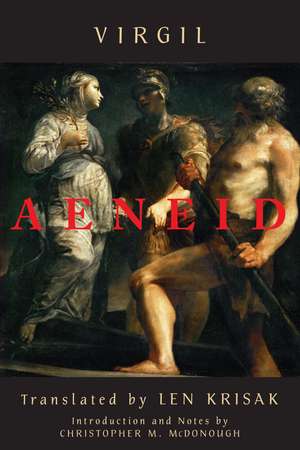
The Aeneid
Autor Virgil Traducere de Len Krisak Introducere de Christopher M. McDonoughen Limba Engleză Hardback – 23 sep 2020
Preț: 251.84 lei
Puncte Express: 378
Carte disponibilă
Livrare economică 14-28 noiembrie
Livrare prin curier în România Termenul estimat este afișat lângă disponibilitate.
Transport gratuit de la 400.00 lei Plată online sau ramburs, în funcție de opțiunile comenzii.
Retur gratuit în 14 zile Comandă securizată și suport în română.
Specificații
ISBN-13: 9781585109647
ISBN-10: 1585109649
Pagini: 424
Ilustrații: 1 map
Dimensiuni: 152 x 229 x 32 mm
Greutate: 0.71 kg
Editura: Hackett Publishing Company,Inc
Colecția Focus
Locul publicării:United States
ISBN-10: 1585109649
Pagini: 424
Ilustrații: 1 map
Dimensiuni: 152 x 229 x 32 mm
Greutate: 0.71 kg
Editura: Hackett Publishing Company,Inc
Colecția Focus
Locul publicării:United States
V-ar putea interesa
-
 Voltaire in LoveNancy Mitford-37%Preț: 58.20 lei92.60 lei
 -
 The OresteiaAeschylusPreț: 93.23 lei
 -
 MetamorphosesOvid-21%Preț: 65.59 lei83.02 lei
 -
 Monkey King: Journey to the WestWu Ch'Eng-En-17%Preț: 131.63 lei159.23 lei
 -
 Don QuixoteMiguel De Cervantes Saavedra-35%Preț: 129.36 lei197.56 lei
 -
 Animal FarmGeorge Orwell-19%Preț: 86.85 lei107.06 lei
 -
 UlyssesJames Joyce-35%Preț: 128.96 lei198.09 lei
 -
 Too Much and Not the MoodDurga Chew-BosePreț: 100.41 lei
 -
 The MothersBrit BennettPreț: 94.34 lei
 -
 Eyes of the Storm: A Graphic Novel (Bone #3)Jeff SmithPreț: 96.77 lei
 -
 The Story Orchestra: In the Hall of the Mountain KingJessica Courtney Tickle-17%Preț: 115.40 lei138.49 lei
 -
 Plato: Complete WorksPlato-22%Preț: 466.38 lei599.24 lei
 -
 A Companion to the Aeneid in Translation: Volume 2: Books 1-6Christopher Tanfield-15%Preț: 190.92 lei223.39 lei
 -
 A Companion to the Aeneid in Translation: Volume 1: Introduction and IndicesChristopher Tanfield-30%Preț: 117.02 lei167.25 lei
 -
 A Companion to the Aeneid in Translation: Volume 3: Books 7-12Christopher Tanfield-14%Preț: 194.25 lei225.49 lei
 -
 The Story of HiawathaHenry Wadsworth LongfellowPreț: 56.95 lei
 -
 The Boys King ArthurSidney LanierPreț: 63.28 lei
 -
 The Book of AccidentsChuck Wendig-22%Preț: 62.85 lei81.06 lei
 -
 The Merry Adventures of Robin HoodHoward Pyle-43%Preț: 75.32 lei131.41 lei
 -
 The Haunting of Ashburn HouseDarcy Coates-15%Preț: 56.73 lei66.79 lei
 -
 The Twisted OnesT. Kingfisher-16%Preț: 61.17 lei73.16 lei
 -
 The Infinite and The DivineRobert Rath-15%Preț: 56.24 lei66.50 lei
 -
 The OdysseyHomerPreț: 39.36 lei
 -
 Midsummer Night''s DreamWilliam ShakespearePreț: 35.95 lei
 -
 Lord JimJoseph ConradPreț: 28.01 lei
 -
 Robinson CrusoeDaniel DefoePreț: 36.10 lei
 -
 The Story of the IliadAlfred J. ChurchPreț: 69.86 lei
 -
 A Wonder Book and Tanglewood Tales, for Girls and BoysNathaniel HawthornePreț: 53.38 lei
Recenzii
"Virgil's Aeneid, though central to the Western canon, is also one of the most difficult to tackle for the translator, with its knotty syntax, its famously 'pious' protagonist, and its slippery ambivalence toward questions of truth and power. In this fresh translation, Len Krisak not only boldly meets Virgil line-for-line, but in a hexameter that answers the original meter, all while hewing to straightforward English with a weather eye on the Latin. The six-beat line has a reputation in English for dragging, but Krisak's hexameters drive along briskly. His choice to rhyme throughout, sometimes chiming ingeniously and sometimes with subtler off-rhyme effects, brings home that we are reading not only an epic narrative, but a verse performance. This work, concerned with human displacement in the aftermath of a prolonged war, with its themes of personal responsibility, duty, and leadership, and imbued with anxiety about the direction of a nation, could not be more topical."
—A. E. Stallings
"Len Krisak’s translation of the Aeneid is smooth, speedy, musical, and clear. Sometimes witty, always ingenious, Krisak's rhymes manage to feel effortless; together with meter, they move the story briskly along. Virgil's variety is here: dark vision, but also vividness and pace. The Aeneid is a narrative that is also a great poem; Krisak’s rendering, accurate line for line and also packed with lush imagery, constantly reminds us of these twin facts."
—Rachel Hadas, Board of Governors Professor of English, Rutgers University-Newark
"Yes, another English Aeneid . . . but one that merits its place in the great tradition of translations of the untranslatable. There are passages where Krisak seems to hit on exactly the right word or turn of phrase that has eluded so many readers and translators of Virgil’s epic before him. This is a splendid book, which surely deserves to be the choice for classes reading the Aeneid in English, or for those who wish to become better acquainted with the premier poet of Augustan Rome."
—Lee Fratantuono, Professor of Classics, Ohio Wesleyan University
"Len Krisak’s rhymed English hexameter couplets will allow readers to experience the Aeneid as its first Roman audience did: here is an exciting story told in an unprecedented way."
—Charles Martin
—A. E. Stallings
"Len Krisak’s translation of the Aeneid is smooth, speedy, musical, and clear. Sometimes witty, always ingenious, Krisak's rhymes manage to feel effortless; together with meter, they move the story briskly along. Virgil's variety is here: dark vision, but also vividness and pace. The Aeneid is a narrative that is also a great poem; Krisak’s rendering, accurate line for line and also packed with lush imagery, constantly reminds us of these twin facts."
—Rachel Hadas, Board of Governors Professor of English, Rutgers University-Newark
"Yes, another English Aeneid . . . but one that merits its place in the great tradition of translations of the untranslatable. There are passages where Krisak seems to hit on exactly the right word or turn of phrase that has eluded so many readers and translators of Virgil’s epic before him. This is a splendid book, which surely deserves to be the choice for classes reading the Aeneid in English, or for those who wish to become better acquainted with the premier poet of Augustan Rome."
—Lee Fratantuono, Professor of Classics, Ohio Wesleyan University
"Len Krisak’s rhymed English hexameter couplets will allow readers to experience the Aeneid as its first Roman audience did: here is an exciting story told in an unprecedented way."
—Charles Martin
Textul de pe ultima copertă
This book is the equal of its great Homeric predecessors, The Iliad and The Odyssey, in dramatic and narrative power, and it surpasses them in the intense sympathy which makes events such as the passion and destruction of Dido and the fall of Turnus among the most memorable in literature.
Notă biografică
Publius Vergilius Maro (70-19 B.C.), known as Virgil, was born near Mantua in the last days of the Roman Republic. In his comparatively short life he became the supreme poet of his age, whose Aeneid gave the Romans a great national epic equal to the Greeks’, celebrating their city’s origins and the creation of their empire. Virgil is also credited with authoring two other major works of Latin literature, the Eclogues and the Georgics.
Robert Fagles (1933-2008) was Arthur W. Marks ’19 Professor of Comparative Literature, Emeritus, at Princeton University. He was the recipient of the 1997 PEN/Ralph Manheim Medal for Translation and a 1996 Award in Literature from the American Academy of Arts and Letters. His translations include Sophocles’s Three Theban Plays, Aeschylus’s Oresteia (nominated for a National Book Award), Homer’s Iliad (winner of the 1991 Harold Morton Landon Translation Award by The Academy of American Poets), Homer’s Odyssey, and Virgil's Aeneid.
Bernard Knox (1914-2010) was Director Emeritus of Harvard’s Center for Hellenic Studies in Washington, D.C. He taught at Yale University for many years. Among his numerous honors are awards from the National Institute of Arts and Letters and the National Endowment for the Humanities. His works include The Heroic Temper: Studies in Sophoclean Tragedy, Oedipus at Thebes: Sophocles’ Tragic Hero and His Time and Essays Ancient and Modern (awarded the 1989 PEN/Spielvogel-Diamonstein Award).
Robert Fagles (1933-2008) was Arthur W. Marks ’19 Professor of Comparative Literature, Emeritus, at Princeton University. He was the recipient of the 1997 PEN/Ralph Manheim Medal for Translation and a 1996 Award in Literature from the American Academy of Arts and Letters. His translations include Sophocles’s Three Theban Plays, Aeschylus’s Oresteia (nominated for a National Book Award), Homer’s Iliad (winner of the 1991 Harold Morton Landon Translation Award by The Academy of American Poets), Homer’s Odyssey, and Virgil's Aeneid.
Bernard Knox (1914-2010) was Director Emeritus of Harvard’s Center for Hellenic Studies in Washington, D.C. He taught at Yale University for many years. Among his numerous honors are awards from the National Institute of Arts and Letters and the National Endowment for the Humanities. His works include The Heroic Temper: Studies in Sophoclean Tragedy, Oedipus at Thebes: Sophocles’ Tragic Hero and His Time and Essays Ancient and Modern (awarded the 1989 PEN/Spielvogel-Diamonstein Award).
Cuprins
The AeneidAcknowledgements
Introduction
The Aeneid
One: The Trojans reach Carthage
Two: Aeneas' Narration—The Sack of Troy
Three: Aeneas' Narration continued-His Travels
Four: The Tragedy of Dido
Five: The Funeral Games
Six: The Visit to the Underworld
Seven: War in Latium
Eight: The Site of the Future Rome
Nine: Siege of the Trojan Camp
Ten: The Relief and Pitched Battle
Eleven: Councils of War: Pitched Battle Again
Twelve: Decision: the Death of Turnus
List of Variations from the Oxford Text
Glossary of Names
Select Bibliography
Maps
Genealogical Table of the Royal House of Troy and Greece
Introduction
The Aeneid
One: The Trojans reach Carthage
Two: Aeneas' Narration—The Sack of Troy
Three: Aeneas' Narration continued-His Travels
Four: The Tragedy of Dido
Five: The Funeral Games
Six: The Visit to the Underworld
Seven: War in Latium
Eight: The Site of the Future Rome
Nine: Siege of the Trojan Camp
Ten: The Relief and Pitched Battle
Eleven: Councils of War: Pitched Battle Again
Twelve: Decision: the Death of Turnus
List of Variations from the Oxford Text
Glossary of Names
Select Bibliography
Maps
Genealogical Table of the Royal House of Troy and Greece