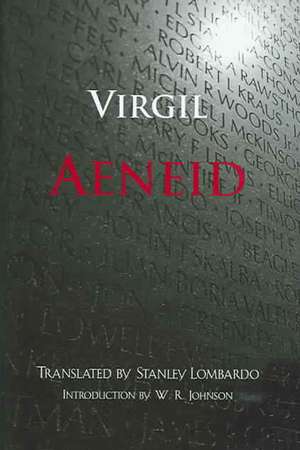
Aeneid
Autor Virgil Traducere de Stanley Lombardo Introducere de W. R. Johnsonen Limba Engleză Hardback – 15 mar 2005
Long a master of the crafts of Homeric translation and of rhapsodic performance, Stanley Lombardo now turns to the quintessential epic of Roman antiquity, a work with deep roots in the Homeric tradition. With characteristic virtuosity, he delivers a rendering of the Aeneid as compelling as his groundbreaking translations of the Iliad and the Odyssey, yet one that--like the Aeneid itself--conveys a unique epic sensibility and a haunting artistry all its own.
W. R. Johnson's Introduction makes an ideal companion to the translation, offering brilliant insight into the legend of Aeneas; the contrasting roles of the gods, fate, and fortune in Homeric versus Virgilian epic; the character of Aeneas as both wanderer and warrior; Aeneas' relationship to both his enemy Turnus and his lover Dido; the theme of doomed youths in the epic; and Virgil's relationship to the brutal history of Rome that he memorializes in his poem.
A map, a Glossary of Names, a Translator's Preface, and Suggestions for Further Reading are also included.
W. R. Johnson's Introduction makes an ideal companion to the translation, offering brilliant insight into the legend of Aeneas; the contrasting roles of the gods, fate, and fortune in Homeric versus Virgilian epic; the character of Aeneas as both wanderer and warrior; Aeneas' relationship to both his enemy Turnus and his lover Dido; the theme of doomed youths in the epic; and Virgil's relationship to the brutal history of Rome that he memorializes in his poem.
A map, a Glossary of Names, a Translator's Preface, and Suggestions for Further Reading are also included.
Preț: 273.74 lei
Preț vechi: 349.44 lei
-22%
Puncte Express: 411
Carte disponibilă
Livrare economică 02-16 noiembrie
Livrare prin curier în România Termenul estimat este afișat lângă disponibilitate.
Transport gratuit de la 400.00 lei Plată online sau ramburs, în funcție de opțiunile comenzii.
Retur gratuit în 14 zile Comandă securizată și suport în română.
Specificații
ISBN-13: 9780872207325
ISBN-10: 0872207323
Pagini: 432
Ilustrații: 1 halftone (2-page map)
Dimensiuni: 140 x 216 x 29 mm
Greutate: 0.51 kg
Editura: Hackett Publishing Company,Inc
Colecția Hackett Publishing Company, Inc.
Locul publicării:United States
ISBN-10: 0872207323
Pagini: 432
Ilustrații: 1 halftone (2-page map)
Dimensiuni: 140 x 216 x 29 mm
Greutate: 0.51 kg
Editura: Hackett Publishing Company,Inc
Colecția Hackett Publishing Company, Inc.
Locul publicării:United States
V-ar putea interesa
-
 Voltaire in LoveNancy Mitford-37%Preț: 58.20 lei92.60 lei
 -
 The OresteiaAeschylusPreț: 93.23 lei
 -
 MetamorphosesOvid-21%Preț: 65.49 lei83.02 lei
 -
 Monkey King: Journey to the WestWu Ch'Eng-En-18%Preț: 130.25 lei159.23 lei
 -
 Don QuixoteMiguel De Cervantes Saavedra-35%Preț: 128.13 lei197.56 lei
 -
 Animal FarmGeorge Orwell-19%Preț: 86.30 lei107.06 lei
 -
 UlyssesJames Joyce-35%Preț: 128.96 lei198.09 lei
 -
 Too Much and Not the MoodDurga Chew-BosePreț: 100.41 lei
 -
 The MothersBrit BennettPreț: 93.95 lei
 -
 Eyes of the Storm: A Graphic Novel (Bone #3)Jeff SmithPreț: 96.77 lei
 -
 The Story Orchestra: In the Hall of the Mountain KingJessica Courtney Tickle-18%Preț: 114.21 lei138.51 lei
 -
 Plato: Complete WorksPlato-23%Preț: 461.83 lei598.18 lei
 -
 A Companion to the Aeneid in Translation: Volume 2: Books 1-6Christopher Tanfield-15%Preț: 190.83 lei223.39 lei
 -
 A Companion to the Aeneid in Translation: Volume 1: Introduction and IndicesChristopher Tanfield-31%Preț: 113.39 lei164.65 lei
 -
 A Companion to the Aeneid in Translation: Volume 3: Books 7-12Christopher Tanfield-14%Preț: 189.59 lei221.56 lei
 -
 The Story of HiawathaHenry Wadsworth LongfellowPreț: 56.95 lei
 -
 The Boys King ArthurSidney LanierPreț: 63.28 lei
 -
 The Book of AccidentsChuck Wendig-23%Preț: 62.19 lei81.06 lei
 -
 The Merry Adventures of Robin HoodHoward Pyle-43%Preț: 74.85 lei131.41 lei
 -
 The Haunting of Ashburn HouseDarcy Coates-16%Preț: 56.12 lei66.79 lei
 -
 The Twisted OnesT. Kingfisher-17%Preț: 60.38 lei73.16 lei
 -
 The Infinite and The DivineRobert Rath-16%Preț: 55.63 lei66.50 lei
 -
 The OdysseyHomerPreț: 39.36 lei
 -
 Midsummer Night''s DreamWilliam ShakespearePreț: 35.95 lei
 -
 Lord JimJoseph ConradPreț: 28.01 lei
 -
 Robinson CrusoeDaniel DefoePreț: 36.10 lei
 -
 The Story of the IliadAlfred J. ChurchPreț: 69.86 lei
 -
 A Wonder Book and Tanglewood Tales, for Girls and BoysNathaniel HawthornePreț: 53.38 lei
Recenzii
Adapting words of the ancient critic Longinus, [Lombardo] refers to the intense light of noon of the Iliad, the magical glow of the setting sun in the Odyssey, and the chiaroscuro of the Aeneid, a darkness visible. This latter phrase is the title of a famous interpretation of the Aeneid by W. R. Johnson, who contributes a splendid essay to the translation. Whether recited or read, the present volume stands as another fine performance on Lombardo's part. Summing up: Highly recommended. --C. Fantazzi, CHOICE
Lombardo . . . tends to let Virgil be Virgil, and so avoids imposing unwarranted interpretation on the unwary reader. . . . [W.R. Johnson's] introduction is masterful and illuminating. --Hayden Pelliccia, The New York Review of Books
Crisp, idiomatic, and precise, this is a translation for our era. The list of further reading, grounded in the writings of W.R. Johnson (who also wrote the Introduction) and Michael C. J. Putnam, suggests the context that informs the translation: here, as the translator says in the Preface, you will find an Aeneid that works more in the shadows than in the light. . . . This translation would be excellent for classroom use: not only would it incite fascinating discussions about issues of war and empire, but it also reads well aloud. . . . Together with Johnson's Introduction, this volume offers the Aeneid in terms that will resonate strongly with the general reader of today. --Sarah Spence, New England Classical Journal
Textul de pe ultima copertă
This book is the equal of its great Homeric predecessors, The Iliad and The Odyssey, in dramatic and narrative power, and it surpasses them in the intense sympathy which makes events such as the passion and destruction of Dido and the fall of Turnus among the most memorable in literature.
Notă biografică
Publius Vergilius Maro (70-19 B.C.), known as Virgil, was born near Mantua in the last days of the Roman Republic. In his comparatively short life he became the supreme poet of his age, whose Aeneid gave the Romans a great national epic equal to the Greeks’, celebrating their city’s origins and the creation of their empire. Virgil is also credited with authoring two other major works of Latin literature, the Eclogues and the Georgics.
Robert Fagles (1933-2008) was Arthur W. Marks ’19 Professor of Comparative Literature, Emeritus, at Princeton University. He was the recipient of the 1997 PEN/Ralph Manheim Medal for Translation and a 1996 Award in Literature from the American Academy of Arts and Letters. His translations include Sophocles’s Three Theban Plays, Aeschylus’s Oresteia (nominated for a National Book Award), Homer’s Iliad (winner of the 1991 Harold Morton Landon Translation Award by The Academy of American Poets), Homer’s Odyssey, and Virgil's Aeneid.
Bernard Knox (1914-2010) was Director Emeritus of Harvard’s Center for Hellenic Studies in Washington, D.C. He taught at Yale University for many years. Among his numerous honors are awards from the National Institute of Arts and Letters and the National Endowment for the Humanities. His works include The Heroic Temper: Studies in Sophoclean Tragedy, Oedipus at Thebes: Sophocles’ Tragic Hero and His Time and Essays Ancient and Modern (awarded the 1989 PEN/Spielvogel-Diamonstein Award).
Robert Fagles (1933-2008) was Arthur W. Marks ’19 Professor of Comparative Literature, Emeritus, at Princeton University. He was the recipient of the 1997 PEN/Ralph Manheim Medal for Translation and a 1996 Award in Literature from the American Academy of Arts and Letters. His translations include Sophocles’s Three Theban Plays, Aeschylus’s Oresteia (nominated for a National Book Award), Homer’s Iliad (winner of the 1991 Harold Morton Landon Translation Award by The Academy of American Poets), Homer’s Odyssey, and Virgil's Aeneid.
Bernard Knox (1914-2010) was Director Emeritus of Harvard’s Center for Hellenic Studies in Washington, D.C. He taught at Yale University for many years. Among his numerous honors are awards from the National Institute of Arts and Letters and the National Endowment for the Humanities. His works include The Heroic Temper: Studies in Sophoclean Tragedy, Oedipus at Thebes: Sophocles’ Tragic Hero and His Time and Essays Ancient and Modern (awarded the 1989 PEN/Spielvogel-Diamonstein Award).
Cuprins
The AeneidAcknowledgements
Introduction
The Aeneid
One: The Trojans reach Carthage
Two: Aeneas' Narration—The Sack of Troy
Three: Aeneas' Narration continued-His Travels
Four: The Tragedy of Dido
Five: The Funeral Games
Six: The Visit to the Underworld
Seven: War in Latium
Eight: The Site of the Future Rome
Nine: Siege of the Trojan Camp
Ten: The Relief and Pitched Battle
Eleven: Councils of War: Pitched Battle Again
Twelve: Decision: the Death of Turnus
List of Variations from the Oxford Text
Glossary of Names
Select Bibliography
Maps
Genealogical Table of the Royal House of Troy and Greece
Introduction
The Aeneid
One: The Trojans reach Carthage
Two: Aeneas' Narration—The Sack of Troy
Three: Aeneas' Narration continued-His Travels
Four: The Tragedy of Dido
Five: The Funeral Games
Six: The Visit to the Underworld
Seven: War in Latium
Eight: The Site of the Future Rome
Nine: Siege of the Trojan Camp
Ten: The Relief and Pitched Battle
Eleven: Councils of War: Pitched Battle Again
Twelve: Decision: the Death of Turnus
List of Variations from the Oxford Text
Glossary of Names
Select Bibliography
Maps
Genealogical Table of the Royal House of Troy and Greece