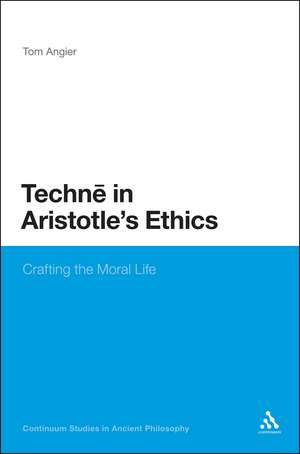
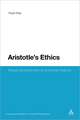
Techne in Aristotle's Ethics: Crafting the Moral Life: Continuum Studies in Ancient Philosophy
Autor Dr Tom Angieren Limba Engleză Paperback – 27 aug 2012
Exploring the importance of 'techne' in the Platonic and pre-Platonic intellectual context in which Aristotle was writing, Tom Angier here shows that this concept has an important role in Aristotle's Ethics that has rarely been studied in Anglo-American scholarship. Through close-analysis of the primary texts, this book uses the focus on 'techne' to systematically critique and renew Aristotelian moral philosophy.
Techne in Aristotle's 'Ethics' provides a novel and challenging approach to one of the Ancient World's most enduring intellectual legacies.
Din seria Continuum Studies in Ancient Philosophy
- 25%
 Preț: 282.22 lei
 - 25%
 Preț: 1086.14 lei
 - 25%
 Preț: 960.15 lei
 - 25%
 Preț: 959.84 lei
 - 24%
 Preț: 262.90 lei
 - 25%
 Preț: 975.70 lei
 - 33%
 Preț: 1025.20 lei
 - 33%
 Preț: 962.65 lei
 - 25%
 Preț: 1040.07 lei
 - 25%
 Preț: 280.19 lei
 -
 Preț: 276.19 lei
 - 25%
 Preț: 961.25 lei
 -
 Preț: 280.11 lei
 -
 Preț: 276.98 lei
 -
 Preț: 276.58 lei
 -
 Preț: 277.48 lei
 -
 Preț: 276.19 lei
 - 14%
 Preț: 961.32 lei
 -
 Preț: 277.87 lei
 - 14%
 Preț: 1022.63 lei
Preț: 276.19 lei
Puncte Express: 414
Carte tipărită la comandă
Livrare economică 07-21 decembrie
Livrare prin curier în România Termenul estimat este afișat lângă disponibilitate.
Transport gratuit de la 400.00 lei Plată online sau ramburs, în funcție de opțiunile comenzii.
Retur gratuit în 14 zile Comandă securizată și suport în română.
Specificații
ISBN-13: 9781441175144
ISBN-10: 1441175148
Pagini: 192
Dimensiuni: 156 x 234 x 10 mm
Greutate: 0.27 kg
Editura: Bloomsbury Publishing
Colecția Continuum
Seria Continuum Studies in Ancient Philosophy
Locul publicării:London, United Kingdom
ISBN-10: 1441175148
Pagini: 192
Dimensiuni: 156 x 234 x 10 mm
Greutate: 0.27 kg
Editura: Bloomsbury Publishing
Colecția Continuum
Seria Continuum Studies in Ancient Philosophy
Locul publicării:London, United Kingdom
V-ar putea interesa
-
 The RepublicPlato-29%Preț: 67.55 lei94.49 lei
 -
 -31%Preț: 530.89 lei769.91 lei
 -
 -14%Preț: 96.17 lei112.35 lei
 -
 -20%Preț: 535.83 lei671.37 lei
 -
 Plato on Pleasure and the Good LifeDaniel Russell-18%Preț: 335.06 lei406.79 lei
 -
 Epictetus: Discourses, Book 1Robert F. Dobbin-28%Preț: 404.41 lei565.46 lei
 -
 Aristotle on TeleologyMonte Ransome Johnson-20%Preț: 409.18 lei509.59 lei
 -
 Essays on Plato and AristotleJ. L. Ackrill-27%Preț: 437.33 lei603.15 lei
 -
 Topics in Stoic PhilosophyKaterina Ierodiakonou-27%Preț: 370.64 lei509.42 lei
 -
 Plato's Reception of ParmenidesJohn A. Palmer-27%Preț: 494.33 lei680.24 lei
 -
 Order in Multiplicity: Homonymy in the Philosophy of AristotleChristopher Shields-27%Preț: 439.99 lei604.68 lei
 -
 -13%Preț: 269.99 lei309.51 lei
 -
 Preț: 332.10 lei
 -
 Diogenes of SinopeLuis Navia-29%Preț: 563.79 lei792.05 lei
 -
 The Cambridge History of Hellenistic PhilosophyJonathan Barnes-19%Preț: 589.17 lei727.36 lei
 -
 Aristotle's 'Nicomachean Ethics': A Reader's GuideChristopher WarnePreț: 190.79 lei
 -
 Plato's UniverseGregory VlastosPreț: 221.43 lei
Cuprins
Abbreviations
Preface
Introduction: Techne in pre-Platonic Greek Thought
1. Techne in the Platonic dialogues
2. Aristotle reacts to his inheritance
3. Ergon: The Function Argument
4. Mesotes: Aristotle's Ethical Mean
5. Ethismos: Aristotle's Theory of Habituation
Conclusion
Appendix
Bibliography
Index
Preface
Introduction: Techne in pre-Platonic Greek Thought
1. Techne in the Platonic dialogues
2. Aristotle reacts to his inheritance
3. Ergon: The Function Argument
4. Mesotes: Aristotle's Ethical Mean
5. Ethismos: Aristotle's Theory of Habituation
Conclusion
Appendix
Bibliography
Index
Recenzii
Angier's rigorous defence of the centrality of craft models and metaphors in Aristotle's ethics is a significant contribution to Aristotelian scholarship with which we would do well to engage.
By identifying the extent to which Aristotle's thinking about ethics was shaped by notions drawn from the crafts Angier has thrown new light on a surprising number of topics and has deepened our understanding of tensions within Aristotle's thought. It is by now a rare achievement to have said something new, true and important about Aristotle.
Sharp in its argumentation and impressively conversant with secondary literature. It is well written and clear. Even where the reader does not agree with the conclusions defended, he or she should still profit from the challenge of the book's reasoning and its conversance with Aristotle's difficult text. That Aristotle's reflection upon the arts shapes his ethical thought quite as much as Angier proposes is unlikely, but nonetheless the case is energetically and skilfully made.
By identifying the extent to which Aristotle's thinking about ethics was shaped by notions drawn from the crafts Angier has thrown new light on a surprising number of topics and has deepened our understanding of tensions within Aristotle's thought. It is by now a rare achievement to have said something new, true and important about Aristotle.
Sharp in its argumentation and impressively conversant with secondary literature. It is well written and clear. Even where the reader does not agree with the conclusions defended, he or she should still profit from the challenge of the book's reasoning and its conversance with Aristotle's difficult text. That Aristotle's reflection upon the arts shapes his ethical thought quite as much as Angier proposes is unlikely, but nonetheless the case is energetically and skilfully made.