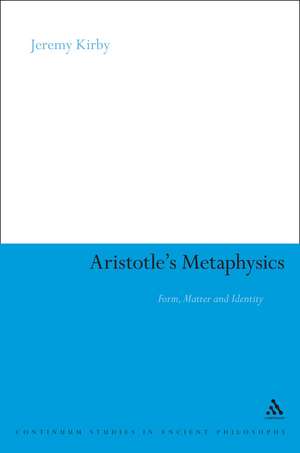
Aristotle's Metaphysics: Form, Matter and Identity: Continuum Studies in Ancient Philosophy
Autor Dr Jeremy Kirbyen Limba Engleză Paperback – 20 oct 2011
Aristotle maintains that biological organisms are compounds of matter and form and that compounds that have the same form are individuated by their matter. According to Aristotle, an object that undergoes change is an object that undergoes a change in form, i.e. form is imposed upon something material in nature. Aristotle therefore identifies organisms according to their matter and essential forms, forms that are arguably essential to an object's existence.
Jeremy Kirby addresses a difficulty in Aristotle's metaphysics, namely the possibility that two organisms of the same species might share the same matter. If they share the same form, as Aristotle seems to suggest, then they seem to share that which they cannot, their identity. By taking into account Aristotle's views on the soul, its relation to living matter, and his rejection of the possibility of resurrection, Kirby reconstructs an answer to this problem and shows how Aristotle relies on some of the central themes in his system in order to resist this unwelcome result that his metaphysics might suggest.
Jeremy Kirby addresses a difficulty in Aristotle's metaphysics, namely the possibility that two organisms of the same species might share the same matter. If they share the same form, as Aristotle seems to suggest, then they seem to share that which they cannot, their identity. By taking into account Aristotle's views on the soul, its relation to living matter, and his rejection of the possibility of resurrection, Kirby reconstructs an answer to this problem and shows how Aristotle relies on some of the central themes in his system in order to resist this unwelcome result that his metaphysics might suggest.
Din seria Continuum Studies in Ancient Philosophy
- 25%
 Preț: 282.22 lei
 - 25%
 Preț: 1086.14 lei
 - 25%
 Preț: 960.15 lei
 - 25%
 Preț: 959.84 lei
 - 25%
 Preț: 255.16 lei
 - 25%
 Preț: 975.70 lei
 - 33%
 Preț: 1025.20 lei
 - 33%
 Preț: 962.65 lei
 - 25%
 Preț: 1040.07 lei
 -
 Preț: 276.19 lei
 - 25%
 Preț: 961.25 lei
 -
 Preț: 280.11 lei
 -
 Preț: 276.98 lei
 -
 Preț: 276.58 lei
 -
 Preț: 277.48 lei
 -
 Preț: 276.19 lei
 -
 Preț: 276.19 lei
 - 14%
 Preț: 961.32 lei
 -
 Preț: 277.87 lei
 - 14%
 Preț: 1022.63 lei
Preț: 280.19 lei
Preț vechi: 374.17 lei
-25%
Puncte Express: 420
Carte tipărită la comandă
Livrare economică 28 noiembrie-12 decembrie
Livrare prin curier în România Termenul estimat este afișat lângă disponibilitate.
Transport gratuit de la 400.00 lei Plată online sau ramburs, în funcție de opțiunile comenzii.
Retur gratuit în 14 zile Comandă securizată și suport în română.
Specificații
ISBN-13: 9781441154613
ISBN-10: 1441154612
Pagini: 172
Dimensiuni: 156 x 234 x 9 mm
Greutate: 0.25 kg
Editura: Bloomsbury Publishing
Colecția Continuum
Seria Continuum Studies in Ancient Philosophy
Locul publicării:London, United Kingdom
ISBN-10: 1441154612
Pagini: 172
Dimensiuni: 156 x 234 x 9 mm
Greutate: 0.25 kg
Editura: Bloomsbury Publishing
Colecția Continuum
Seria Continuum Studies in Ancient Philosophy
Locul publicării:London, United Kingdom
V-ar putea interesa
-
 The EnneadsPlotinus-26%Preț: 91.19 lei123.79 lei
 -
 -37%Preț: 58.93 lei93.00 lei
 -
 The Art of PoetryAristotle-15%Preț: 256.03 lei301.92 lei
 -
 -29%Preț: 501.18 lei703.62 lei
 -
 Athenian Religion: A HistoryRobert Parker-28%Preț: 527.08 lei735.10 lei
 -
 Nature, Justice, and Rights in Aristotle's PoliticsFred D. Miller-29%Preț: 499.27 lei699.64 lei
 -
 The Anatomy of NeoplatonismA. C. Lloyd-29%Preț: 402.91 lei564.57 lei
 -
 Pythagoras Revived: Mathematics and Philosophy in Late AntiquityDominic J. O'Meara-29%Preț: 404.12 lei565.28 lei
 -
 Rationality in Greek ThoughtMichael Frede-28%Preț: 366.48 lei510.64 lei
 -
 -28%Preț: 428.35 lei594.82 lei
 -
 Method in Ancient PhilosophyJyl Gentzler-28%Preț: 397.39 lei550.48 lei
 -
 -29%Preț: 517.25 lei723.90 lei
 -
 -28%Preț: 392.32 lei542.67 lei
 -
 Aristotle on Meaning and EssenceDavid Charles-28%Preț: 396.60 lei550.02 lei
 -
 -28%Preț: 438.42 lei612.53 lei
 -
 Platonopolis: Platonic Political Philosophy in Late AntiquityDominic J. O'Meara-29%Preț: 516.09 lei723.21 lei
 -
 Knowing Persons: A Study in PlatoLloyd P. Gerson-28%Preț: 446.21 lei622.52 lei
 -
 Preț: 235.02 lei
 -
 Simplicius: On Aristotle Physics 8.1-5István Bodnár-25%Preț: 1025.63 lei1358.81 lei
Cuprins
Introduction
i. The Metaphysics of Aristotle
ii. Two Challenges to Change
iii. Matter, Form, and Paradox
1. Matters of Individuation
i. Matters of Change
ii. Matters of Difference
iii. Identity, Diversity, and Unity
iv. Aristotle and the Absolutist versus Relativist Controversy
v. The Bare Materials
vi. Prime Matter, Somatic Matter, and Individuation
vii. The Varieties of Matter
viii. Two Old Arguments against Migration
ix. A Possible Objection
x. Conclusion
2. Resurrection and Entrapment
i. A Putative Response to the Puzzle of Simple Composition ii. Anastasis and Anachronism
iii. Scientific and Dialectical Contexts
iv. Possibility and Inevitability
v. Eternal Recurrence Limited
vi. Eternality and Essentialism
vii. Resurrection, Migration, and Gappy Existences
viii. Resurrection and the Problem of Shared Identity
ix. Aristotle's Rejection of Migration
x. Conclusion
4. Aristotle on Composition and the Puzzle of Unity
i. Composition
ii. The Puzzle of Unity
iii. The Popular Strategy
iv. Eliminativism
v. The Identity Thesis
vi. Constituency as Adjectival Being
vii. Toward a Relational Unity
viii. Teleological Dependence as the Adhesive for Unity
ix. Conclusion
5. Particularities and the Puzzle of Composition
i. Haecceities
ii. The Problem of Universals
iii. The Zeta Problem
iv. No Substance is a Universal
v. Conclusion
5. Conclusion
i. The Puzzle of Simple Composition Revisited
ii. Alternative Proposals for Resolving the Puzzle of Simple Composition
iii. The Puzzle of Transplantation
Postscript
Bibliography
i. The Metaphysics of Aristotle
ii. Two Challenges to Change
iii. Matter, Form, and Paradox
1. Matters of Individuation
i. Matters of Change
ii. Matters of Difference
iii. Identity, Diversity, and Unity
iv. Aristotle and the Absolutist versus Relativist Controversy
v. The Bare Materials
vi. Prime Matter, Somatic Matter, and Individuation
vii. The Varieties of Matter
viii. Two Old Arguments against Migration
ix. A Possible Objection
x. Conclusion
2. Resurrection and Entrapment
i. A Putative Response to the Puzzle of Simple Composition ii. Anastasis and Anachronism
iii. Scientific and Dialectical Contexts
iv. Possibility and Inevitability
v. Eternal Recurrence Limited
vi. Eternality and Essentialism
vii. Resurrection, Migration, and Gappy Existences
viii. Resurrection and the Problem of Shared Identity
ix. Aristotle's Rejection of Migration
x. Conclusion
4. Aristotle on Composition and the Puzzle of Unity
i. Composition
ii. The Puzzle of Unity
iii. The Popular Strategy
iv. Eliminativism
v. The Identity Thesis
vi. Constituency as Adjectival Being
vii. Toward a Relational Unity
viii. Teleological Dependence as the Adhesive for Unity
ix. Conclusion
5. Particularities and the Puzzle of Composition
i. Haecceities
ii. The Problem of Universals
iii. The Zeta Problem
iv. No Substance is a Universal
v. Conclusion
5. Conclusion
i. The Puzzle of Simple Composition Revisited
ii. Alternative Proposals for Resolving the Puzzle of Simple Composition
iii. The Puzzle of Transplantation
Postscript
Bibliography