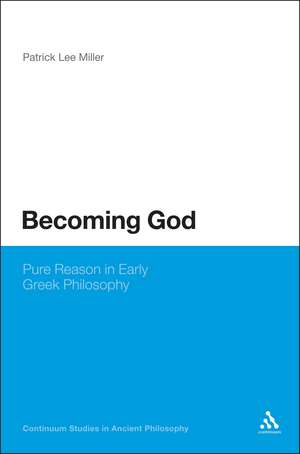
Becoming God: Pure Reason in Early Greek Philosophy: Continuum Studies in Ancient Philosophy
Autor Dr Patrick Lee Milleren Limba Engleză Paperback – 26 iul 2012
Din seria Continuum Studies in Ancient Philosophy
- 25%
 Preț: 282.22 lei
 - 25%
 Preț: 1086.14 lei
 - 25%
 Preț: 960.15 lei
 - 25%
 Preț: 959.84 lei
 - 24%
 Preț: 262.90 lei
 - 25%
 Preț: 975.70 lei
 - 33%
 Preț: 1025.20 lei
 - 33%
 Preț: 962.65 lei
 - 25%
 Preț: 1040.07 lei
 - 25%
 Preț: 280.19 lei
 -
 Preț: 276.19 lei
 - 25%
 Preț: 961.25 lei
 -
 Preț: 280.11 lei
 -
 Preț: 276.98 lei
 -
 Preț: 276.58 lei
 -
 Preț: 277.48 lei
 -
 Preț: 276.19 lei
 - 14%
 Preț: 961.32 lei
 -
 Preț: 277.87 lei
 - 14%
 Preț: 1022.63 lei
Preț: 276.19 lei
Puncte Express: 414
Carte tipărită la comandă
Livrare economică 03-17 decembrie
Livrare prin curier în România Termenul estimat este afișat lângă disponibilitate.
Transport gratuit de la 400.00 lei Plată online sau ramburs, în funcție de opțiunile comenzii.
Retur gratuit în 14 zile Comandă securizată și suport în română.
Specificații
ISBN-13: 9781441152701
ISBN-10: 1441152709
Pagini: 190
Dimensiuni: 156 x 234 x 10 mm
Greutate: 0.27 kg
Editura: Bloomsbury Publishing
Colecția Continuum
Seria Continuum Studies in Ancient Philosophy
Locul publicării:London, United Kingdom
ISBN-10: 1441152709
Pagini: 190
Dimensiuni: 156 x 234 x 10 mm
Greutate: 0.27 kg
Editura: Bloomsbury Publishing
Colecția Continuum
Seria Continuum Studies in Ancient Philosophy
Locul publicării:London, United Kingdom
V-ar putea interesa
-
 Plato: A Very Short IntroductionJulia Annas-20%Preț: 56.77 lei70.88 lei
 -
 Plato's Penal Code: Tradition, Controversy, and Reform in Greek PenologyTrevor J. Saunders-32%Preț: 624.90 lei923.13 lei
 -
 Cicero the Philosopher: Twelve PapersJ. G. F. Powell-28%Preț: 446.06 lei622.44 lei
 -
 Aristotle's Physics: A Collection of EssaysLindsay Judson-28%Preț: 405.01 lei565.77 lei
 -
 Plato's TheaetetusDavid Bostock-29%Preț: 463.41 lei648.89 lei
 -
 Aristotle's First PrinciplesTerence Irwin-27%Preț: 411.06 lei563.91 lei
 -
 Determinism and Freedom in Stoic PhilosophySusanne Bobzien-28%Preț: 514.53 lei717.64 lei
 -
 Aristotle's Theory of Substance: The Categories and Metaphysics ZetaMichael V. Wedin-28%Preț: 542.04 lei754.71 lei
 -
 Aristotle's De Interpretatione: Contradiction and DialecticC. W. A. Whitaker-29%Preț: 501.12 lei706.17 lei
 -
 Plato's Utopia Recast: His Later Ethics and PoliticsChristopher Bobonich-27%Preț: 494.02 lei677.11 lei
 -
 Individual and Conflict in Greek EthicsNicholas White-28%Preț: 350.17 lei484.79 lei
 -
 Facing Death: Epicurus and his CriticsJames Warren-29%Preț: 462.59 lei648.42 lei
 -
 Preț: 262.38 lei
 -
 HermeticaWalter ScottPreț: 261.72 lei
 -
 Introductory Readings in Ancient Greek and Roman PhilosophyPatrick Lee Miller-24%Preț: 416.46 lei546.66 lei
Cuprins
1. Introduction \ 2.Heraclitus \ 3. Parmenides and Pythagoreans \ 4.Plato \ Conclusion \ Bibliography \ Index.
Recenzii
Miller provides an interesting study of the possibility of human transcendence through rationality in the early Greek tradition. He plans to pursue this topic into later Greek philosophy where it becomes even more prominent, and his study already points the way to Aristotle's life of reason. We may look forward for the sequel to carry on his study.