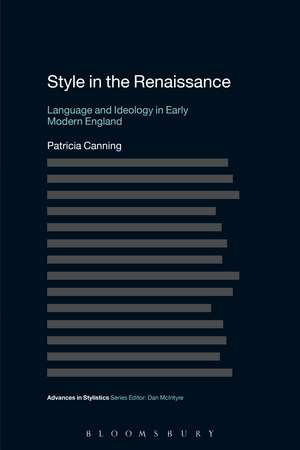
Style in the Renaissance: Language and Ideology in Early Modern England: Advances in Stylistics
Autor Dr Patricia Canningen Limba Engleză Paperback – 16 ian 2014
Din seria Advances in Stylistics
- 17%
 Preț: 245.59 lei
 -
 Preț: 265.87 lei
 - 17%
 Preț: 264.61 lei
 -
 Preț: 244.18 lei
 - 28%
 Preț: 224.68 lei
 - 17%
 Preț: 246.84 lei
 -
 Preț: 265.26 lei
 -
 Preț: 266.83 lei
 - 17%
 Preț: 265.26 lei
 -
 Preț: 261.63 lei
 - 25%
 Preț: 231.40 lei
 - 17%
 Preț: 265.47 lei
 - 17%
 Preț: 263.21 lei
 - 26%
 Preț: 206.63 lei
 - 26%
 Preț: 230.25 lei
 - 26%
 Preț: 236.54 lei
 - 25%
 Preț: 224.61 lei
 - 27%
 Preț: 205.25 lei
 - 6%
 Preț: 204.32 lei
 - 29%
 Preț: 198.17 lei
 - 26%
 Preț: 186.01 lei
 -
 Preț: 262.24 lei
Preț: 263.21 lei
Preț vechi: 318.61 lei
-17%
Puncte Express: 395
Carte tipărită la comandă
Livrare economică 08-22 iunie
Specificații
ISBN-13: 9781472530059
ISBN-10: 1472530055
Pagini: 224
Dimensiuni: 156 x 234 x 12 mm
Greutate: 0.28 kg
Editura: Bloomsbury Publishing
Colecția Bloomsbury Academic
Seria Advances in Stylistics
Locul publicării:London, United Kingdom
ISBN-10: 1472530055
Pagini: 224
Dimensiuni: 156 x 234 x 12 mm
Greutate: 0.28 kg
Editura: Bloomsbury Publishing
Colecția Bloomsbury Academic
Seria Advances in Stylistics
Locul publicării:London, United Kingdom
V-ar putea interesa
-
 English: Meaning and CultureAnna WierzbickaPreț: 355.66 lei
 -
 The Origins of Meaning: Language in the Light of EvolutionJames R. Hurford-13%Preț: 423.60 lei486.87 lei
 -
 Questions and Answers in Embedded ContextsUtpal Lahiri-24%Preț: 405.54 lei536.49 lei
 -
 Reflections on MeaningPaul Horwich-15%Preț: 302.38 lei355.19 lei
 -
 Semantics versus PragmaticsZoltan Gendler Szabo-14%Preț: 369.74 lei429.51 lei
 -
 Rhetoric: A Very Short IntroductionRichard Toye-21%Preț: 53.16 lei67.60 lei
 -
 Political Discourse Analysis: A Method for Advanced StudentsIsabela Fairclough-15%Preț: 421.59 lei495.98 lei
 -
 How to do Discourse Analysis: A ToolkitJames Paul GeePreț: 359.75 lei
 -
 On DialogueDavid BohmPreț: 211.59 lei
 -
 Discourse AnalysisGillian Brown-19%Preț: 412.98 lei509.85 lei
 -
 Preț: 453.21 lei
 -
 Organizational DiscourseFrancois CoorenPreț: 180.13 lei
 -
 Language and PowerNorman Fairclough-8%Preț: 407.30 lei442.72 lei
 -
 Critical Discourse Analysis: The Critical Study of LanguageNorman FaircloughPreț: 383.44 lei
 -
 The Bloomsbury Companion to Discourse AnalysisProfessor Ken HylandPreț: 276.30 lei
 -
 Worlds of Written Discourse: A Genre-Based ViewVijay Bhatia-18%Preț: 171.12 lei208.57 lei
 -
 Hermeneutics & Discourse Analysis in Social PsychologySalomon Rettig-30%Preț: 1066.51 lei1529.69 lei
 -
 Musical RhetoricPatrick Saint-Dizier-9%Preț: 944.83 lei1038.27 lei
Cuprins
Acknowledgements
Introduction: In the Beginning was the Word
Chapter One: Constructing Plausible Stories: Ideology, Conceptual Integration Theory and the Politics of Representation in George Herbert's 'JESU'
Chapter Two: 'A Deed Without a Name': Murder and the Linguistics of Agency in Shakespeare's Macbeth
Chapter Three: 'Bit-Part' Actors: Metonymy in Thomas Middleton and William Rowley's The Changeling
Chapter Four: Picturing Words: Ekphrasis and the Word-as-Image in Early Modern Poetry Conclusion: 'Being Nothing': The value of the W/word
Notes
Bibliography
Index
Introduction: In the Beginning was the Word
Chapter One: Constructing Plausible Stories: Ideology, Conceptual Integration Theory and the Politics of Representation in George Herbert's 'JESU'
Chapter Two: 'A Deed Without a Name': Murder and the Linguistics of Agency in Shakespeare's Macbeth
Chapter Three: 'Bit-Part' Actors: Metonymy in Thomas Middleton and William Rowley's The Changeling
Chapter Four: Picturing Words: Ekphrasis and the Word-as-Image in Early Modern Poetry Conclusion: 'Being Nothing': The value of the W/word
Notes
Bibliography
Index
Recenzii
Patricia Canning's adventurous interdisciplinary study brings together in new and exciting ways the two fields of linguistics and literary criticism in her examination of selected texts by Shakespeare and his contemporaries. The range and detail of her analysis, evident especially in her microscopic examination of linguistic forms, cultural assumptions, and historical contexts in plays by Shakespeare and Middleton, and in the poetry of George Crashaw, is impressive. Here is a rare combination of strenuous scholarly rigour, and uncompromising analysis, replete with a full and clear awareness of what interdisciplinarity involves. A welcome new voice offering unique insights into texts that we thought we knew.
Canning's book opens new and exciting avenues for literary and stylistic investigation, while making an important contribution to the study of English Renaissance. Elegantly combining cognitive poetics focus with more traditional historically situated analysis yields a multi-faceted scholarly perspective from which scholars of many orientations can learn. The work is a model example of how the gap between linguistics and literature can be bridged for the benefit of both disciplines.
Patricia Canning provides a reading of Macbeth informed by contemporary stylistics in [the chapter entitled] "A Deed Without A Name" . . . Canning patiently explains her approach as it progresses, and her methodology will be of special interest to those working in stylistics.
Canning's book opens new and exciting avenues for literary and stylistic investigation, while making an important contribution to the study of English Renaissance. Elegantly combining cognitive poetics focus with more traditional historically situated analysis yields a multi-faceted scholarly perspective from which scholars of many orientations can learn. The work is a model example of how the gap between linguistics and literature can be bridged for the benefit of both disciplines.
Patricia Canning provides a reading of Macbeth informed by contemporary stylistics in [the chapter entitled] "A Deed Without A Name" . . . Canning patiently explains her approach as it progresses, and her methodology will be of special interest to those working in stylistics.